
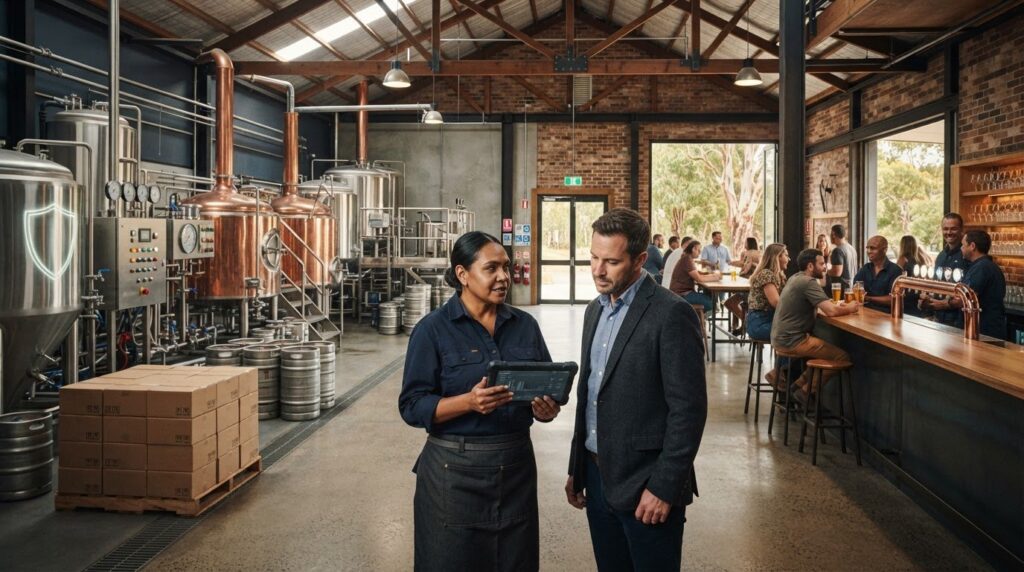
A brewpub’s insurance needs extend beyond the front door. For an Australian craft brewery with a taproom, consider property and machinery breakdown cover, business interruption, public and product liability, and protection for contamination, spoilage or product recalls. A specialist brewpub insurance broker can help match cover to how you brew, sell and serve.
A brewpub is more than what’s in the tank. Equipment failure can interrupt production, while a customer incident or faulty batch can bring liability claims and unexpected costs. The key is identifying which risks matter most to your particular setup.
This guide covers insurance to consider, how a broker assesses brewery and liability risks, and what can affect costs. It also explains why suitable cover depends on your operations, from production and deliveries to tastings, events and service at the bar.
Key Takeaways
- Map cover to your brewpub’s full operation, from brewing and stock to customer service and production recovery.
- Separate public liability risks from product-related claims, then consider how each connects to your taproom and sales.
- Understand how business size, location, claims history, risk exposures and cover choices can affect insurance costs.
- Assess practical exposures such as equipment failure, contamination, deliveries and environmental incidents to identify gaps.
- A tailored insurance package can reflect how your brewery works today and the risks that come with its activities.
What insurance should I consider for my craft brewery?
For brewing equipment, stock and buildings, consider property cover, machinery breakdown and protection for stock at or away from your premises. Business interruption cover can help with lost income, wages and ongoing expenses when an insured event disrupts production.
Business interruption and production recovery
A brewery interruption might start with a failed pump, fire, or loss of electricity, gas or water. Business interruption cover can help with lost revenue, wages and ongoing expenses when an insured event stops operations. Machinery breakdown cover is also worth considering: a failed fermenter or chiller can delay brewing and leave supply commitments unfilled.
Read the policy wording to understand which events trigger cover, what costs are included, and what limits or exclusions apply. Then map your recovery needs: which batches could be affected, what orders are due, and which bills continue while the brewhouse is idle. This connects insurance choices to the disruption your brewery could actually face.
Property and business asset cover
Property cover can protect buildings, brewing equipment, stock and other business assets against insured damage. Consider the value of tanks, pumps, chillers, packaging equipment and ingredients such as hops, grain and malt. Brewery cover can also include property damage caused by bursting bottles or barrels, as well as stock kept away from your premises.
Check how the policy covers stock stored at a third party’s premises, including any secure-building requirements. Empty vessels kept outdoors at your site or a customer’s premises may also need attention. For a country pub, a professional building replacement valuation can help set appropriate building and contents sums insured, reducing the risk of underinsurance after a major loss.
Cover for business expansion
As a brewery grows, its risks can change. Adding a taproom, brewery shop, public tastings or festival stalls brings new property, stock and customer exposures. Cover may include attendance at exhibitions, beer festivals, farmers markets and trade fairs, as well as operating a brewery shop. Review the insured activities whenever your operation expands.
Country pub risks can include fire, property damage, theft, business interruption, equipment breakdown, worker injuries and cyber theft. Use these as prompts to assess your own site, from the bar and kitchen to production and storage areas. A growing brewery may need insurance that adapts as production, sales channels and premises change, rather than relying on cover shaped for an earlier stage.
Public and product liability
Workers’ compensation requirements are jurisdiction-specific across NSW, Victoria, Queensland, Western Australia, South Australia, Tasmania, the ACT and the Northern Territory. For a brewpub, employment arrangements and where staff work matter, so map each role and work location against the applicable scheme. Workers’ compensation is separate from public liability insurance.
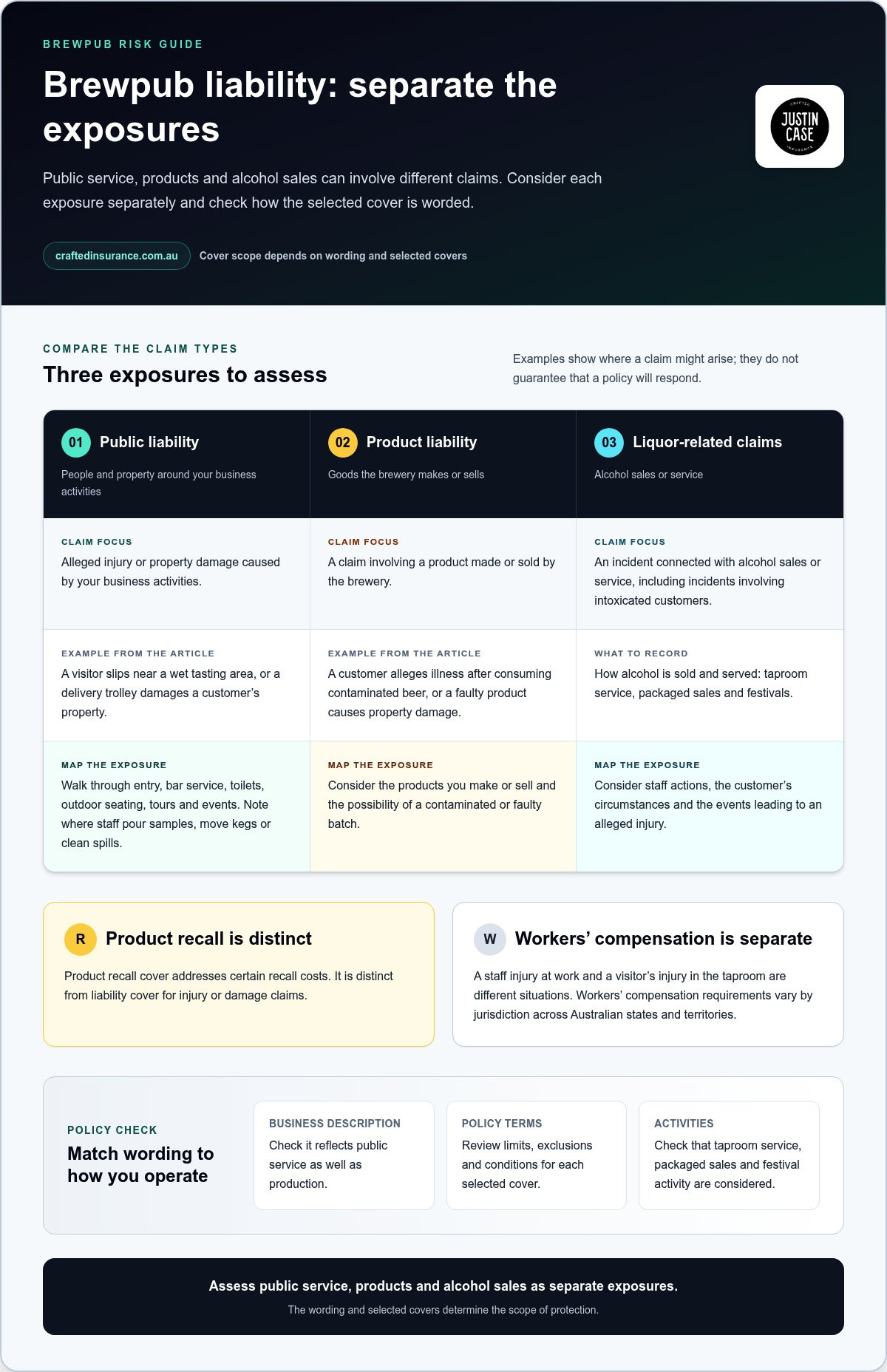
Brewery insurance can include public and product liability, while liquor liability can address claims connected with alcohol sales or service, including incidents involving intoxicated customers. The wording and selected covers determine the scope. Check each separately rather than assuming one automatically includes the others.
Public liability in the taproom
Public liability responds to claims alleging that your business activities caused injury or property damage to another person. For example, a visitor might slip near a wet tasting area, or a delivery trolley might damage a customer’s property. If the business is found liable, the claim may involve legal costs and compensation.
Walk through the customer journey to identify exposures: entry, bar service, toilets, outdoor seating, tours and events. Note where staff pour samples, move kegs or clean spills. Then compare those activities with the policy’s business description, limits, exclusions and conditions. A policy describing production alone may not reflect public service at a brewpub.
Product liability and liquor claims
Product liability relates to claims involving goods a brewery makes or sells. A customer might allege illness after consuming contaminated beer, or a faulty product could cause property damage. Product recall cover addresses certain recall costs, but is distinct from liability cover for injury or damage claims.
Give liquor-related incidents separate attention. A claim connected with alcohol service may involve staff actions, the customer’s circumstances and the events leading to an alleged injury. Record how alcohol is sold and served, including taproom service, packaged sales and festivals. Then check whether the selected covers address those activities and any relevant exclusions.
Employees, cyber and management exposures
Liability can arise from business activities involving employees, third parties or products. Workers’ compensation and public liability, however, serve different purposes. Consider the separate covers your brewery needs, and don’t treat one policy as a substitute for another. A staff injury at work and a visitor’s injury in the taproom are different situations.
Cyber and management liability are also worth assessing alongside brewing risks. Cyber incidents can disrupt booking, payment or customer systems, while management-related claims concern decisions made in running the business. Review which systems hold customer or payment information, who can access them, and which business decisions create exposure. These details can guide a practical risk management discussion.
For a useful review, group your activities into public service, products, alcohol sales and staff operations. A brewpub liability risk review can help connect those exposures with the covers and policy wording that fit your operation.
Factors affecting brewery insurance costs
Brewery insurance costs depend on the business’s size, nature and location, claims history, risk exposures and chosen level of cover. A nano brewery focused on production has a different risk profile from a commercial brewery with a taproom, packaged sales and events.
To compare options in Australia, look beyond the premium. Compare insured activities, limits, exclusions and excesses in each policy wording and Product Disclosure Statement. A specialist brewpub insurance broker should explain how the covers relate to your actual operations, not just show a lower figure.
The premium depends on your operation and its risk profile, and is provided after a quote request. Key factors include business size, location, claims history, exposure to property damage or liability claims, and the cover selected. Claims history can influence how insurers assess risk, while broader cover can affect the premium.
Scale matters, but so does what you do. A start-up microbrewery may have different equipment, production volumes and sales channels from an established commercial brewery. A brewpub adds public service and customer activity, while a distillery has its own production and stock exposures. Describe each activity accurately, including events and off-site sales.
Prepare a clear snapshot for the quote process. Include the business address and premises details, a description of brewing or distilling activities, and how products reach customers. A current asset and stock summary helps explain what needs cover. Add claims history and details of taproom service, festivals, deliveries or other trading activities.
Then compare like with like. Check whether each option accounts for buildings, contents, equipment, stock, liability and interruption needs. Note exclusions and conditions that could affect a claim, such as how stock is stored or which activities are insured. Ask for unclear terms to be explained in plain language before you decide.
Owners of nano, micro, local and national breweries should revisit their cover as the business changes. New equipment, increased production, a brewery shop or expanded public service can alter the exposure. Keep the information used for your quote current, and review the policy when operations or premises change.
Finally, read the policy wording and Product Disclosure Statement carefully. A lower premium may come with more exclusions, so compare the protection relevant to your operation, not price alone. Matching your activities, assets and claims history to suitable cover gives you a clearer basis for choosing between insurance options.
Broker assessment of beverage-industry risks
A useful risk assessment follows the product through each stage: ingredients, manufacturing, storage, delivery and service. This highlights where an unforeseen event could affect people, property or trading, and helps match insurance cover to the brewery’s actual work.
Start with a walk-through of the site. Trace the route from grain intake to the brewhouse, fermentation, packaging and dispatch. Note where ingredients and finished stock are stored, which processes depend on specific equipment, and how staff move through production areas. A risk assessment built around these details is more practical than a generic hospitality checklist.
Next, map activities beyond the premises. A brewery may supply distributors, attend a beer festival, host tours or ship products overseas. Each activity can create different exposures. Transit cover, for example, may address beer or raw materials being transported to customers, distributors or suppliers. Product liability arrangements may also need to reflect where products are sold.
Review quality and product handling, from batch records to labels. A production error or mislabelling could lead to a third-party financial loss, while a faulty or contaminated batch may prompt a recall. Product recall cover can help with associated costs, including logistics and public relations. Distinguish these costs from claims for injury or property damage, as different covers may respond.
Give environmental exposures specific attention. Consider where brewing materials, cleaning substances and fuel are stored, and what could happen if a tank or silo failed. For example, a collapsed wine silo or diesel tank could release material into a local waterway. Environmental liability cover can help fund contamination clean-up, subject to the policy terms.
Connect each risk to a practical control and insurance question. For a spill, note the storage area, containment measures and clean-up process. For an unforeseen breakdown, identify the production dependency and recovery steps. For a recall, record how the business traces batches and communicates with customers. These details help clarify the exposure and the cover under consideration.
- People: identify staff, visitors, contractors and delivery drivers who enter each area.
- Property: record brewing assets, stock locations and materials stored off-site.
- Products: map batch checks, labelling, sales channels and recall procedures.
- Environment: note potential release points and the route contamination could take.
Finally, revisit the assessment when manufacturing changes, new products launch or distribution expands. An updated risk map gives the insurance discussion a clear basis and helps keep cover aligned with how the beverage business operates now.
Tailored insurance brokerage
A tailored insurance package starts with how your beverage business operates. A brewpub may combine manufacturing, public service and packaged sales, while a distillery has different production activities. A broker connects those details with relevant cover and explains the policy wording.
Start by mapping your operation from production to customer. Include brewing, tastings, tours, festivals, brewery shop sales and deliveries. Overseas shipping matters too, because exported products can lead to injury claims beyond Australia. A broker can use this activity map to identify where liability, property or interruption cover needs closer attention.
Separate the exposures rather than treating them as one broad risk. A visitor injury during a tour differs from a product-related claim, and both differ from a production error that causes financial loss to a third party. Ask how each activity is represented in the policy, which cover responds, and what exclusions or conditions apply.
Good brokerage also considers how risks connect. A production fault, for example, could affect a batch, trigger a recall and interrupt supply to customers. A tailored review considers recall expenses alongside liability claims and ongoing business costs. It also considers environmental liability if a spill or tank failure could release material into surrounding land or waterways.
Use a practical review sequence to keep the discussion focused:
- Describe the work: list products, production steps, premises and customer-facing activities.
- Trace the exposure: follow ingredients and finished goods through storage, transport, sales and events.
- Match the cover: compare the policy’s insured activities, limits, exclusions and conditions against that map.
- Review changes: update the picture when you add tours, overseas shipping or new sales channels.
This approach matters because a standard package may not reflect every activity. A brewery producing only for wholesale has a different customer interface from one serving drinks at a taproom. Adding tours or trade fairs changes where people interact with the business. Tailored advice can bring these moving parts into one structured insurance discussion.
Ask for clear explanations of how public liability, product cover, recall costs and business interruption fit together. Compare the response with situations relevant to your operation, such as a visitor injury, faulty batch or delayed orders after an insured event. Understand how the cover responds before choosing, rather than assuming every loss falls under one policy.
For a review centred on your activities, discuss tailored brewery insurance and the risks across production, sales and public service.
Crafted Insurance: Nano Brewery
Crafted Insurance helps Australian craft breweries and brewpubs shape cover around production, sales and public service risks. Its Nano Brewery and Local Craft Brewery offerings suit brewery operations, while BrewPub cover is relevant when brewing and customer service share the same premises.
For a growing operation, a risk audit can help identify exposures across equipment, stock, customer areas and sales activities. Crafted Insurance also provides claims advocacy and ongoing risk management, bringing policy questions and changing business risks into the same conversation.
If you run a nano brewery, local craft brewery or brewpub and want to discuss cover for your operation, contact Crafted Insurance.
Make your next insurance review count
Turn the risks in your operation into a clear brief. Note what’s changed since your last review, where your products are sold, and which activities matter most to your business. This gives a brewpub insurance broker a practical starting point for discussing cover that fits how you work.
Crafted Insurance offers Nano Brewery, Micro Distillery and BrewPub options for Australian beverage businesses. If you’re opening a taproom, adding production or reviewing cover for your current setup, bring those plans into the conversation. A business change is a good time to revisit whether your insurance still matches your work.
Ready to take the next step? Contact Crafted Insurance to discuss your brewery or brewpub insurance needs. You’ve put plenty of care into what’s on tap. Now give the protection behind the business the same attention, and keep building with confidence.
Frequently Asked Questions
What can it cover?
Brewery insurance can address separate areas of risk, with policy wording setting what each part covers. Transit cover, for example, can apply to beer or raw materials being transported, while stock cover can address goods kept away from the brewery. If you sell at a festival, check that the event activity and location are included in the insured business description.
Why use a broker?
A brewpub insurance broker can match insurance options to your operations and explain how policy terms apply. That matters when brewing, alcohol service and events share one venue. A broker can also help organise a risk review and support you through the claims process. Provide a clear picture of your activities, including new sales channels or products.
What risks can brewery insurance protect against?
Brewery insurance can address risks such as fire, theft, equipment breakdown, product-related claims and business interruption, depending on the covers selected. Environmental liability is another exposure to consider: a leaking storage tank could release material beyond your premises and require clean-up. Map where ingredients, fuel and cleaning materials are stored, then consider how a loss in each area could affect the business.
What should I look for when comparing policies and quotes?
Compare insured activities, limits, excesses, exclusions and conditions, not just the premium. Check that the business description reflects brewing, taproom service, deliveries and events where relevant. Then test the wording against a realistic situation, such as stock damaged in transit or a claim involving an event. Read the Product Disclosure Statement and policy wording closely, as a lower premium can involve more exclusions.
What insurance coverage does an Australian brewpub need?
Build cover around the brewpub’s operations: property and contents, brewing equipment, stock, liability and business interruption are common areas to assess. Public and product liability address different kinds of claims, while liquor-related exposures need careful consideration for alcohol service. Workers’ compensation is separate, and requirements vary across Australian jurisdictions. Include staff roles and work locations in your insurance review.
Which Australian insurance brokers specialise in brewpubs, breweries or hospitality businesses?
Crafted Insurance specialises in Australian craft breweries, distilleries and brewpubs. Its offerings include Nano Brewery, Micro Distillery and BrewPub, with packages tailored to production, sales and public service risks. The business also provides risk audits, claims advocacy and ongoing risk management. For a brewpub seeking specialist advice, this is a focused starting point for discussing your insurance needs.
How much does brewpub insurance cost in Australia?
The cost depends on the business and the cover selected, and is provided after a quote request. Relevant details include the size, nature and location of the operation, its claims history, risk exposures and desired cover. A production-only brewery and a venue serving customers have different activities to describe. Provide an accurate picture of your premises, stock, equipment and trading channels for a useful quote.
What factors affect brewpub insurance premiums in Australia?
Insurers assess the business’s scale, location, claims history, risk exposures and level of cover. Adding a public tasting room, for example, changes the activities and customer exposures compared with wholesale production alone. The values insured for buildings, equipment and stock also shape the cover needed. Keep your business information current, especially after changes to premises, production, events or distribution.