
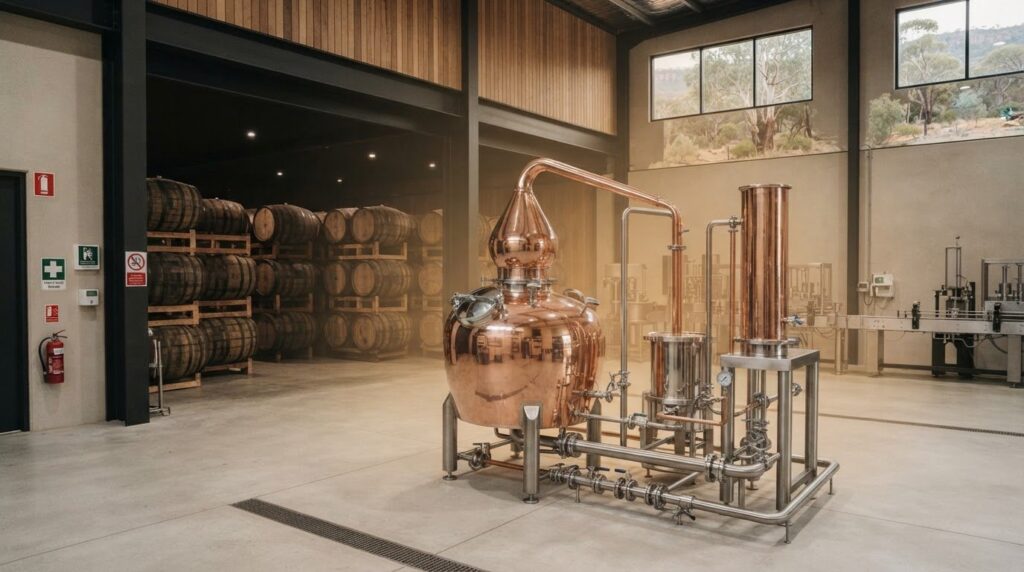
A still breakdown can stop production, but machinery breakdown insurance can cover repair costs and financial losses when you can’t trade. For Australian distilleries, AS 1940 distillery insurance planning should account for the time needed to replace and commission equipment: a 12-month business interruption indemnity period may be too short for a custom or imported still.
You’ve put serious time and craft into every batch. A production stoppage, contaminated product or cellar door claim can cost more than the repair bill alone.
This guide explains how cover may respond to still repairs, product contamination, spoilage and liquor liability. It also unpacks how AS 1940:2017 fits into distillery risk planning, and what to consider when reviewing cover for your equipment, maturing stock and customer-facing operations.
Key Takeaways
- Product recall cover may help with the cost of withdrawing contaminated or incorrectly labelled products, while spoilage cover can address stock made unsaleable by covered events.
- Set business interruption cover around realistic repair, replacement and commissioning times. A 12-month indemnity period may be too short for a custom or imported still.
- If your cellar door hosts tastings, tours or events, consider how public and liquor liability cover responds to intoxication-related claims and customer injuries.
- Review property, equipment and safety arrangements as your distillery changes, and make sure your insurance reflects the risks of production, maturing stock and customer service.
Does insurance cover product contamination or spoilage for distilleries?
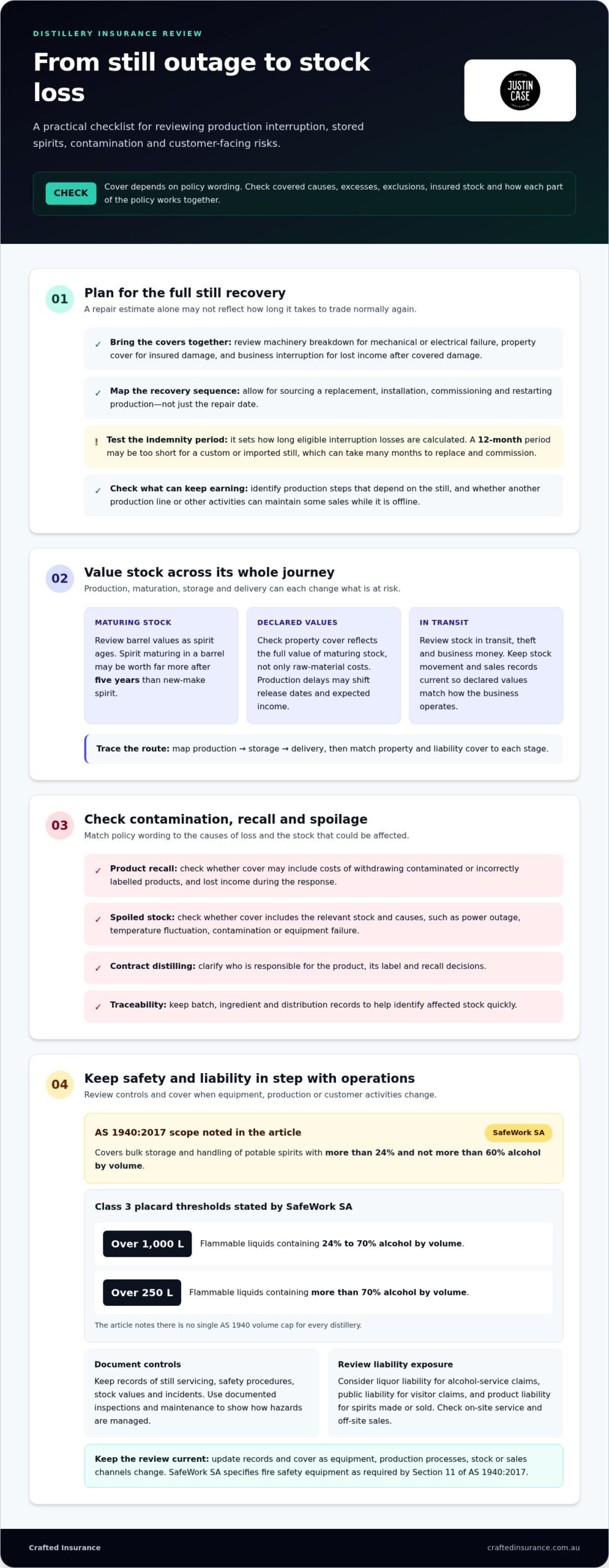
Insurance may cover recall costs, spoiled stock, equipment damage and liability, depending on the policy wording. AS 1940:2017 covers bulk storage and handling of potable spirits with more than 24 per cent but not more than 60 per cent alcohol by volume, according to SafeWork SA.
There is no single AS 1940 volume cap for every distillery. SafeWork SA says a Class 3 placard is required above 1000 L for flammable liquids containing 24 per cent to 70 per cent alcohol by volume, or above 250 L when they contain more than 70 per cent.
Public and products liability may respond to claims involving injury or property damage linked to spirits you make or sell. Property cover may protect stills and production equipment against insured damage, while machinery breakdown cover addresses mechanical or electrical failure. Check how the policy treats each risk, including excesses and exclusions.
Product recall and contamination cover
Product recall insurance may cover costs arising from contamination, labelling errors or safety concerns. Review whether it includes withdrawing affected products from the market and lost income during the response. For contract distilling, clarify who is responsible for the product, its label and recall decisions. Keep batch, ingredient and distribution records to help identify affected stock quickly.
Production, storage and distribution cover
Map the route from production through storage to delivery, then match property and liability cover to each stage. Include stills, stored spirits and stock in transit in your review. Spoilage cover may respond when a covered event, such as a power outage, temperature fluctuation, contamination or equipment failure, makes stock unsaleable. Check that the policy wording includes the relevant cause and stock.
Insurers assess equipment, maintenance and risk controls when considering a distillery. Keep records of still servicing, safety procedures, stock values and incidents. SafeWork SA specifies fire safety equipment as required by Section 11 of AS 1940:2017. Use documented inspections and maintenance to show how you manage hazards, and update your records when equipment or production processes change.
Does business interruption cover a distillery while a still is being repaired?
Machinery breakdown insurance can cover repair costs and financial losses when a distillery can’t trade. Property cover may address insured damage from events such as fire or explosion, while business interruption cover can help replace lost income after covered damage. A review of AS 1940 distillery insurance should consider how these parts of the policy work together.
Business interruption indemnity periods
The indemnity period sets how long eligible interruption losses are calculated. Choose a period that reflects realistic equipment replacement and commissioning times, not only the repair estimate. Custom or imported stills can take many months to replace and commission. A 12-month indemnity period may be too short for that recovery. Map the production steps that depend on the still, then identify which other activities can continue bringing in income while it’s offline.
Recovery periods
Finishing repairs doesn’t always mean normal trading can resume. Allow time for sourcing a replacement, installation, commissioning and restarting production. For a custom or imported unit, this process can take many months. Consider specialist parts and whether another production line can maintain some sales. Set the indemnity period around the return to trading, not just the repair date.
Ageing inventory adds another recovery pressure. Spirit maturing in a barrel may be worth far more after five years than new-make spirit. Review barrel stock values as the spirit ages, and make sure property cover reflects the full value of maturing stock, not just raw-material costs. Production delays can also shift release dates and expected income.
Check policy terms for stock in transit, theft and business money. A distillery distributing spirits faces different exposures from one selling only at its premises. Keep stock movement and sales records current so declared values reflect how the business operates.
Distilleries relying on a still, holding maturing stock or depending on continuous production should test their interruption cover against a realistic recovery plan. Treat AS 1940 distillery insurance as part of that wider review, alongside the equipment, inventory and sales channels that support cash flow.
Do I need liquor liability for my distillery cellar door?
Yes. A distillery serving alcohol on its premises should consider liquor liability for claims involving intoxication, injury or resulting property damage. AS 1940 also informs safe bulk spirit handling, while insurance addresses financial risks from operating and serving customers.
Tastings and cellar door liability
Liquor liability may respond to claims connected to alcohol service, including injury after a tasting. Public liability addresses other claims arising from visitors on the premises. Review cover against your actual setup: guided tastings, tours, events and sales each involve different visitor interactions. Record serving procedures and staff training so your operating controls are clear if an incident occurs.
Distillery operations liability
General liability matters beyond the tasting room. Manufacturing, packaging, deliveries and customer visits can each create injury or property damage exposures. For example, a visitor could be hurt during a tour, while a product complaint could involve spirits sold through distribution. Check that your policy reflects both on-site service and off-site sales, not just cellar door activity.
Regulatory and professional liability
AS 1940:2017 applies to bulk storage and handling of potable spirits containing more than 24 per cent but not more than 60 per cent alcohol by volume. SafeWork SA says Section 11 covers fire safety equipment, and identifies AS/NZS 60079.10.1:2009 for classifying explosive gas atmospheres when selecting electrical equipment. SafeWork SA says a Class 3 placard is required when flammable liquids containing 24 % to 70 % alcohol by volume exceed 1000 L, and when flammable liquids containing more than 70 % alcohol by volume exceed 250 L.
SafeWork SA also points to the Work Health and Safety Act 2012 (SA) and Dangerous Substances (General) Regulations 2017. Insurers assess declared operations, risk controls and claims history; premiums depend on business size, location and exposures. Keep inspection, maintenance and incident records. Gaps in fire equipment or mismatches between actual alcohol service and declared activities can complicate coverage and claims.
Insurance for craft distilleries
It shows why Australian distillers need to consider how insurance addresses fire, flammable liquids, equipment failure and interruption, alongside everyday public-facing risks.
Build cover around the assets and activities that keep your operation moving. Consider property insurance for buildings, stills, production equipment and stock; equipment breakdown cover for mechanical or electrical failures; and business interruption cover if insured damage disrupts production. Public and products liability, workers compensation, management liability, cyber and product recall cover may also suit a distillery, depending on its size and operations.
Tailor cover to your actual operation. A producer selling at the cellar door faces different exposures from one distributing spirits or hosting events. Map your production, storage, sales and delivery activities, then compare them with the policy wording and Product Disclosure Statement. A lower premium can come with more exclusions, so compare cover terms, excesses and limits, not price alone.
Risk controls matter too. Include fire suppression, ventilation, equipment maintenance and safe work procedures in your risk review. Keep current records of assets, stock, equipment servicing and operating procedures. Those details help describe your exposures and support claims if damage or disruption occurs. Update the review when you add equipment, change product lines, expand distribution or introduce events.
Premiums depend on factors such as business size, location, claims history, risk exposures and the cover you choose. A broker familiar with your region can help assess how those factors apply to your operation. The practical takeaway: match each insured asset and activity to the risks it faces, then revisit the arrangement as your distillery changes.
Review craft distillery insurance against your production, stock, sales and risk controls.
Crafted Insurance: Nano Brewery
Crafted Insurance helps craft producers review production, sales and customer-facing risks together. Its specialist Micro Distillery package brings the insurance conversation back to the realities of making and selling spirits.
That’s useful when you’re reviewing stills, maturing stock, product liability, cellar door service and business interruption together. Crafted Insurance also provides risk audits, claim advocacy and ongoing risk management to help you understand exposures and keep cover aligned as your operation changes.
Its Nano Brewery, BrewPub and Local Craft Brewery packages support other craft businesses with different operating models. A useful starting point is a clear picture of what you make, store and sell, along with the risks you most need to manage.
Contact Crafted Insurance to discuss cover for your craft operation.
Make your next cover review count
Use your next renewal or operational change as a chance to update your insurance picture. A clear snapshot of your equipment, stock, production steps and sales channels can make the discussion more useful. Note what has changed since your last review, such as a new still, product line or cellar door activity.
That practical groundwork helps connect AS 1940 distillery insurance considerations with the way your business actually runs. Crafted Insurance works with craft operations through its Nano Brewery, Micro Distillery and BrewPub offerings, alongside risk management and claim advocacy.
Bring your questions about cover, risk controls or a changing operation to the conversation. Contact Crafted Insurance about distillery cover and take a clear next step for your business.
Frequently Asked Questions
Does distillery insurance cover fire and explosion from high-proof spirit?
Distillery insurance may cover fire or explosion damage when the policy includes the affected property and cause. Check how the wording treats stills, tanks, electrical equipment, buildings and spirits stock. For example, damage to a still and damage to stored product may fall under different policy sections. Keep equipment details and stock records current so declared assets reflect your operation.
What insurance does a craft distillery need in Australia?
Australian craft distilleries commonly consider property, machinery breakdown, business interruption, public and products liability, workers compensation and product recall cover. The right mix depends on the business’s activities. A contract producer, for example, should map its manufacturing and storage responsibilities as well as its sales activities. Include cyber or management liability in the review where those exposures apply.
Do distilleries need extra insurance for tours and tastings?
Distilleries serving alcohol to visitors should include liquor liability in their review, alongside public liability for other premises-related claims. Tell your broker whether you run guided tours, tastings, private functions or regular cellar door service. A tasting-only setup differs from an event with food, retail sales and larger visitor flows. Make sure your declared activities match what happens on site.
Is my maturing whisky stock covered while it sits in barrels?
Barrel stock is covered only when the policy includes that inventory and its value. Keep a barrel register with spirit type, fill date, location and current valuation method. For example, separate new-make spirit from older whisky rather than recording every barrel at its original production cost. Review declared values as maturation changes the stock’s worth, and update them at renewal.
Is the gin I bottle covered if it injures a customer?
Products liability is the cover to examine for a customer injury linked to bottled gin. The policy wording determines how it treats the alleged cause, such as contamination, packaging or labelling. Keep batch numbers, ingredient records, label versions and distribution details together. Those records help trace the bottles involved and document the product’s path to market.
Does AS 1940 cover alcohol production, maturation warehouses and packaged spirit storage?
AS 1940 is a flammable and combustible liquids standard, not insurance cover. SafeWork SA says bulk storage and handling of potable spirits containing more than 24 per cent but not more than 60 per cent alcohol by volume should refer to AS 1940:2017. Production areas, maturation warehouses and packaged stock involve different activities, so assess each area’s storage and handling arrangements separately.