

Your brewery’s insurance needs can change before the first batch is poured. The risks in a planning spreadsheet look different once equipment arrives, production starts and customers walk through the door. Consider insurance for starting a brewery alongside each step towards opening, rather than leaving it until the last minute.
It’s easy to focus on expensive equipment and overlook a customer-facing taproom, stock in tanks or the financial effect of a production stoppage. It may also be unclear what information an insurer needs to understand how your brewery will operate.
This checklist follows the business from planning to production, helping you identify risks early and prepare for an informed conversation about cover. It looks at your premises and fit-out, equipment, stock, staff, customers, sales and distribution.
Before speaking with a specialist broker, gather clear information about what you’ll make, where you’ll make it and how customers or distributors will access it. The cover available depends on your circumstances and policy terms. Preparing these details can make the insurance conversation more useful, leaving you with more headspace for the brew.
Key Takeaways
- Define how your brewery will produce, sell and serve beer to build a clear picture of its risks.
- Review exposures in the order they arise, from fitting out the premises to making your first sale.
- Explore how insurance for starting a brewery may address property, equipment breakdown, business interruption and liability exposures.
- Gather key details about ownership, premises, production, equipment, stock and sales before discussing cover.
- Review your insurance details when your brewery adds premises, products, distribution channels or public events.
Starting a brewery in Australia? Map the business before choosing insurance
Building a brewery means shaping recipes, choosing equipment and planning that first pour. But the business takes on different risks as it moves from an idea to an operating site, especially if staff, contractors, customers or deliveries are involved.
Before discussing insurance for starting a brewery, map how the business will run. Will you only brew, or will you also package and sell beer? Will you supply wholesalers, take online orders, host tastings or operate a taproom and public events? A hospitality venue or delivery operation involves different activities from production alone.
Insurance planning starts with the activities the business will actually undertake. This gives a specialist broker a clearer view of what needs to be assessed and avoids describing the brewery as just a production space. For general background on the processes involved, see Brewery operations and history.
Which brewery activities should a startup include in its plan?
Follow the product from ingredients to customer. Record each stage and where it happens, including brewing, fermentation, packaging, cleaning and storage. Include areas beyond the brew deck: ingredients and finished stock may be stored in different places or at another party’s premises.
- Production: Record planned brewing stages, cleaning routines and processes that could affect equipment or stock.
- Storage and packaging: Note where ingredients, packaged beer and beer in tanks will be kept, and how packaging will be handled.
- Sales and service: Include direct sales, wholesale, online orders, tastings, taproom service and public events.
- People and movement: List employees, contractors, delivery arrangements and work carried out by others on site.
Describe what you plan to do, not just what will be operating on day one. If you expect to add a taproom after production begins, include it in your outline. That change can affect the risk picture before the doors open.
What changes when the business moves from plan to premises?
Break the startup into milestones: signing a lease, fitting out the site, installing equipment and starting production. Each step changes what is at the premises and how it is used. Keep notes as plans develop so the insurance discussion reflects the business’s current stage, not an early concept.
Make an asset list that records who owns each item and where it will be located. Distinguish equipment you own from items that are hired, financed or temporarily held at another party’s premises. Keep supplier details, invoices or agreements handy where available. This information helps describe the value and ownership of the property being assessed.
Flag changes that could reshape the operation, such as a new product, another sales channel, wholesale deliveries or public events. Share updates as plans develop. Clear, current details help a broker assess the operation and discuss cover tailored to the business and relevant policy terms.
Brewery startup insurance risks: follow the journey from fit-out to first sale
A brewery’s risk picture changes as the business takes shape. Start with the premises, then track what arrives, what happens during production, where stock is stored and how products reach customers. This timeline connects insurance for starting a brewery to the way the operation will run.
What should founders consider before fitting out brewery premises?
Record the site’s proposed use, lease responsibilities and any shared areas. Note planned building work and hot-work activity, such as welding or cutting, so these can be discussed before work begins. List major brewing, refrigeration and packaging equipment, including whether each item is owned, hired, financed or located at another party’s premises.
How do production and sales introduce different exposures?
Describe the brewing process, cleaning routines, ingredients and finished-product storage. Then map how you’ll reach customers: wholesale deliveries, online orders, direct sales, taproom service, tastings, events or food service. These activities raise different questions from production alone, so be specific about what’s planned and when it will begin.
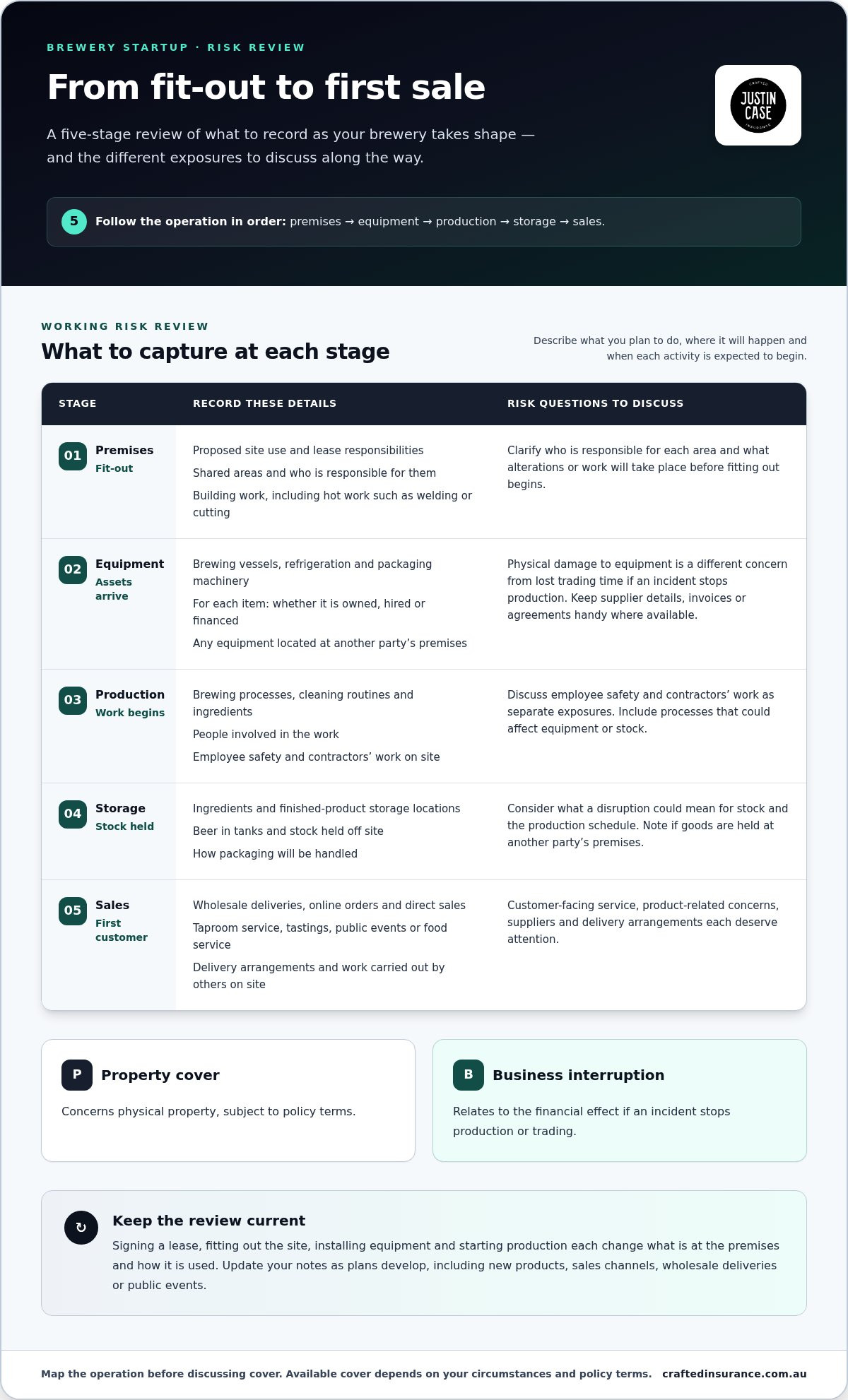
Use the stages below as a working risk review:
- Premises and fit-out: Consider the building, lease arrangements, alterations and shared spaces. Clarify who is responsible for each area and what work will take place.
- Equipment: List brewing vessels, refrigeration, packaging machinery and other key assets. Physical damage to equipment is a different concern from lost trading time if an incident stops production.
- Production: Set out processes, cleaning, ingredients and the people involved. Discuss employee safety and contractors’ work on site as separate exposures.
- Storage: Record where ingredients and finished stock are held, including stock in tanks or stored off site. Consider what a disruption could mean for stock and the production schedule.
- Sales: Note how beer is sold, delivered and served. Customer-facing service, product-related concerns, suppliers and delivery arrangements each deserve attention.
Property cover and business interruption cover address different questions. Property cover concerns physical property, subject to policy terms. Business interruption relates to the financial effect of disrupted trading. How it responds depends on policy wording, definitions and exclusions. The Australian Government’s guide to Australian business insurance types provides an overview of business cover categories.
Keep the review current as plans develop. A change in premises, production or sales can change a brewery’s risk profile. A new delivery channel or public event, for example, may introduce activities that weren’t part of the original plan. A specialist broker can help translate those operational details into an insurance discussion. Read about brewery insurance support as you map the risks.
Which insurance covers might suit a new brewery’s activities?
There isn’t one cover list that fits every brewery. A production-only startup has different needs from a business that also runs a taproom, hosts events or delivers beer. Use the table to turn details of your operation into practical questions for a specialist broker. The Insurance guide for Australian independent breweries is another reference for this conversation.
| Exposure | Possible cover category | Startup information to share | Policy questions to discuss |
|---|---|---|---|
| Premises, fit-out, equipment and stock | Property | What you own or lease, asset details, location and stock held on or off site. | Which property is insured, how is its value assessed, and what exclusions or limits apply? |
| Breakdown of brewing, refrigeration or packaging machinery | Equipment breakdown | Equipment types, installation details, maintenance plans and the role each item plays in production. | What events and equipment are covered, and how are breakdown and resulting damage defined? |
| Trading disruption after an insured event | Business interruption | How production and sales generate income, key dependencies and the time needed to resume operations. | What insured event must occur for cover to apply, and how are the cover period and limits set? |
| Injury or property damage involving customers or products supplied | Public and products liability | Taproom service, tastings, events, product types, sales channels and distribution arrangements. | How does the policy define covered activities, products, exclusions and limits? |
How can founders connect cover categories with brewery risks?
Match each category to an actual exposure, not just a policy name. Property discussions may include the premises, fit-out, brewing equipment and declared stock. Business interruption may relate to lost trading after an insured event, subject to the wording. Public liability relates to customer-facing activities, while products liability concerns products supplied. Definitions, exclusions and limits vary by insurer and policy.
For insurance for starting a brewery, give the broker enough detail to distinguish damage to an asset from the knock-on effect of halted production. Ask how the policy treats each exposure and which conditions apply. Don’t assume a category will respond until the relevant wording has been reviewed.
What should Australian founders know about workers compensation?
Workers compensation is handled through state and territory schemes, so requirements and processes vary. Don’t assume a single national process applies to your startup. Check current guidance from the relevant state or territory authority for your business location and circumstances, including how the scheme applies to your workforce. Keep this discussion separate from other insurance categories because workers compensation follows its own rules.
Prepare a brewery insurance checklist before requesting a quote
A useful insurance discussion starts with a clear picture of the business you’re building. You don’t need every detail finalised, but separate confirmed plans from estimates and flag what’s likely to change. This helps keep the conversation about insurance for starting a brewery focused on your operation, not a generic brewery template.
Use this preparation sequence before requesting a quote:
- Summarise the business. Note the business structure, owners, proposed opening timeline and planned activities, including production, sales and customer-facing service.
- Describe the premises. Record the address, how the site will be used, whether it’s leased or owned, relevant lease responsibilities, shared areas and off-site storage.
- Build an asset schedule. List brewing, refrigeration, packaging and other key equipment, plus stock. Identify what’s owned, hired or financed, and keep available invoices or other supporting records.
- Map the operation. Outline production and cleaning processes, storage arrangements, staff and contractor plans, and how products will reach customers through wholesale, direct sales, online orders or delivery.
- Mark what’s still changing. Flag proposed fit-out work, new products or sales channels and provisional details. Update the information if the plan changes before opening.
What information helps explain a brewery startup?
Keep your notes together in one working file. Add equipment and stock details as they become clearer, distinguish estimates from confirmed values, and record when each asset will arrive and where it will be kept. A concise summary of the brewing process, planned output, sales channels and customer service will show how the parts of the business fit together.
Include activities you intend to add, even if they won’t begin on opening day. A future taproom, event programme or delivery arrangement may change the operation being assessed. Clear disclosure helps a broker discuss the proposed business accurately. It doesn’t guarantee that a particular event or loss will be covered, as that depends on the policy wording.
Which questions can make an insurance discussion more useful?
Bring questions as well as documents. Ask how the activities you’ve described relate to the cover being considered, how declared asset values and policy limits are approached, and which exclusions, conditions and excesses matter for your planned work. Ask how to report a material change, such as moving premises or adding a sales channel, and how to keep your insurance details current.
A specialist broker can turn operational details into a tailored insurance discussion, while policy terms determine how cover applies. Learn about Crafted Insurance’s brewery risk support as you prepare your startup information.
Keep brewery insurance aligned as the business grows
Opening day is a milestone, not the finish line for insurance planning. A brewery can change quickly as production expands, new products launch or a taproom becomes part of the business. If the insurance details still describe an earlier version of the operation, they may no longer give a clear picture of the risks to assess.
Build a review into your business planning. Before a significant change takes effect, update your records and discuss it with your broker. This gives you an opportunity to consider whether current arrangements still suit the activities, assets and policy terms involved. Insurance for starting a brewery should keep pace with the brewery you’re becoming.
When should a brewery review its insurance details?
Revisit your information before adding a site, production line, product range or sales channel. Review declared values when you acquire equipment, build up stock or add other business assets. A new wholesale arrangement, online sales or public event can change how products reach customers and how the business interacts with the public.
Changes in staffing, service or distribution matter too. Keep a simple change log with the date, what’s changing and when it will start. Share meaningful updates rather than assuming the original description automatically includes a new activity. A review doesn’t promise a particular response from an insurer, but it helps ensure the discussion reflects the current operation.
- Premises: A move, expansion or change in how a site is used.
- Assets: New machinery, upgraded refrigeration or a material change in stock.
- Products and sales: A new beer range, online channel, wholesale route or delivery arrangement.
- People and public access: A change in staffing, taproom service, tastings or event plans.
How can a specialist broker support a brewery startup?
A specialist broker assesses how the brewery operates and uses those details to source insurance options suited to its activities. This means considering production and equipment alongside customer service and distribution, then discussing how proposed cover, limits and policy wording fit the business. The insurer and policy determine the final terms.
Risk audits and ongoing risk management can help identify exposures and organise the questions that need attention as the brewery develops. If a claim arises, claims advocacy means broker support through the claims process. It doesn’t guarantee an outcome. The policy wording and circumstances of the claim remain central.
Keep your asset schedule and activity summary current, and use them as the starting point for each review. This habit can make growth conversations clearer and help you spot when the business has moved beyond its original plan.
For a practical review of your brewery’s risks, request Crafted Insurance’s free brewery risk audit and get support mapping the next stage of your operation.
Give your brewery’s next step a clearer starting point
Your brewery will keep evolving after opening day. Make insurance a regular part of planning so growth doesn’t leave your risk information behind. A clear, current picture of your operation helps make each conversation about cover more useful.
For insurance for starting a brewery, specialist insight can turn the details of your craft beverage business into a practical insurance discussion. Crafted Insurance is an Australian broker focused on craft beverage businesses, with a decade of experience stated on its website. Its free insurance risk audit offers a way to review your business risks with a specialist.
Cover is tailored to the operation, and policy wording sets out the terms, limits and exclusions. The aim is to understand the options and make informed decisions as your plans take shape, not to assume every risk will be covered.
Ready to take the next step? Book Crafted Insurance’s free brewery insurance risk audit to get your brewery’s insurance conversation moving. Then you can get back to building something worth raising a glass to.
Frequently Asked Questions
What insurance do I need to start a brewery in Australia?
There’s no single package that suits every brewery. Insurance for starting a brewery may involve property, equipment breakdown, business interruption and public or products liability, depending on your activities and the policy terms. A production-only site and a brewery serving customers have different exposures to discuss. List what you’ll own, make and sell, then ask a specialist broker to assess which cover categories may fit your operation.
Can I insure brewery equipment before the business opens?
It may be possible to arrange cover before opening, but timing and protection depend on the insurer and policy wording. Tell your broker when equipment is purchased, where it will be stored, when it will be installed and when production is expected to begin. Equipment in transit, awaiting installation or held temporarily at another site may need particular attention. Don’t assume cover starts automatically when you place an order or take possession.
Does brewery insurance cover a taproom or tasting events?
A taproom or event can be considered as part of the brewery’s insurance arrangements, but describe these activities accurately. Explain whether you’ll serve alcohol, host tastings, run ticketed events or allow private functions, and how often they’re planned. Ask how the policy defines covered activities and whether conditions or exclusions apply. Don’t assume production-related cover automatically includes public-facing service or every event format.
Is public liability insurance the same as products liability insurance for a brewery?
No. Public liability generally relates to injury or property damage involving other people during business activities, such as a visitor slipping in a taproom. Products liability relates to injury or damage alleged to have been caused by a product supplied, such as packaged beer. The categories address different exposures, though exact definitions vary by policy. If you sell through wholesalers or online, describe those channels and ask how the wording treats them.
How does workers compensation work for a new brewery in Australia?
Workers compensation is managed through state and territory schemes, and the process and requirements depend on where your brewery operates and its circumstances. Before hiring, check current official guidance for the relevant jurisdiction rather than relying on another state’s process or an older checklist. Have your planned roles, work arrangements and expected workforce details ready. A broker can help identify insurance questions, while the scheme authority provides current jurisdiction-specific information.
What information do insurers need from a startup brewery?
Insurers typically need a clear description of the business and its proposed activities to assess the risk. Be ready to explain the premises, ownership or lease arrangements, production methods, equipment, stock, staffing and sales channels. For example, note whether beer will be sold wholesale, online or across a bar. Provide accurate estimates where values aren’t final, label them as estimates and update them as decisions are confirmed.
When should a brewery update its insurance after opening?
Tell your broker about material changes as they arise, rather than waiting for renewal. A second site, larger production line, new product, online store, delivery service or public event can alter the activities or assets being assessed. Keep a dated record of the change and its start date, then ask how it affects your current arrangements. Review policy wording and updated documents carefully, including limits, conditions and exclusions.