

What if your policy sees a “small brewery” but misses the taproom, keg deliveries or online sales that shape your day? Nano brewery insurance should reflect what you make and how you sell it, not just the size of your brewhouse.
A compact operation can still rely on specialised equipment, stored stock and people visiting the premises. The challenge is working out which activities create distinct risks and whether policy limits, exclusions and business interruption terms suit your setup. You shouldn’t have to guess, or pay for cover built around a very different business.
This guide explains how to map your exposures, prepare for an insurance review and compare policy wording against practical scenarios. We’ll look at public and product liability, property, machinery breakdown, spoilage and business interruption, and what to revisit when you add products, change sales channels or take on new activities. A clear picture of how your brewery operates makes for a more focused cover conversation and less fine-print guesswork.
Key Takeaways
- Match nano brewery insurance to your actual activities, from brewing and storing stock to serving customers and distributing beer.
- Review public liability and product liability separately, then check the policy wording for how each applies to your operations.
- Compare real-life scenarios with policy limits, exclusions and business interruption terms. A policy name alone won’t show where gaps may exist.
- Prepare for a review by documenting equipment, stock, existing cover and sales channels, and noting any planned changes.
- A specialist broker can assess your operating details against potential insurance options and provide claim advocacy if you need to make a claim.
Nano brewery insurance in Australia: why business size is not the whole story
A small brewhouse can support a varied operation. One day might involve brewing and packaging; another might include storing finished stock, welcoming tasters or arranging deliveries. Each activity brings different property, people and product exposures into the picture.
Nano brewery insurance needs depend on your operations, assets and customer-facing activities. Production volume and staff numbers alone don’t describe the full risk. Consider the work happening on site and beyond it, then check that the policy wording reflects those details.
A production-only brewery has a different setup from one that also cans beer, sells direct, runs tastings or serves customers. In a small team, people may share responsibilities: a brewer might also handle stock records, deliveries and customer service. Describe the whole operation, not just the brewing process.
Map where people, products and equipment move. A batch might go from a tank to packaging, into storage, then out to a retailer or customer. If there’s a taproom, visitors add another customer-facing activity. These details help make an insurance review more specific, but don’t automatically determine a policy or outcome.
What makes a nano brewery’s risk profile different?
Small teams often rely on a few people to keep several parts of the business moving, while critical equipment may be central to production. A single premises can combine brewing, storage, tastings and direct sales. Start with a list of activities rather than the “nano” label. Note who does each job, where it happens and which assets support it.
When does a small brewery’s insurance needs change?
Changes can happen gradually: adding online sales, taking on staff, delivering kegs or opening the premises for on-site service. Events may bring customers onto the premises in a new way. Contract production can also change how products, equipment and responsibilities are arranged. Each change is a prompt to review what’s declared and how the policy wording applies.
Keep a simple change log. Record what changed, when it began and whether it’s ongoing or occasional. Include products, sales channels, staffing and customer access. This makes it easier to give a clear account of the brewery during an insurance review and discuss whether existing arrangements still reflect how it operates.
Which insurance exposures can arise across nano brewery operations?
A brewery’s exposures can follow the beer from production through to sale. Brewing, packaging and storing stock raise different property and equipment considerations from welcoming tasters, supplying retailers or delivering orders. Map each step, then check how the relevant policy wording responds.
An injured visitor raises a different liability question from an allegation that a beer product caused harm. Public liability and product liability are separate considerations, although the exact response depends on the policy terms. Don’t assume one automatically includes the other, or that a policy label explains what’s covered.
Production, premises and brewery equipment
Start with an inventory of the premises, brewing and packaging equipment, and stock. Record the equipment type, location, ownership and replacement value, as well as the stock you typically hold. Keep the information current so your broker can assess the assets behind the operation.
Property damage and machinery breakdown are separate insurance considerations. Damage to premises or equipment may be treated differently from a mechanical or electrical failure, and resulting losses may depend on selected options and policy wording. Declared values, exclusions and limits also matter. For example, a chiller failure could affect production and stored beer, but don’t assume every resulting cost is covered.
Business interruption is another area to examine. If an insured event disrupts trading, the policy terms determine whether and how lost income or ongoing expenses may be addressed. Consider what would happen if a key part of production couldn’t operate, and how long the business could manage while repairs or replacement were arranged.
Customers, beer products and selling channels
Customer-facing activities change the questions to ask. Tastings and on-site service involve visitors at the premises. Wholesale supply, direct sales and online orders put products into other settings, while deliveries add movement beyond the brewery. Describe each channel and whether it’s occasional or part of regular trading.
A visitor injury during a tasting and a complaint about packaged beer are different scenarios. The first may raise a public liability question; the second may raise a product liability question. Whether either falls within cover depends on the policy wording, exclusions and circumstances. Be precise about what you make, package, sell and serve.
For a plain-language overview of the wider cover landscape, Types of business insurance in Australia from business.gov.au outlines common business insurance types, including some that may be legally required. It’s a helpful reference, but it doesn’t determine what a particular brewery policy covers.
Good nano brewery insurance discussions start with actual exposures, not assumptions. Crafted Insurance specialises in Australian craft breweries, including nano breweries, and can assess your operation against potential insurance options. Read more about specialist brewery insurance support.
How to assess nano brewery insurance options and find potential gaps
A policy name can sound reassuring, but it doesn’t prove that a particular loss is covered. To assess nano brewery insurance, compare the work you actually do with the activities, assets and events described in the wording. Then examine the limits, excesses, exclusions and conditions that shape how the policy may respond.
Use real situations to guide the review. These questions are prompts, not a promise that a particular policy will cover a loss.
| Operational scenario | Policy wording to examine |
|---|---|
| Brewing equipment is damaged | Is the equipment described, and what damage or breakdown events are included or excluded? |
| A batch is spoiled after a chiller failure | Does the wording address stock spoilage, machinery failure and resulting losses? |
| A visitor is injured during a tasting | Are tastings and other customer visits among the declared activities? |
| A customer alleges a packaged beer caused harm | How does the policy describe product liability, and what exclusions or conditions apply? |
| A fire interrupts trading | Is business interruption included, and what event must cause the interruption? |
Read the schedule alongside the full policy wording. The schedule summarises details such as insured activities, property descriptions, sums insured, limits and excesses. The wording sets out exclusions and conditions that can affect whether a claim is accepted and how it’s handled. Wording isn’t necessarily the same across policies, so check the documents you hold.
Which policy details deserve a closer read?
Start with the business description. Does it reflect the production, packaging, storage, tastings, direct sales and other activities you carry out? Then check that listed property and declared values still match the equipment and stock you rely on. An incorrect description or a limit that doesn’t reflect your assets may leave a mismatch. Ask for unfamiliar exclusions and conditions to be explained in plain English, using a brewery scenario you recognise.
A general business policy doesn’t necessarily account for every brewing activity or loss. The title is only a starting point. For questions about food standards and product information, Food Standards Australia New Zealand provides a useful reference. Standards and insurance wording serve different purposes, so compliance information doesn’t confirm insurance cover.
Does business interruption cover automatically follow property cover?
Don’t assume it does. Business interruption is a separate consideration, and any response depends on the policy terms and the event that causes the disruption. Think through how long trading could be affected if key equipment or part of the premises couldn’t be used. Review which ongoing expenses matter, what waiting periods or limits apply, and whether the wording links interruption to insured damage.
Use the table to identify questions, then compare the answers with your declared activities and current records. A brewery insurance review with Crafted Insurance can connect those operating details with potential options and help clarify the wording. The aim is a more informed discussion, not an assumption that every loss is insured.
How to prepare for a nano brewery insurance review
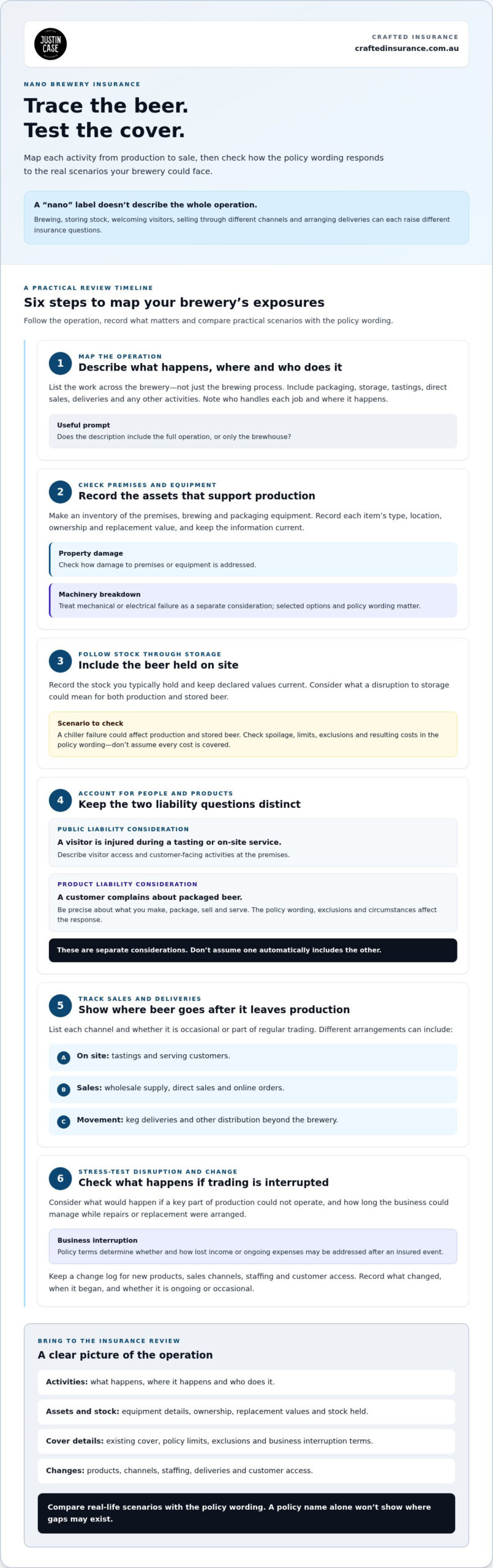
A useful review starts with a clear picture of how the brewery runs today. You don’t need a polished report. Gather practical records, note what’s changed and make it easier to compare your operations with the cover you hold.
Work through these steps:
- Describe your activities. Outline brewing, packaging, storage, tastings, events, deliveries and each sales channel.
- Document your assets. List equipment, premises details and stock, with current values and supporting records where available.
- Check existing cover. Gather policy schedules and wording, then note unclear terms, exclusions or details that may no longer be accurate.
- Discuss changes. Flag new products, staff, equipment, premises use or sales arrangements, including changes you’re planning.
What information should a nano brewery gather?
Build a working file with equipment descriptions, purchase or replacement records, stock information and details of how brewing and packaging are carried out. Add a short summary of premises use, staffing, customer visits, events, deliveries and sales arrangements. Note what’s occasional and what’s part of regular trading. These details help a broker understand the operation, assess its risks and explore suitable insurance options.
Accuracy matters. If a policy describes a production-only business but the brewery now hosts tastings or makes deliveries, that difference is worth discussing. The same applies to changes in equipment or stock levels. Clear declarations give your broker a sounder basis for reviewing options, but don’t by themselves confirm that a particular loss will be covered.
When should a brewery revisit its insurance arrangements?
Set a regular time to review your records and policy details, and bring the conversation forward when a material change occurs. That might be a new product, a different premises setup, more staff or a move into online sales. A change doesn’t automatically mean a policy must change, but it can affect how your activities should be described and assessed.
Include risk-management improvements in your review notes. For instance, record equipment maintenance or changes to how stock is stored. These steps can help explain how you manage risks, but don’t assume they automatically alter cover or policy terms. Keep the discussion focused on what changed, when it changed and what it means for day-to-day trading.
With your records organised, a review of Crafted Insurance’s brewery risk support can help connect your declared activities with a tailored insurance discussion.
How a specialist broker can help tailor nano brewery insurance
A specialist broker can turn the way your brewery operates into a clearer insurance conversation. Instead of starting with a generic business label, they can assess your production, premises, products, customers and plans for growth, then source insurance options suited to the operation.
Two breweries with similar output can have very different setups. One might supply packaged beer to retailers; another might host tastings and sell directly on site. Those details inform the risk assessment and which options are worth considering. They don’t guarantee that a particular loss will be covered.
Crafted Insurance specialises in cover for Australian craft breweries, distilleries and brewpubs, including nano breweries. Its free insurance risk audit is a practical starting point for mapping exposures and identifying questions to bring into a review.
What specialist brewery insurance support can look like
A broker can use your business information to build a rounded picture of how the brewery works, from production and equipment to customer visits and sales channels. They can then source options suited to the assessed business profile and help you understand differences in wording, limits and exclusions. Ongoing risk management can keep the discussion current as your products, premises or activities evolve.
Useful support is specific. It connects the details you provide with practical questions, such as whether a new sales channel changes the activities declared or whether a growth plan affects the assets you need to account for. You remain involved in decisions, with clearer information to weigh up the options.
What to expect when a claim needs support
If something goes wrong, claim advocacy can help you communicate with insurers, organise relevant information and work through the steps involved in making a claim. That support can make a complicated process easier to follow, especially when you’re also trying to keep the brewery running.
The outcome still depends on the policy wording and the circumstances of the claim. A broker can explain the process and advocate on your behalf, but can’t promise that a claim will be paid or resolved in a particular way. Clear records of the incident, affected property or products, and conversations about the claim can help keep the process organised.
Specialist guidance can help you work through the fine print while you focus on the beer and the business. Talk with Crafted Insurance about your brewery.
Make your next cover conversation count
Your next step doesn’t need to be a major overhaul. Check that your insurance details still reflect the brewery you’re running now, not the one you started with. A new product, a different way of selling or a change in how customers visit can all prompt a review.
Crafted Insurance works with Australian craft breweries and related businesses, bringing brewery operations into the insurance discussion. Clear information about your plans can make the conversation more focused, whether you’re reviewing existing arrangements or preparing for a change.
Give your brewery’s next chapter a more confident start. Talk with Crafted Insurance about your nano brewery and discuss insurance options shaped around the way you work.
Frequently Asked Questions
Is nano brewery insurance different from standard business insurance?
It can use familiar types of business cover, but the details need to reflect the brewery’s work. A policy set up for an office or shop may not describe brewing, packaging or alcohol sales accurately. Check that the business description accounts for the products made and how they reach customers. The policy label isn’t enough; the schedule and wording show what has been declared.
Does public liability insurance cover beer sold by a nano brewery?
Not necessarily. Public liability generally concerns claims involving injury to other people or damage to their property, while an allegation about harm caused by beer may involve product liability. A customer slipping during a tasting is different from a wholesale buyer reporting a problem with a supplied batch. Check how the policy defines each type of cover and whether exclusions, conditions or limits affect the situation.
Can a nano brewery insure equipment kept at another site?
Possibly, but don’t assume equipment is covered wherever it’s stored. The policy may describe specific premises or set conditions for property kept elsewhere. Tell your broker what equipment is off-site, who owns or controls the location, whether it moves between sites and how it gets there. A tank stored at another business’s premises, for instance, raises different location and transit questions from equipment kept at the brewery.
Is business interruption insurance automatically included for a brewery?
No, don’t assume it is. Business interruption may be an optional section or extension, and its terms can specify which event must cause trading to stop before cover may respond. Check the insured trigger, any waiting period and the maximum period stated in the wording. Consider seasonal demand or production delays as part of assessing whether the arrangement reflects how your brewery earns income.
Does a nano brewery need to update its insurance when it starts selling online?
Tell your broker when online sales begin so the new arrangement can be considered. Explain who takes payment, packs orders and organises delivery, and whether another business stores or dispatches the beer. Those details may affect how the operation is described and which insurance options are relevant. Keep records of the sales process and review any policy conditions about distribution or customer transactions.
How often should a nano brewery review its insurance?
Review it at renewal and whenever a meaningful change could affect the business’s activities or assets. That might include moving equipment, adding a product line or changing how orders are fulfilled. A diary reminder ahead of renewal gives you time to gather records and read the documents. Between renewals, keep a note of changes so they’re easier to explain during a review.
Can a home insurance policy cover a nano brewery operated from home?
Don’t assume a household policy covers brewing equipment, stock or business activity. The wording may limit or exclude property used for business, while customer visits or deliveries can raise separate questions. Describe the home-based setup, including where brewing takes place, what equipment and stock are kept there, and whether customers attend. Arrange a business insurance review that considers those details alongside any relevant household policy wording.