

What if your insurance needs change the moment you add a tasting room, start maturing spirits or sell beyond the distillery? Insurance for starting a distillery should reflect the business you’re actually building, not a generic picture of a small manufacturer.
There’s a lot to juggle when you’re focused on recipes, equipment and getting ready to open. The details matter: what you make, how you produce it, where stock is stored and whether visitors come on site all help shape the risks an insurer needs to understand.
This practical checklist will help you gather the right information and map likely cover needs, from property and equipment to stock, liability and business interruption. You’ll also see which operational changes may affect your cover, and how a specialist broker can turn the realities of your distillery into a clear insurance discussion. Less guesswork, more room to focus on the craft.
Key Takeaways
- Shape insurance for starting a distillery around your business plan, even while some start-up details are still taking form.
- Separate production, storage, customer access, sales and deliveries to make each part of the operation easier to discuss.
- Prepare details about your premises, activities and asset values to support practical conversations about potential cover.
- A specialist broker can assess your operation, explain policy details and revisit the discussion as your plans change.
- Use a pre-opening checklist to organise the information you need before reviewing insurance options.
Starting a distillery? Begin your insurance checklist with the business plan
Building a distillery means making insurance decisions before every detail is locked in. You might be finalising a lease while still working through your production plan. That’s normal. Separate what’s decided from what’s still taking shape so the insurance discussion starts with a clear, honest picture.
This isn’t about choosing a one-size-fits-all policy. It’s about preparing the right information for a tailored conversation about insurance for starting a distillery. Write down your business stage, intended opening timeline and operating model. If your launch date is a target rather than a confirmed date, label it clearly.
Write down what the distillery will do
Describe the work, not just the end product. A general overview of a Microdistillery can help put the small-scale craft model in context, but your own plans are what make the insurance conversation practical.
- Production: List the spirit types you plan to make and the stages involved, such as fermentation, distillation, blending, bottling and storing stock. Note which activities you’ll handle yourself and which may involve contractors.
- Sales: Record whether you expect to sell wholesale, directly to customers or through both channels. Include planned online sales and deliveries.
- Visitors: Note whether you plan to host tastings, tours, events or hospitality activities. Include where visitors may go and whether each plan is confirmed or still under consideration.
These details show how the business will actually run. They also help prevent a production-only description from leaving out customer-facing activities that bring different exposures into the discussion.
Set out the start-up’s operating picture
Describe the premises as you currently understand them. Is the site owned, leased, shared or still being arranged? Note which areas you expect to use for production, storage, sales and visitor access. If the layout is still being finalised, say so rather than treating a draft plan as settled.
Next, map the people involved in day-to-day operations. Include planned employees, contractors and anyone else who may work on site. You don’t need every role nailed down. A clear outline of the intended team is more useful than leaving people out because hiring hasn’t started.
Keep a simple “confirmed” and “to be decided” list beside your notes. A shared site might become a dedicated premises, tastings could be added later, or production volumes may shift. These changes can affect the questions asked about your operation, so make assumptions visible and update them as plans firm up.
Bring this working snapshot to a broker discussion. It gives a specialist a practical starting point to assess the operation and discuss suitable cover, without suggesting your start-up is further along than it is. Clear notes now can help avoid crossed wires later.
Map distillery activities to insurer risks
A business plan describes what you hope to build. An activity-to-exposure worksheet shows how the work will happen, from receiving ingredients to getting a finished bottle into a customer’s hands. That distinction makes insurance for starting a distillery a grounded discussion about your actual operations, not a guess based on the word “distillery”.
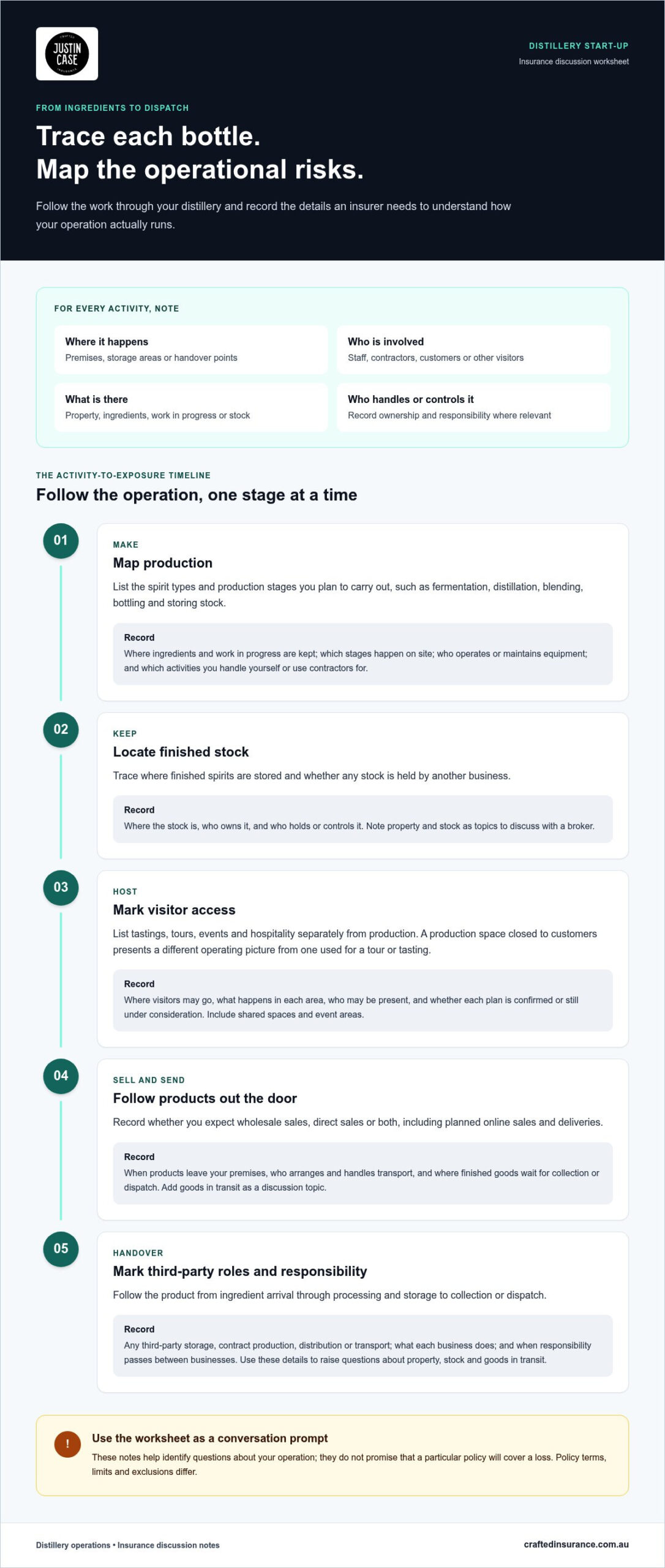
Keep the worksheet practical. For each activity, record where it happens, who’s involved, what property or stock is there, and who owns, controls or handles it. Then note the insurance topic to discuss. These are prompts for a conversation, not promises that a particular policy will cover a loss. Terms, limits and exclusions differ between policies.
- Production: Record where ingredients and work in progress are kept, which stages take place on site, and who operates or maintains equipment.
- Storage: Note where finished spirits are stored, who owns the stock and whether any of it is held by another business.
- Customer access: Map the areas visitors can enter and the activities planned in each space.
- Sales and delivery: Track how products are sold, when they leave your premises, and who arranges and handles transport.
Trace the path from production to customer
Follow a product through each handover. Note where ingredients arrive, where spirits are processed and stored, and where finished goods wait for collection or dispatch. If a third party provides storage, contract production, distribution or transport, write down their role and when responsibility passes between businesses. These details help a broker identify questions about property, stock and goods in transit without assuming cover applies automatically.
For industry context, the Australian Distillers Association shares information relevant to the Australian distilling sector. Keep your worksheet focused on your own arrangements, especially practical handovers that are easy to overlook.
Include people, premises and customer-facing activities
List planned tastings, tours, launches, markets and hospitality activities separately from production. Describe how each area of the premises will be used, including shared spaces and visitor access. Then note who may be present: staff, contractors, customers or other visitors. A production space closed to customers presents a different operating picture from one used for a tour or tasting.
Be specific about timing and control. For example, note whether a contractor works on equipment during operating hours, or whether a launch event uses a shared outdoor area. The point isn’t to predict every incident. It’s to show what happens, where it happens and who’s involved.
Keep operational facts separate from insurance assumptions. Write “delivery arranged by the distillery” rather than assuming goods are covered once they leave the site. A specialist broker can assess these details, explain the policy wording and help you consider suitable cover. For support translating your activity map into an insurance discussion, explore distillery insurance support.
Compare the insurance questions behind a distillery start-up
Turn your activity map into questions about insurance. The table below is a discussion tool, not a shopping list or a promise that any policy will cover a particular loss. For insurance for starting a distillery, begin with what could be affected, what you want to understand and which facts will help explain your operation.
| Business exposure | Insurance topic to discuss | Details to prepare |
|---|---|---|
| Buildings, stills, production equipment and other property | Property and equipment | List what you own, lease or share, where it’s used, how it’s used and how you’ve estimated its value. Note any replacement needs or equipment that’s still planned. |
| Visitors, customers, contractors or other people interacting with the business | Liability | Describe customer access, tastings, tours, events, contractor work and the areas where each activity happens. |
| Spirits sold through wholesale, direct sales or other channels | Product-related liability | Set out what you make, how products are handled, who sells them and how they reach customers. |
| Interruption to production or sales after a disruptive event | Business interruption | Outline key operations, income sources, dependencies and how long it could take to resume work. Ask what the policy wording requires for a claim to apply. |
| Stock or products travelling between locations | Goods in transit | Record the route, transport arrangements, who organises the delivery, and when responsibility passes to another party. |
Match common cover topics to the questions they raise
Use each row to ask a practical question. For property, clarify how the proposed cover treats equipment you own, lease or use in a shared space. For liability and products, connect the discussion to customer contact, sales channels and product handling. Business interruption concerns possible income impacts, not guaranteed recovery. The policy’s terms and the circumstances of a loss matter.
Check where the policy boundaries may sit
A policy label doesn’t tell you the full scope of cover. Read the definitions, conditions, limits and exclusions, and check how the wording reflects your declared activities, premises and sales channels. Ask your broker to explain terms that affect your plans. If the discussion touches on Australian laws, regulations or standards, make sure any relevant guidance is current and comes from a qualified source.
Keep the answers beside your worksheet. If your plans change, such as adding visitor activities or using a new delivery arrangement, revisit the relevant questions. This keeps the insurance discussion connected to the distillery you’re building, rather than relying on assumptions that no longer fit.
Pre-opening checklist for insurance discussions
A tidy set of notes can make an insurance conversation much more useful. You don’t need every start-up decision finalised, but you do need to show what’s settled, what’s still an estimate and what may change before opening.
Use this checklist to organise the key details for insurance for starting a distillery. Keep supporting documents together in one digital or printed folder, and date updates as your plans develop.
Gather the information a broker will need
- Set out the business basics. Record the business structure, ownership details, current stage and expected start date. Mark target dates clearly so they aren’t mistaken for confirmed milestones.
- Describe the premises. Note the address, whether the site is owned, leased or shared, and how you expect to use each area. Include available plans or lease information, plus details of access and shared spaces.
- Summarise the operation. Bring together your production plan, spirit types, sales channels, storage arrangements and delivery model. Add planned tastings, tours, events or hospitality, along with the staff and contractors expected to be involved.
- List property, stock and equipment. Note what the business owns, leases or uses under another arrangement. Include estimated values and available purchase receipts, quotes, inventories or valuation records. If an item is not yet purchased, label its value as an estimate.
- Organise the supporting records. Keep the activity map, premises information, asset list and relevant business documents in the same place. This gives your broker a clearer view of the operation and makes it easier to answer follow-up questions.
- Review the proposed policy wording. Check that the business activities, premises and sales channels discussed are reflected in the information used to arrange cover. Ask for plain-English explanations of definitions, conditions, limits and exclusions you’re unsure about.
Review changes before the first sale
Before opening, compare the final operating plan with the details used in your insurance discussions. Have production plans shifted? Are visitors coming into a new area? Have staffing, events or distribution arrangements changed? Note each difference and discuss its insurance implications with your broker instead of relying on old assumptions.
Then keep the checklist current. A new sales channel, a change of premises or an added customer activity can alter the picture you originally presented. Update your records when plans change, and note when you shared those updates. Simple housekeeping can make the details easier to follow.
A specialist broker can translate the facts into a tailored insurance discussion and explain the policy details as your plans take shape. Explore Crafted Insurance’s specialist support for your distillery start-up.
Work with a distillery insurance broker as your plans take shape
A specialist broker turns your distillery’s real-world activities into an insurance conversation. They assess how you plan to operate, source suitable cover options and explain policy details in plain language. That can help when insurance for starting a distillery feels like another technical job on an already long start-up list.
Your first plan doesn’t have to be your forever plan. You might begin with production and wholesale, then add tastings or direct sales. Tell your broker when the setup changes. New activities, a different premises arrangement or a new way of moving stock can all be reasons to revisit the details used to arrange cover.
What to expect from specialist broking support
Your activity map gives the broker a practical starting point. They can use it to assess the operation, identify details that need more discussion and source insurance options suited to the business you’re building. Risk assessment can also bring operational questions into focus, such as who handles stock at each stage or how visitors access the site.
That support can continue as the business develops. Ongoing risk management helps keep attention on changes to day-to-day operations, while claim advocacy can provide guidance through the claims process if an incident occurs. It doesn’t guarantee a claim outcome. Policy terms and the circumstances still matter.
A broker’s role is to help you understand the choices and wording, not to make your operating decisions for you. You bring the plans and the honest detail. They connect those details to insurance questions and available options.
Turn the checklist into a clear next step
Bring your business plan, activity worksheet and any available asset records to the discussion. Include the parts still in progress, too. A draft opening timeline or estimated equipment value is useful when clearly labelled as an estimate. Clear information gives the broker a better basis for assessing your operation and explaining what needs attention.
Crafted Insurance provides a free insurance risk audit. It can be a starting point for reviewing the business information and risks you’ve identified, without assuming in advance what the review will find. Keep your notes handy as the launch approaches, then share meaningful changes to production, premises, staffing, events or distribution as they arise.
You’ve put serious work into the craft. Let a specialist help make the insurance conversation more manageable. Start a conversation about your distillery’s insurance.
Take your distillery plans into the next conversation
Your insurance plan can grow alongside the distillery. Treat it as a working part of your launch and revisit it as your operation settles into its rhythm. That way, insurance for starting a distillery stays connected to the business you’re actually building.
Crafted Insurance specialises in Australian craft distillery broking, with a decade of experience stated by the business. Its support includes risk management and claim advocacy, and it provides a free insurance risk audit. These are practical starting points for founders who want to bring their plans into a focused insurance discussion without having to translate every detail alone.
Have your business plan and latest operating notes ready, even if some parts are still evolving. A clear picture of what you’re making and how you’ll operate gives the conversation somewhere practical to begin.
Talk with a specialist about your distillery insurance. Take the next step with a clearer picture of your risks and insurance needs.
Frequently Asked Questions
Do I need insurance before my distillery opens?
There’s no single start date that suits every distillery. Your exposure may begin before the first bottle is sold, such as when you take possession of a site, equipment or stock, or people start working there. For insurance for starting a distillery, map these milestones against your expected launch date. Then discuss when cover may need to begin and what it should address with a specialist broker, based on your actual plans.
Can a new distillery arrange insurance before producing its first spirit?
Yes, a start-up can begin discussing insurance before production starts. Explain what you intend to make, where the business will operate and which activities are planned, even if some details are still being finalised. The proposed cover and start date depend on the insurer’s terms and the information provided. If your plans change before the first production run, update the discussion so it reflects the operation you’ll actually launch.
Does distillery insurance cover tastings, tours or launch events?
Not automatically. Tastings, tours and launch events can affect the risks to discuss, so describe how each activity will run, including where visitors will go and what they’ll do. A private launch at the distillery may differ from a tasting held at another venue. Whether an event is covered depends on the policy wording, declared activities and circumstances. Don’t assume an existing policy applies to every event format or location.
Will insurance cover my spirits after they leave the distillery?
It depends on the policy and the journey your products take. A bottle may pass from your premises to a carrier, distributor, retailer or customer, and different arrangements can affect which insurance questions arise. Explain who books transport, who handles the goods and whether products are stored elsewhere before sale. Don’t assume protection automatically continues from production through delivery. Ask your broker to clarify how the wording treats each part of the journey.
Should I tell my insurer if my distillery changes its activities?
Yes. Tell your broker about changes that could make the original description of the business inaccurate, such as adding tours, contract production, wholesale distribution or a new sales channel. For example, moving from trade-only sales to welcoming customers on site changes who interacts with your operation. Keep a written record of planned changes and discuss them before they become routine. The effect on cover depends on the policy wording and circumstances.
Can I insure a distillery in leased or shared premises?
A leased or shared site can be part of an insurance discussion, but the arrangement alone doesn’t determine what cover applies. Explain which areas your distillery uses, what spaces are shared and who owns the building, equipment and stock. For example, equipment you lease may need to be described differently from machinery you own. Share relevant lease or site details with your broker so they can assess the operation and discuss suitable options.