

What if the right cover for your micro distillery depends less on its size and more on how each bottle is made, stored and sold? A still, ageing stock, deliveries and a cellar door can all create different exposures. Micro distillery insurance should reflect the work behind your spirits, not just the business name on a policy.
A general business policy may not describe production equipment, stock on site or customer sales in enough detail. Policy wording can also be difficult to compare: limits, conditions and exclusions determine how cover applies to your operation.
This guide explains the main risk areas for Australian micro distilleries and the cover categories to consider, from property and equipment to liability and business interruption. You’ll also find practical steps for preparing for an insurance review and explaining your setup to a specialist broker.
Key Takeaways
- Shape cover discussions around how your distillery produces, stores and sells spirits, not just its size.
- Consider property, equipment, stock, business interruption and liability, then compare wording, limits, conditions and exclusions.
- Map exposures across production, flammable-liquid handling, storage, stock movement and customer interactions.
- Prepare for a micro distillery insurance review by recording your production stages, premises use, equipment, stock and sales channels.
- A specialist broker can assess your operation and source insurance options. Insurers make underwriting and claims decisions.
Micro distillery insurance in Australia: why your operating model matters
Micro distillery insurance means arranging business cover around the activities and exposures of a small distillery. Start by mapping how the business operates: what happens on site, where stock is kept, how products reach customers, who handles each task and how the premises are used.
Suitable cover depends on what your distillery does, not simply how much it produces. Two small operators can have very different setups. One might focus on production and wholesale supply, while another also matures stock, packages products on site and welcomes customers for direct sales.
Risk controls and insurance serve different purposes. Controls help reduce exposure through the way work is organised and hazards are managed. Insurance responds to agreed events under the policy terms, limits, conditions and exclusions. One doesn’t replace the other.
Distilling turns ingredients into spirits through processes that vary between producers. The general Distilled Beverage Production overview offers background, but an insurance review needs to focus on the specific stages and activities in your own operation.
What makes a micro distillery’s risk profile different?
Production, maturation or storage, packaging and sales each bring different considerations. Equipment and materials used during production are distinct from finished stock waiting for delivery. Direct sales or customer visits can also mean the premises serve both production and public-facing purposes. Distilleries don’t all make the same spirits or use the same process.
In a small team, one person may handle production, package orders and serve customers. Include those overlapping responsibilities when describing who works on site and what they do. A useful review considers the full working day, not just the still or the finished bottle.
When should a distillery review its insurance?
Review your arrangements when the business changes, particularly during start-up or when activities, equipment or premises shift. Changes can affect the information insurers need to understand your operation. Update the description of your business so it reflects the new setup.
- Starting up, or moving from planning into production
- Installing new equipment or changing production methods
- Increasing output or changing how stock is stored
- Adding a sales channel, such as direct customer sales
- Changing how the premises are used or who works there
Keep a simple record of what’s changing, when it’s expected to happen and which activities it affects. For an insurance review, the key is ensuring the description of your operation keeps pace with what happens on the floor.
What micro distillery insurance may cover: understand the main categories
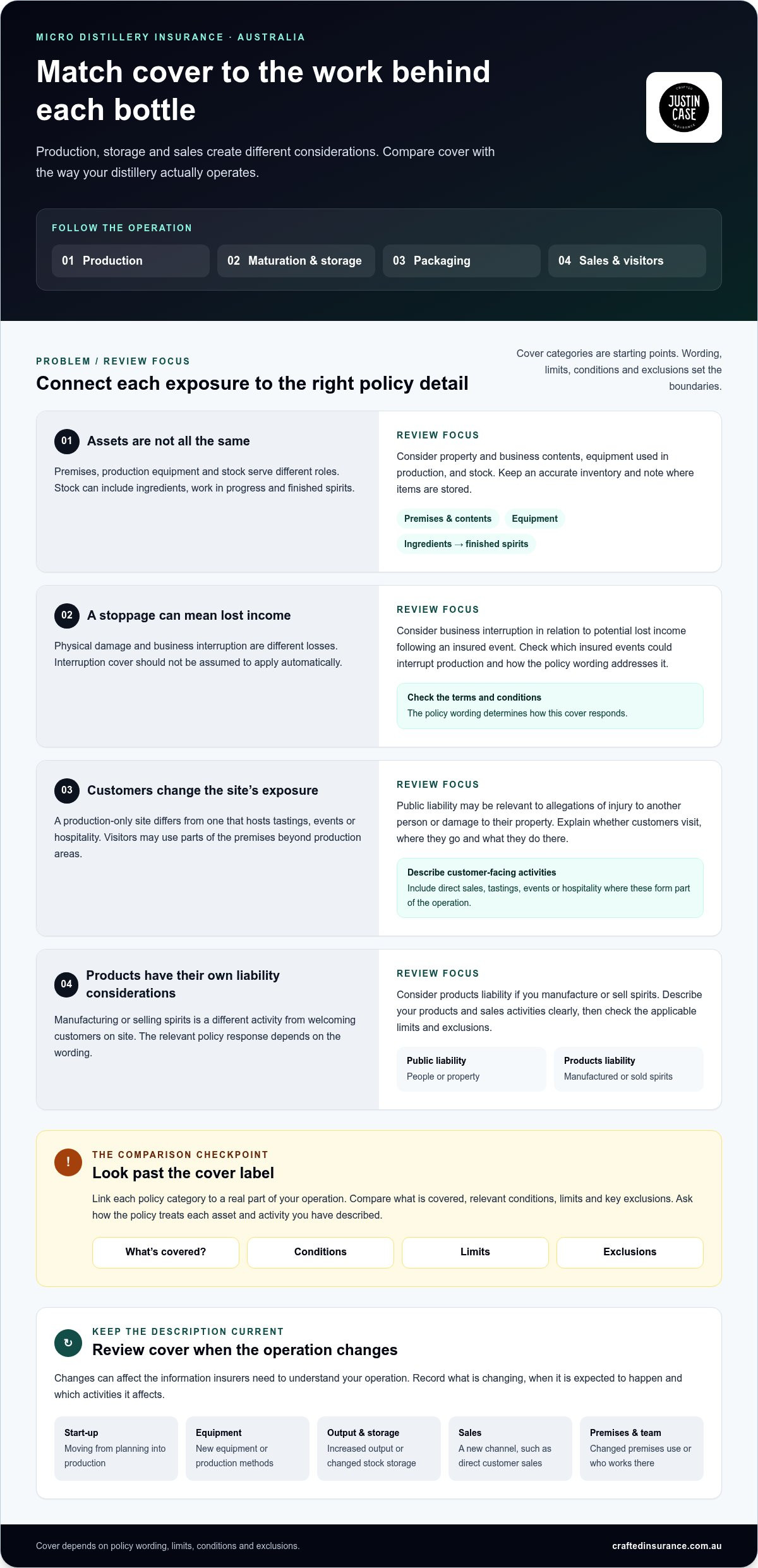
There’s no standard package for every operation. Start by matching possible cover categories to the assets you rely on, the work you do and the people who interact with your business. For a micro distillery, the discussion may include property, equipment, stock, business interruption, public liability and products liability.
A cover label alone doesn’t establish what a policy will pay. The wording, limits, conditions and exclusions set the boundaries. Compare the policy details with the risks and activities you’ve described, rather than relying on the category name.
Property, equipment, stock and business interruption
Property considerations can include the premises and business contents. Equipment cover relates to items used in production, while stock may include ingredients, work in progress and finished spirits. These assets can be valued, described and treated differently under a policy. Keep an accurate inventory and note where items are stored.
Business interruption is a separate consideration. It relates to potential lost income following an insured event, subject to the policy’s terms and conditions. Physical damage and interruption are different losses, and neither category should be assumed to apply automatically. When comparing options, consider which insured events could interrupt production and how the wording addresses that interruption.
Liability connected with products and customer-facing activities
Public liability may be relevant to allegations that your business caused injury to another person or damage to their property. Products liability is another consideration if you manufacture or sell spirits. The policy wording determines how each responds, including limits and exclusions. Describe your products and sales activities clearly during the review.
A production-only site has a different customer exposure from one that also hosts tastings, events or hospitality. If people visit, explain where they go and what they do there. If product labels or standards are part of your wider operating responsibilities, the Food Standards Australia New Zealand Food Standards Code is a useful reference. Insurance doesn’t replace your other business responsibilities.
Make comparisons practical by linking each category to a real part of your operation. List the premises and equipment you rely on, trace stock from ingredients to finished bottles, and note whether customers visit. Then check the wording for what’s covered, relevant conditions, limits and key exclusions. Ask how the policy treats each activity or asset you’ve described. This makes it easier to compare the details that matter, not just familiar labels.
A specialist broker can assess those details and source suitable insurance options. For a review shaped around your distillery’s activities, explore specialist distillery insurance support.
Distillery insurance risks: connect production, storage and sales
A useful risk review follows the work from start to finish. Production, alcohol handling, stock storage, equipment maintenance, order fulfilment and customer visits can each create different hazards or points of disruption.
A hazard and its insurance treatment aren’t the same thing. Risk controls can help reduce exposure, while a policy’s response depends on its wording, conditions, limits and exclusions. Describe each activity clearly to inform both your risk management and insurance discussions.
Production and flammable-liquid handling
Distillation involves production processes, heat sources and alcohol handling. The details matter. Quantities, processes, storage arrangements and controls all help explain the risks at your site. A description such as “small producer” won’t show how the operation works day to day.
AS 1940 may be a relevant reference when investigating storage and handling of flammable and combustible liquids. Its current applicability and requirements for your operation need to be verified. Referencing a standard doesn’t automatically show that a business meets every requirement or that an insurance policy will cover a loss. Describe your storage and handling arrangements accurately during an insurance review.
Storage, equipment, stock movement and customer contact
Consider where work could stall. Equipment failure might interrupt production. Damage to ingredients, work in progress or finished stock could affect different stages of the business. Restricted access to part of the premises might disrupt production, deliveries or customer visits.
Deliveries and distribution can mean stock is moving beyond the production site. On-site tastings or events bring people into areas that may otherwise be production-focused. These activities don’t automatically mean a particular cover applies. They help identify what to explain and what to discuss during an insurance review.
| Activity | Possible disruption | Insurance question to explore |
|---|---|---|
| Distillation and alcohol handling | Production may be interrupted after an incident | How are the process, quantities and controls described? |
| Equipment use | A fault could delay or stop production | How does the policy treat equipment and resulting interruption? |
| Stock storage | Ingredients or finished products may be damaged | How are stock types, locations and values addressed? |
| Deliveries and distribution | Orders may be delayed or stock affected in transit | What activities and locations does the policy wording address? |
| Tastings or events | Customer access or an incident could affect operations | Are customer-facing activities accurately described? |
Use the table as a discussion prompt, not a coverage checklist. For micro distillery insurance, connect each activity to a possible disruption, then review how the policy wording treats that situation. A specialist review can help organise those details while keeping risk prevention distinct from a promise of cover.
How to prepare for a micro distillery insurance review
A clear picture of your day-to-day operation makes an insurance review more useful. It helps a broker understand what happens on site, what could be affected by a disruption and which details may matter when sourcing options. Start with a practical record, then compare it with your current policy information.
Build a clear picture of the business
Capture how the business runs now, not just how you planned it to run. Include each production stage and who handles it, from making and storing spirits through to packaging and sales. Note what happens at the premises, who works there and whether customers attend for tastings, events or other services.
- Describe your premises and activities. Record how each area is used, where production takes place and whether customers or delivery workers visit.
- Map the people and process. Note staff roles, production stages and any tasks handled by the same person across production, packing and customer-facing work.
- List equipment and stock. Include key production equipment, ingredients, work in progress and finished products. Note how you assess values and keep those figures up to date.
- Outline sales and stock movement. Record your sales channels and how products move from the premises to customers or distributors.
- Flag planned changes. Note expected increases in output, equipment additions, premises changes or new sales channels for the next operating period.
Keep the information together in a format you can update. A current inventory or simple process map can make changes easier to spot, especially as the business grows. Accurate details give the broker a stronger basis to assess your operation and source appropriate insurance options.
Review policy wording and changing exposures
Set your records beside the policy documents. Check whether the insured activities and premises description still match the way you work. Then review limits, conditions, excesses and exclusions. A familiar cover name doesn’t tell the whole story. The wording does.
- Compare listed activities with the production and sales you actually carry out.
- Check whether equipment, stock types and premises use are described accurately.
- Look for limits, conditions, excesses and exclusions that could affect how a claim is considered.
- Mark any changes since the policy information was last provided.
Write down questions as you go. If you’ve added customer tastings or started distributing products through a new channel, point to the change and ask how the current policy wording addresses that activity.
Once you’ve gathered the details, Crafted Insurance’s advertised free insurance risk audit can be a practical starting point for reviewing operational exposures. Arrange a free insurance risk audit and bring your notes into the conversation.
How a specialist broker can help arrange micro distillery insurance
A broker’s job is to understand how your distillery works, then help source insurance options suited to the operation. For a small producer, that means looking beyond a business description and considering practical details: production stages, equipment, stock, premises, sales channels and customer visits.
A specialist can connect those details to the insurance discussion. Storing spirits for maturation, selling direct to customers or adding a tasting space each changes what the business does. Clear information helps a broker explain relevant options and identify questions to explore with insurers.
What a specialist insurance broker does
The broker gathers details about your activities and exposures, assesses the operation and helps arrange suitable insurance options. They can also explain policy wording, so you can compare limits, conditions and exclusions with the risks you’ve described.
The roles are distinct. Brokers arrange insurance and support clients through the process. Insurers make underwriting decisions and assess claims under the policy terms. A broker can advocate for you during a claim, but can’t promise that a claim will be accepted or paid.
A specialist review can make the conversation more specific than a generic small-business assessment. It can follow how stock moves from production to storage and sales, and how different areas of the premises are used. That gives you a clearer way to discuss what needs attention and where policy wording may need a closer read.
A practical next step with Crafted Insurance
Crafted Insurance focuses on Australian craft breweries and distilleries, including micro distilleries and emerging businesses. Its specialist approach brings production, property, stock and sales activities into one operational picture. Crafted assesses each business’s risks, arranges suitable insurance options and provides ongoing risk management as the operation changes.
Risk management doesn’t end once cover is arranged. A new sales channel, equipment change or shift in production can prompt a fresh look at your exposures and the information insurers hold. If a claim occurs, Crafted advocates for clients during the process while the insurer makes the claim decision.
Bring your current operating details and policy documents to the discussion. A clear account of what you make, where stock is held, how products are sold and what has changed gives the review a practical starting point. It also turns broad questions about micro distillery insurance into a focused conversation about your business.
Ready to discuss cover around your operation? Explore micro distillery insurance support with Crafted Insurance.
Make your next insurance review a confident one
Your distillery will keep evolving. A new product, a different way of selling or a change to the premises can be a good reason to revisit how your business is described to insurers. Keep your operating notes current so the next conversation about micro distillery insurance starts with what’s happening now, not what you planned at launch.
Crafted Insurance specialises in Australian craft breweries, distilleries and brewpubs. Its support includes risk management and advocacy during claims, while the insurer retains responsibility for the claim decision.
To put your operation into focus, explore micro distillery insurance support with Crafted Insurance. A clear account of your activities is a practical starting point for a considered conversation about cover.
Frequently Asked Questions
What insurance does a micro distillery need?
There’s no standard package that suits every micro distillery. Depending on your setup, discuss property, equipment, stock, business interruption and liability, then check how the policy wording applies to your activities. For example, a producer storing spirits for maturation may have different priorities from one selling mainly through wholesale. Document how you produce, store and sell. A specialist broker can assess the operation and arrange suitable options, while insurers make underwriting and claim decisions.
Is public liability insurance enough for a distillery?
Not necessarily. Public liability addresses a particular area of exposure, such as allegations of injury to a third party or damage to their property. It doesn’t automatically address damage to your still, stock or premises, or lost income after an interruption. Products liability and customer-facing activities may also be relevant. Review what your business does alongside the policy wording, limits, conditions and exclusions with a broker. No single policy is sufficient for every operation.
Does a micro distillery need business interruption insurance?
It’s a category to consider if an insured event could interrupt trading, but suitability and response depend on the policy. For example, property damage that stops production might affect your ability to fulfil orders. Whether the interruption is insured, and what the policy may respond to, depends on the insured events, limits and conditions. A delay, equipment fault or other disruption isn’t automatically covered. Discuss likely interruption scenarios and how they relate to your operation.
Can a home-based distillery be covered by standard home insurance?
Don’t assume a standard home policy covers a distilling business. Producing spirits and storing alcohol at home can change the premises’ risk profile, and business equipment, stock, liability or production activities may be treated differently from ordinary household use. The answer depends on the policy wording and the details of the setup. Clearly disclose how each part of the premises is used, then seek a business-focused review before relying on existing cover.
What does AS 1940 mean for micro distillery insurance?
AS 1940 is an Australian Standard associated with storing and handling flammable and combustible liquids. Whether it’s relevant, and what requirements apply, depends on the substances, quantities and site arrangements involved. Don’t treat reference to the standard as proof that insurance requirements are met or that a claim will be covered. Check current requirements with appropriately qualified safety and compliance advisers, and describe your storage and handling arrangements accurately in an insurance review.
How can a micro distillery prepare for an insurance review?
Pull together a current snapshot of the business: production stages, premises use, equipment, stock, staff roles, sales channels and planned changes. Keep existing policy documents handy, and note questions about limits, conditions and exclusions. Accurate information helps a broker assess the operation and source options. Crafted Insurance’s free insurance risk audit is a practical starting point for reviewing operational exposures and preparing for a broader cover discussion.
Will insurance cover a distillery’s equipment breakdown?
Equipment breakdown isn’t automatically included in every business policy. The response depends on the wording, the equipment involved, the event, limits, conditions and exclusions. Record key machinery and consider what production relies on each item. For example, note which stages would pause if a critical piece of equipment stopped working. A broker can help you explore how equipment risks relate to available options, but only the specific policy terms and insurer’s decision determine how a claim is handled.