

Two breweries can make the same style of beer and still face very different insurance premiums. That’s because craft brewery insurance cost Australia 2026 depends on the risks your operation presents, not a standard industry price list.
It’s reasonable to want a clear figure before comparing quotes. But production volume, the value of your brewing equipment and stock, whether you run a taproom, and how you distribute your products can all shape an insurer’s assessment. The mix of cover, limits, excesses and exclusions matters as much as the premium.
This guide explains the main factors that influence cost, the covers breweries may need to consider, and how to compare quotes on more than price alone. You’ll also find out what business details to organise before requesting a tailored quote. Crafted Insurance specialises in Australian craft beverage businesses, and its free insurance risk audit can help you review your exposures. Less guesswork, more time for the brew.
Key Takeaways
- There’s no single price for craft brewery insurance cost Australia 2026. Your operation and chosen cover shape the quote.
- Map your brewery’s scale, assets and activities to understand which details may affect an insurer’s assessment.
- Compare quotes using the same business information, cover limits and policy periods, then weigh excesses and exclusions alongside the premium.
- Gather accurate operational details and up-to-date asset and stock values before requesting a tailored quote.
- A specialist broker can help connect your production, sales and public service activities with a clearer insurance discussion.
Craft brewery insurance cost in Australia: why there is no standard price
Brewery insurance cost depends on the business and the cover requested. There’s no single premium for every Australian brewery in 2026. A small production site, a brewpub and a brewery supplying products to other businesses can have very different operations and risks.
That’s why the phrase craft brewery insurance cost Australia 2026 doesn’t point to one reliable figure. A useful quote reflects the operation you run, the protection you choose and the insurer’s assessment of the information provided. The wider Beer in Australia landscape includes different brewery types and ways of doing business. Insurance needs can vary just as much.
Start with what your brewery does day to day. How much beer do you produce? Do customers drink on site? Do you distribute products elsewhere? What equipment and stock do you want to protect? These details describe your operation more accurately than the label “craft brewery” alone.
What does a craft brewery insurance premium pay for?
A premium is the amount paid for the agreed insurance policy. It’s different from an excess, which is the amount you may need to contribute when making an eligible claim, subject to the policy terms. A premium also doesn’t cover every possible cost of an incident. Losses outside the policy can remain the business’s responsibility.
The protection purchased depends on more than the premium. Policy limits set the maximum amount available for covered losses, while conditions and exclusions describe how the policy responds and what it doesn’t cover. Two quotes with similar premiums may offer different protection, so read the wording alongside the price.
Why online averages can mislead brewery owners
A broad small-business average can’t account for the differences between a brewery focused on production and one that also serves customers on site. Scale, equipment, stock, distribution and other activities all affect the risk being assessed. Another brewery’s premium may reflect different operations, cover, limits and excesses, making it a poor budgeting benchmark on its own.
Brewery insurance cost is the premium for cover shaped by a brewery’s disclosed operations, selected policy terms and insurer assessment. Keep that definition in mind when you see a price online. Treat general averages as background, not as a prediction of your own quote.
Broker fees, where applicable, are separate from the insurance premium, so consider them distinctly when reviewing a quote. Neither the premium nor the excess tells the whole story. A lower price could come with different limits or exclusions, while an uncovered loss can create costs beyond what the policy responds to. Next, look closely at what shapes the assessment and compare quotes on the same basis.
What drives craft brewery insurance costs in Australia?
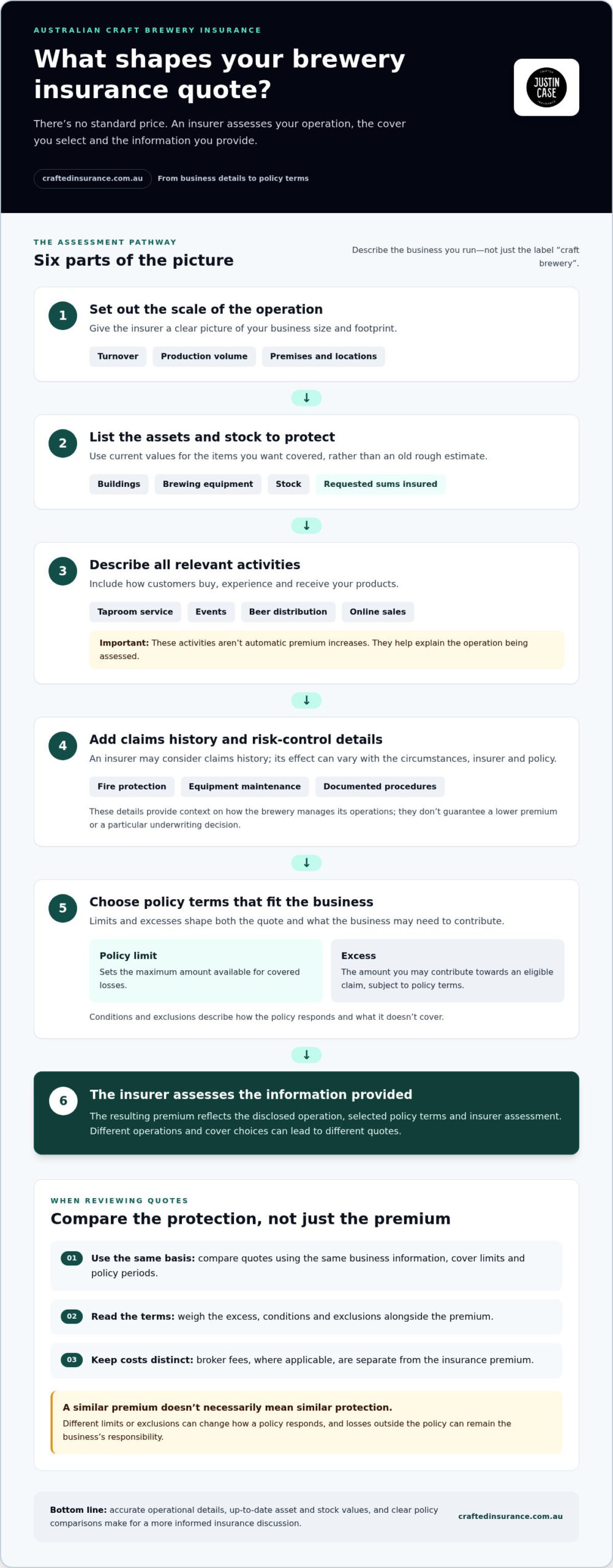
The main influences on a brewery premium are the scale of the operation, the assets and stock to insure, the activities carried out, and the policy terms selected. Insurers assess the business you describe, not just its brewery label. A production-only site and a brewpub may share a passion for good beer, but their day-to-day activities can present different exposures.
When considering craft brewery insurance cost Australia 2026, separate what you can manage from what you need to disclose accurately. You can review risk controls, choose limits that suit your business and keep asset values current. The facts of your operation need to be described as they are. Clear, complete details help an insurer assess the risk presented.
How brewery size, assets and activities affect a quote
Useful details may include turnover, production volume, premises and business locations. The value of buildings, brewing equipment and stock also matters when you’re seeking cover for them. Set requested sums insured against the assets and stock you want the policy to protect, rather than relying on a rough figure from an old estimate.
Describe the whole operation. Include taproom service, events, beer distribution and online sales where relevant. These activities aren’t automatic premium increases. They explain what the business does, so the insurer can assess the operation against the cover requested. For general background on how insurance works, the Australian Government’s How Insurance Works in Australia guidance is a useful starting point.
How claims history, limits and risk controls matter
An insurer may consider claims history as part of its assessment. Its effect can vary with the circumstances, the insurer and the policy. Limits and excesses also shape the quote. A higher limit can mean more protection for a covered loss, while an excess affects what the business would contribute towards an eligible claim. Weigh both against the risk your business can retain.
Risk controls add useful context. Keep details of fire protection, equipment maintenance and documented procedures organised. These measures don’t guarantee a lower premium or a particular underwriting decision, but they give the insurer a clearer account of how the brewery manages its operations.
- Business scale: turnover, production volume and premises.
- Assets: buildings, equipment, stock and requested sums insured.
- Activities: taproom service, events, distribution and online sales.
- Policy choices: selected limits, excesses and other terms.
Insurer appetite and policy wording vary, so the same detail may be viewed differently across quotes. Crafted Insurance specialises in Australian craft beverage businesses and can help translate your operations into a clearer insurance discussion. A specialist brewery insurance review can help identify the risk details to organise before you compare options.
How to compare craft brewery insurance quotes beyond the premium
Put each quote on the same footing before comparing prices. If a quote uses different business details, requested sums insured or policy periods, its premium may reflect a different risk or level of protection. A side-by-side review can reveal those gaps before a lower figure starts looking like a bargain.
Which policy details deserve a side-by-side check?
Start with the protection relevant to your operation. Depending on what’s quoted, that may include property, equipment, stock, liability or business interruption provisions. Don’t assume every policy includes each type of cover. Check the schedule and wording to see what’s offered and whether it fits your brewery’s needs.
Use a simple comparison table and fill it in from the documents, not memory.
| What to compare | Quote A | Quote B | What to check |
|---|---|---|---|
| Business details | Record details | Record details | Do both describe the same production, sales, service and distribution activities? |
| Cover and limits | Record cover and limits | Record cover and limits | Are relevant property, equipment, stock, liability and business interruption provisions addressed, and are the limits comparable? |
| Excesses | Record each excess | Record each excess | What amount would the business contribute towards an eligible claim? |
| Exclusions and conditions | Note key wording | Note key wording | What restrictions or requirements could affect the cover? |
| Policy period | Record dates | Record dates | Do the quotes cover the same period? |
How to spot a price comparison that is not like-for-like
Look for differences hidden behind similar headings. One quote may use different sums insured, limits, excesses or exclusions, or describe the brewery’s activities differently. Check that details such as taproom service, events, online sales and distribution match the business being insured. Even a small omission can make the comparison less useful.
Read the policy wording alongside the quote. It explains how cover applies, including conditions and exclusions. A listed cover type or limit doesn’t, by itself, explain how a particular loss or activity will be treated. For wider Australian industry context, the Insurance Council of Australia provides information on Australian General Insurance Industry Standards.
Premium alone can’t measure insurance value. Compare what each policy covers, its limits and excesses, and the exclusions and conditions that shape its response. That’s especially useful when reviewing craft brewery insurance cost Australia 2026. Once the business details and policy periods line up, you can judge whether a price difference reflects a genuine difference in protection or a comparison that only looks like a match.
How to prepare for a brewery insurance quote and manage costs
A useful quote discussion starts with an honest snapshot of how your brewery operates today. Accurate details make the assessment more useful and give you a firmer basis for reviewing options. Pull the information together before requesting or renewing cover.
Information to gather before discussing cover
Work through this sequence and keep supporting records close by. Clear, current information is more useful than dressing up the business.
- Describe the operation. Note turnover, production volume, premises and any business locations. Include changes since the last review.
- List assets and stock. Record brewing equipment, buildings and stock relevant to the cover you’re seeking. Use current values and flag major purchases, upgrades or changes in stock levels.
- Map your activities. Include production, sales channels, distribution, taproom or other public service, and events. Describe what happens in practice, not just what the business plans to do.
- Gather claims and risk information. Prepare claims history and outline current fire protection, maintenance routines, safety measures and documented procedures. Be ready to describe how these controls work day to day.
- Set your cover preferences. Note the limits you want to consider and the excesses the business could reasonably retain. These preferences make quote comparisons more meaningful.
Good risk controls give an insurer useful context about how you manage the operation. They don’t guarantee a lower premium or a particular outcome. The insurer still assesses the information and terms for the quote.
Practical ways to avoid paying for the wrong fit
Keep declared asset values and operating details current as your brewery grows or changes. A new canning line, more stock, online sales or a taproom can alter the picture presented at renewal. Accurate updates help you compare a current quote with one based on the same version of your business.
Review limits and excesses against the losses your business could absorb. A higher excess may change the premium, but it also affects what you would contribute towards an eligible claim. Don’t remove relevant cover simply to chase a lower quoted price. First understand what protection would be lost and whether the remaining terms still fit your needs.
For craft brewery insurance cost Australia 2026, preparation won’t produce a universal price, but it can make the quote discussion clearer and the options easier to compare. Crafted Insurance specialises in craft breweries, distilleries and brewpubs, helping translate production, sales and public service details into an insurance discussion. Once your information is organised, request a specialist brewery insurance review.
Get a tailored Australian craft brewery insurance review
There’s no off-the-shelf answer for every brewery. Crafted Insurance is a specialist Australian broker for craft breweries, distilleries and brewpubs, with an approach tailored to different operation sizes. Its specialist focus helps turn the details of your business into a clearer insurance discussion, rather than treating every brewery as if it runs the same way.
Production is only part of the picture. A review can also account for how you sell your products, whether you serve the public, and the assets and risks connected with those activities. A brewery that supplies other businesses has a different operating picture from one that also runs a taproom or hosts events. The aim is to understand your circumstances and consider suitable insurance options, subject to insurer terms and policy wording.
What specialist brewery insurance support can help you assess
A review can bring your operations, assets and risk information together. Crafted Insurance advertises a free insurance risk audit to help identify exposures to discuss and areas that may need closer attention. It’s a practical way to make the risk conversation specific to your brewery, not a promise of particular cover or a particular claim outcome.
Policy terms matter. Cover depends on the insurer, the wording and your business circumstances. A specialist broker can help explain how those terms relate to the operation you’ve described and provide claim advocacy if you need to navigate a claim. Advocacy is support through the process, not a guarantee of the insurer’s decision.
Take the next step towards a clearer insurance decision
Bring the essentials to the conversation: current business and activity details, updated asset and stock values, and relevant claims information. Include changes to production, sales, public service or distribution. A clear picture gives the review a useful starting point and grounds the quote discussion in how the brewery operates now.
Compare options on more than the premium. Look at the cover offered, limits, excesses, exclusions and conditions, and consider whether they fit the risks you want to address. If a term is unclear, get help understanding how it applies before deciding. You don’t need to untangle the fine print alone.
For a clearer view of craft brewery insurance cost Australia 2026, a tailored review can connect your operation with the cover being considered. Gather your details, bring your questions and talk to Crafted Insurance about your brewery.
Make your next insurance review count
Your brewery won’t stand still. New equipment, changing sales channels or a shift in how you serve customers can all be good reasons to revisit your insurance. Keep your business information current and check that the cover you’re considering still fits the way you operate.
For a clearer view of craft brewery insurance cost Australia 2026, Crafted Insurance brings specialist knowledge of Australian craft beverage businesses to the discussion. The business states it has a decade of experience, offers an advertised free insurance risk audit and provides claim advocacy. That support can help you examine exposures and make informed decisions, while policy terms and insurer decisions remain specific to your circumstances.
Ready to take the next step? Talk to Crafted Insurance about your brewery and start a practical conversation about your insurance needs. You’ve got a brewery to run. Get the insurance discussion moving, then get back to the work you love.
Frequently Asked Questions
How much does craft brewery insurance cost in Australia in 2026?
There’s no single premium that fits every brewery. Your craft brewery insurance cost Australia 2026 depends on the operation, the cover requested and the insurer’s assessment. Treat any early figure as an estimate, not a confirmed renewal cost. Build your forecast around the quote’s payment schedule and review it when your business, assets or activities change.
Can a small or newly opened craft brewery get insurance?
Yes, a small or newly opened brewery can seek insurance, but the options depend on its circumstances and the insurer’s assessment. A start-up can prepare a clear picture of its planned production, premises, equipment, opening timeline and sales channels. If it has no claims history, say so rather than leaving the section blank. Include leased equipment or shared premises in the details you provide.
Is brewery equipment automatically covered by business insurance?
No, don’t assume brewing equipment is automatically insured under a general business policy. Check the policy schedule and wording for the equipment insured, applicable limits, excesses and any conditions or exclusions. Keep an equipment register with descriptions, values and whether items are owned or leased. This makes it easier to spot missing or outdated details in the insurance documents.
Can brewery insurance cover beer sold at events or through distribution?
It may, depending on the activities disclosed and the policy terms. Tell the insurer or broker whether you sell through events, taprooms, wholesalers or other distributors, and whether those arrangements change during the year. For example, if your brewery adds a regular event stall, include that activity in the insurance discussion. Check the wording for how the policy responds to the activities and products described.
What happens to brewery insurance when the business expands?
Expansion can change the information an insurer uses to assess the operation. Before adding a taproom, buying a larger production line or starting a new sales channel, review the policy and its notification requirements. Note what’s changing, when it begins and which assets or activities are affected. This gives your broker a clear basis to explain whether the current arrangements need review.
How often should a brewery review its insurance cover?
Review your cover at renewal and whenever a business change could affect its risk profile. A new site, equipment purchase, higher stock levels or a shift from wholesale to direct sales are useful prompts. Keep a running record rather than relying on memory at renewal time. Check that asset values, business activities and limits still reflect the operation, then discuss relevant updates with your broker.