
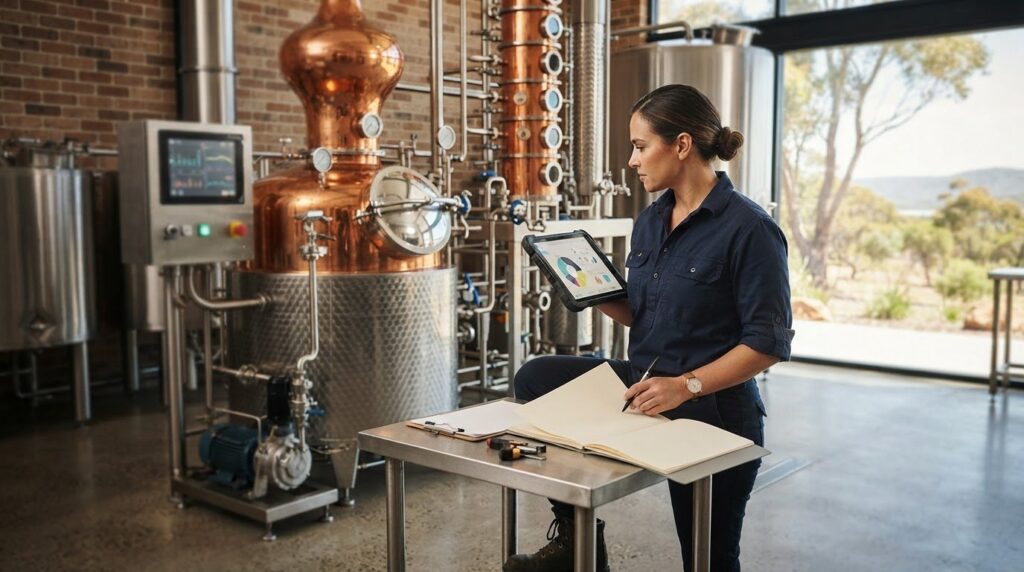
What happens to production if a specialist still fails mid-run, and can your insurance records clearly describe what’s been damaged? Distillery equipment insurance starts with more than a list of machinery. It means understanding what each asset does, how it’s valued and what its loss could mean for your operation.
Stills, condensers, pumps and control systems can be specialised, costly to replace and closely linked to production. Equipment cover may respond to certain losses, but it doesn’t automatically cover every repair cost, interruption or knock-on effect. The policy wording and the details of your operation matter.
This guide explains the equipment exposures Australian distillers can discuss when arranging cover, what to include in a practical plant and machinery record, and how damage could affect production, cash flow and business continuity. You’ll also learn how a specialist broker can connect your equipment details with the realities of your operation, helping you have a clearer conversation about cover before something goes wrong.
Key Takeaways
- Understand how distillery equipment insurance fits into a wider business cover arrangement, and why policy wording and asset descriptions matter.
- Separate damage to plant from the lost income and ongoing costs that may follow a production stoppage.
- Build a useful equipment record by listing assets, gathering documents and considering replacement needs.
- Record maintenance, operating roles and equipment dependencies to show how a disruption could affect production.
- A specialist broker can connect equipment details with your wider operation and help with risk assessment, cover arrangements and claims advocacy.
What does distillery equipment insurance need to account for?
A working distillery is more than a building full of machinery. Plant turns ingredients into a product, with different stages relying on different assets. Equipment therefore needs a clear place in the wider insurance conversation, alongside the premises, stock, liability and the income the business depends on.
Distillery equipment insurance is a discussion about how production assets are described and addressed within a tailored business insurance arrangement. It isn’t a promise that every machine failure or breakdown will be covered.
Policy wording, the property described as insured and the circumstances of a loss all affect how a claim may respond. If a machine is damaged, for example, its repair costs and the income lost while production is paused are separate exposures. Don’t assume one automatically includes the other.
Which assets count as distillery equipment?
Start with the equipment that makes, moves, monitors and packages your product. Depending on your process, this could include:
- Stills and related production vessels
- Fermentation vessels, pumps and transfer equipment
- Bottling machinery, labelling equipment and production controls
- Other plant used to heat, cool, measure or move product through the process
Keep production plant distinct from office contents, stock and the building itself. They serve different purposes and may be described differently in insurance documents. Each distillery has its own equipment mix, so make your list reflect your actual setup rather than relying on a generic package checklist.
Why does specialist plant need a closer look?
A machine’s name doesn’t tell the whole story. Record what it does, where it sits in the production sequence and which other processes rely on it. A pump may be one line in a spreadsheet, but if it transfers product between key stages, its role could be central to keeping a batch moving.
Specifications matter, too. A still’s design, materials and purpose can help distinguish it and inform replacement planning. For background on types of distillery stills and their materials, see the overview of still designs and construction. Your equipment list should capture the details that distinguish your plant, rather than treating every still or vessel as interchangeable.
Consider whether an asset is standard or built for a particular process, and whether another machine could perform the same job. These are practical prompts for describing your operation and its dependencies, not proof that a particular loss is covered. Clear descriptions give the wider cover discussion a more useful starting point.
What equipment-related risks and cover questions should distillers understand?
Equipment can be affected by fire, impact, water damage, an electrical fault or mechanical failure. These are examples of events to discuss, not a promise that every cause of damage or breakdown is insured. The answer depends on the policy wording, the asset description and the circumstances of the loss.
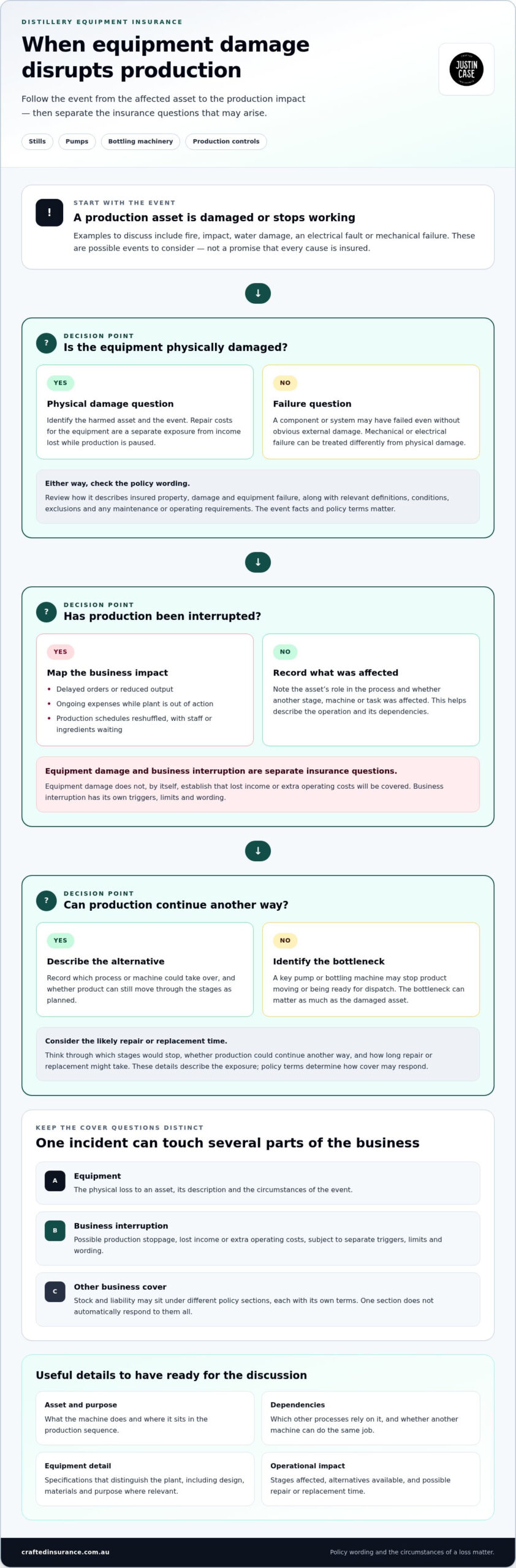
Damage to equipment and the business interruption that may follow are separate insurance questions. Damage concerns physical loss to an asset. A production stoppage can create a different financial impact, such as delayed orders, reduced output or ongoing expenses while plant is out of action.
Consider equipment cover alongside, not instead of, other parts of your business insurance arrangement. Stock, liability and interruption may sit under different policy sections, each with its own terms. One incident could affect several areas, but that doesn’t mean one section automatically responds to them all.
What happens when equipment damage stops production?
Picture a key pump or bottling machine becoming unavailable. Even if the rest of the equipment is working, product may not move through the process or be ready to dispatch as planned. Orders could be delayed, production schedules reshuffled, and staff or ingredients left waiting. The bottleneck can matter as much as the damaged asset.
Business interruption cover has its own triggers, limits and wording. Equipment damage doesn’t, by itself, establish that lost income or extra operating costs will be covered. Consider what disruption could look like in practice: which stages would stop, whether production could continue another way, and how long repair or replacement might take. These details help describe the exposure, while the policy terms determine how cover may respond.
How do repairs, breakdowns and accidental damage differ?
Physical damage usually means an item has been harmed by an event. Mechanical or electrical failure can mean a machine stops working because a component or system has failed, even without obvious external damage. The distinction may affect how an event is treated under a policy, so don’t rely on everyday labels alone.
Read the relevant definitions, conditions and exclusions in the policy wording. Check how it describes insured property, damage and equipment failure, and note any requirements that apply to maintenance or operation. A repair invoice may show what work was done, but it won’t determine how a claim is assessed. The specific facts and policy terms matter. Detailed exclusion analysis is a separate topic. The practical step here is to identify the questions to raise before arranging cover.
Crafted Insurance can help connect equipment risks with the wider operation through risk assessment. To discuss those exposures, explore Crafted Insurance’s specialist broking.
How should you value distillery equipment before arranging cover?
A useful equipment value starts with a clear picture of what you own and what it could take to get production moving again if an asset were damaged. The original purchase price is one clue, but may not reflect current value or the cost and time involved in replacing specialist plant.
For a practical distillery equipment insurance discussion, work through the details in order. Keep figures and descriptions linked to supporting records, then review how the assets are presented for insurance. There’s no single valuation basis that automatically applies to every policy.
- Identify the assets. List each item of production plant separately instead of grouping several machines under a broad label.
- Gather records. Collect purchase documents, specifications, installation details and maintenance records that help identify the equipment.
- Estimate replacement needs. Consider whether a suitable replacement is readily available or would need specialist manufacture, modification or installation.
- Review the descriptions. Check that the information accurately reflects each asset and its role, then discuss the relevant valuation basis in the context of the policy wording.
What information helps describe each asset?
Build a file for each significant item. Record the manufacturer, model, serial number, age and location where available. Add purchase documents, installation details, specifications and clear photographs. These details help distinguish similar-looking equipment and create a more useful record than a single total for “production machinery”.
Include modifications and custom features. A vessel altered to suit a particular process, for example, may not be accurately described by its original model name alone.
How can replacement needs affect the discussion?
Replacement planning involves more than asking, “What did we pay?” The purchase price records the original transaction. Current value is a different measure, while replacement needs focus on what it could take to restore the asset’s function. Those measures aren’t interchangeable, and the policy wording determines which valuation basis applies.
Think through the practical steps. Could you source a like-for-like machine, or would the replacement need custom work? Would it need installation, commissioning or connections to other plant before it could operate? Record those dependencies and any lead-time considerations you can substantiate. A replacement may be available but still not ready to run straight away.
Custom-built or modified equipment deserves especially clear documentation. Keep drawings, specifications, invoices and records of later changes together, and note what the asset does in your production process. This gives a broker a clearer view of the equipment and its place in the operation. Consider the final description and valuation basis against the policy wording, rather than relying on an asset register alone.
What records and operating details should a distillery prepare?
Good records turn a machinery list into a useful picture of how your distillery works. Keep an equipment schedule with supporting documents and maintenance history, and map how production relies on each major asset.
Accurate asset records help a broker describe your distillery’s equipment risks in the context of the operation, not just as a list of machines.
Which documents make an equipment schedule more useful?
For each significant item, gather the available information and keep it together. An organised digital folder works well if it’s easy to update and retrieve.
- Invoices, purchase records and available ownership documents
- Specifications, manuals and installation details
- Photographs showing the equipment and its identifying labels
- Service, maintenance and repair records
- Notes about previous damage, faults or modifications
Record leased, financed, borrowed or customer-owned equipment separately from assets the business owns. Note who owns it and how it’s used so those arrangements can be included in the insurance discussion. Clear paperwork doesn’t guarantee a claim will be accepted, but it can help explain what an asset is and what happened to it.
Keep the schedule current. Update it when machinery is replaced, upgraded, moved or taken out of use. A new control system or change of location can make an old entry misleading. Assign someone to review the records as part of the business’s usual equipment administration.
How does equipment fit into the whole operation?
Map the production flow, then note which major assets each stage depends on. A vessel may hold product while a pump transfers it to the next stage; a control system may manage a process that several pieces of plant rely on. These connections help show where one unavailable asset could create a bottleneck.
Add a short operating note for each key asset. Include who operates it, who handles routine maintenance and what the team does if it’s unavailable. Keep the notes practical:
- Identify the production stage and the equipment it depends on
- Note backup equipment or a manual alternative, if available
- Describe any external production arrangement, if relevant
- Record which orders or activities could be delayed by a stoppage
This isn’t a full risk audit. It’s a snapshot of the links between plant, people and production. That context makes distillery equipment insurance discussions more specific and gives you a record to revisit as the operation changes.
To connect your equipment records with the wider operation, arrange a specialist insurance risk review with Crafted Insurance.
How can a specialist broker help with distillery equipment insurance?
A specialist distillery insurance broker can connect the details of your plant with the way your distillery operates. That means looking beyond an asset schedule to understand what each item does, how production depends on it and what a disruption could affect across the business.
Crafted Insurance assesses operational risks and arranges tailored insurance cover for Australian craft beverage businesses. It also provides claims advocacy and ongoing risk management. The broker helps shape the insurance conversation and support you through it, but doesn’t act as the insurer or promise a particular outcome.
What does an equipment-focused insurance conversation involve?
Your asset schedule gives the conversation a practical starting point. Use it to explain each asset’s function, specialist features and potential replacement needs. Then connect those details to the wider operation, including stock, premises, liability and the possible financial impact of interrupted production.
- Identify which equipment is central to each production stage.
- Explain custom features, dependencies or replacement considerations.
- Discuss how damage could affect stock, orders and other business activities.
- Review how the proposed insurance arrangement describes the assets and related exposures.
This joined-up view avoids treating machinery as an isolated list. A piece of plant may be part of a chain involving other equipment, stored product and planned output. Describing those connections helps a broker present the operation’s exposures clearly when arranging cover.
Keep the limits clear, too. The insurer’s terms, conditions and policy wording determine what cover applies and how a claim may respond. A broker can help explain the arrangement and advocate for you during a claim, but can’t guarantee that a loss will be covered or paid.
What is a useful next step for your distillery?
Bring your asset schedule, supporting records and a simple outline of your production process to an insurance discussion. You don’t need a perfect document to begin. A working list of the main assets, their roles and known dependencies can focus the conversation and show where more detail would help.
Crafted Insurance offers a free insurance risk audit. Use it to discuss your business exposures, including how equipment fits into the wider operation. An audit is a risk review, not a guarantee of cover or claim payment.
To talk through your distillery’s equipment exposures, arrange your free insurance risk audit with Crafted Insurance.
Make your next equipment review count
Your distillery changes as it grows. New plant, process adjustments and updated production plans can all shift what equipment does for the business. Make reviewing those details part of your regular planning, not a job left until machinery is damaged or cover comes up for renewal.
Regular reviews help keep your records relevant and give you a chance to discuss how distillery equipment insurance fits the operation you run now. Crafted Insurance is an Australian specialist broker for craft distilleries and other craft beverage businesses. Its work includes risk management and claims advocacy, alongside arranging tailored insurance cover.
Put your current asset information together and discuss the exposures around it. Crafted Insurance offers a free insurance risk audit to review business risks, without promising a particular insurance outcome.
Arrange your free insurance risk audit and take a clearer next step for your distillery.
Frequently Asked Questions
Is specialist distillery equipment automatically covered by business insurance?
Not necessarily. A broad business policy may include property cover, but that doesn’t mean every still, control panel or transfer pump is insured. With distillery equipment insurance, the schedule and wording should identify the actual plant and relevant causes of loss. Compare descriptions with the equipment on site, including recent additions. If an item is missing or grouped too broadly, discuss updating the record rather than relying on assumptions.
Can distillery insurance cover leased or financed equipment?
It may be possible to arrange cover that reflects leased or financed machinery, but the policy wording and each party’s interest matter. A finance agreement, for example, may set out who owns the equipment and who must insure it. Keep that agreement with your asset records, and note any responsibility for damage or repairs. Don’t assume a policy covering equipment owned outright treats other ownership arrangements in the same way.
Does equipment insurance cover machinery while it’s being installed?
Don’t assume cover for operating machinery automatically applies during installation. The equipment may face different exposures while it’s being transported, lifted, tested or commissioned. The policy, project arrangements and the point at which responsibility begins all matter. Keep contracts, delivery records and handover documents together. If installation involves different stages or parties, record the dates and who is responsible at each point for the insurance discussion.
Can second-hand distillery equipment be insured?
Second-hand machinery can be included in an equipment insurance discussion. Make its history easier to understand by keeping sale documents, available service records and photographs from when it was acquired. Note any refurbishment, changed components or known faults. For example, a used bottling line with replaced controls may need a more precise description than its original model name. Policy terms and the relevant valuation basis determine how it’s treated.
Does equipment insurance cover machinery while it’s being transported?
Cover during transport may differ from cover at your distillery, so don’t assume machinery is protected away from the premises. Consider equipment travelling to a repairer, moving between sites or arriving after purchase. Keep delivery or repair paperwork and record the journey’s purpose and timing. The policy wording and circumstances of the trip affect how cover may respond, including who arranged the transport and when the equipment was in their care.
Will insurance pay to repair or replace damaged distillery equipment?
That depends on the insured event, the asset description, policy wording and applicable settlement terms. Repair may be considered where the equipment can be restored, while replacement may be relevant if it can’t. Neither outcome is automatic. Keep a technician’s report, repair quote and photographs of the damage with the asset records. A broker can help explain the claims process and advocate for you, but can’t guarantee the claim’s outcome.
Can gradual wear and tear lead to an equipment insurance claim?
Gradual deterioration through use may be treated differently from sudden damage, but the policy’s definitions and exclusions determine how a particular event is assessed. If a machine has shown warning signs, record what happened, when it was noticed and any maintenance carried out. Be accurate when discussing the issue. For more detail on limits and exclusions, read the dedicated distillery insurance exclusions article and your own policy wording.