

Could your distillery insurance respond differently to a fire in the still room than to an incident during a tasting? Distillery insurance exclusions vary between policies, and a gap can sit in wording that seems routine at first glance.
It’s understandable if the fine print feels hard to untangle. Distilling brings together production, stored spirits and public-facing activities, so exclusions, limits and conditions can affect different parts of your operation. Details that seem minor may matter when a claim is assessed.
This guide explains how exclusions work and where distillery-specific gaps may appear. You’ll learn which policy documents to read, how to compare the wording with your activities and what questions to raise before you need to claim. Crafted Insurance specialises in Australian craft beverage businesses, helping distillers consider insurance in the context of how they operate. You don’t need to become a fine-print expert overnight. Start by knowing what to look for and when specialist guidance can make the wording clearer.
Key Takeaways
- Distillery insurance exclusions vary between policies, so read the wording alongside your schedule and endorsements.
- Look closely at terms covering gradual damage, maintenance, contamination, product issues and changes to your operation.
- Compare possible incidents with the relevant wording, but remember examples can’t determine whether a real claim is covered.
- Before renewal, gather your policy documents, map your activities, flag unclear terms and record questions to resolve.
- A specialist broker can help relate exclusions, limits and conditions to your declared activities and assets.
Distillery insurance exclusions: why the small print matters
A policy can sound broad, yet specific wording still shapes how it responds when you make a claim. That’s why distillery insurance exclusions deserve a careful read before something goes wrong. A clause may remove or restrict cover for a particular circumstance, type of loss or activity. Its effect depends on the exact wording and what happened.
Consider the operation behind the paperwork: production, storage, equipment and any public-facing activities. A policy description alone won’t explain how every scenario is treated. The detail sits across several documents, and different terms may affect the same incident.
The schedule shows what was arranged; the full policy wording explains how that cover works, so read them together. The schedule sets out selected cover and details such as limits or excesses. The wording explains the terms, exclusions and conditions that apply. Endorsements may change or add to that wording, so include them in your review.
What does an insurance exclusion mean?
An exclusion describes a circumstance or loss the policy doesn’t cover as written, or restricts cover for it. The exact clause matters. Don’t assume a phrase has the same effect across insurers or policies.
Illustrative example only: imagine a policy contains an exclusion for damage caused by gradual deterioration. If a tank develops a slow leak and stock is damaged, that wording may be relevant to the claim assessment. This isn’t a universal exclusion, and the example can’t establish whether a real loss is covered.
Read the policy wording alongside the schedule and every endorsement. An endorsement can alter how a clause applies, add a restriction or change another part of the policy. Reading one document in isolation can leave you with an incomplete picture.
Exclusion, limit or condition: what’s the difference?
These terms do different jobs. An exclusion removes or restricts cover for a stated situation. A limit caps the amount payable under a section of cover, while a sub-limit sets a lower cap for a particular item or type of loss. An excess is the amount you’re responsible for under the policy when you make a claim.
A condition sets a requirement attached to cover. The wording may specify steps the insured must take or information that must be provided. Requirements vary, so look for the precise obligation and any wording about what happens if it isn’t met.
One incident can raise several questions. For example, damage to stock after a leak might involve an exclusion, a limit for stock, an excess and a condition about maintaining the premises. That doesn’t tell you whether a claim is covered. The answer depends on the policy documents, the facts and how the terms apply together.
There’s no single exclusion list for every Australian distillery. Wording varies by insurer, policy, endorsements and the operation insured. Check that the documents describe the activities and assets you want covered, and flag any term you can’t confidently interpret.
Which distillery insurance exclusions and restrictions deserve a closer look?
There’s no universal checklist of exclusions that applies to every distillery policy. Treat the areas below as prompts for a closer read, not proof that your policy excludes a particular loss. The exact wording determines whether an exclusion applies.
Start with the activities, property and stock your policy is intended to cover. Then look for terms that could affect each one. A restriction may sit in an exclusion, condition, definition or endorsement, so read the full wording rather than relying on a heading alone.
Production, fire and property wording
In production areas, check wording about damage that develops over time, maintenance requirements and equipment breakdown. These terms may treat sudden physical damage differently from wear, deterioration or mechanical failure. Note how the policy describes your stills, tanks and other key equipment, and what it says about repair or replacement.
Read fire-related clauses closely too. Look for wording on flammable-liquid storage, the handling of spirits and any safety conditions tied to property cover. Compare those terms with your actual arrangements, including where production happens and where alcohol is stored. This is a policy review, not a substitute for technical fire-safety advice.
Consider equipment breakdown and resulting damage separately. The wording may treat the failed equipment and damage to other property as different parts of an event. Don’t assume one clause answers both questions.
Spirits, products, visitors and interruption
Check how the policy treats stock at each stage. Look for wording on spirits in tanks or barrels, finished bottles held on site and goods in transit. Definitions, limits and exclusions may differ between these situations. Make sure the stock description reflects what you hold and where it is kept.
Product liability, contamination and product recall are separate review questions. Liability wording concerns claims arising from a product, while recall wording concerns costs associated with withdrawing or recalling it. Don’t assume one automatically includes the other. Check how the policy treats contamination, labelling issues and costs related to removing affected stock.
Consider the people side of the operation as well. If you run a cellar door, serve alcohol, host tastings or hold events, check that these activities are accurately described in the information provided for the policy. Review wording about alcohol service, visitor injury and events, including any conditions or restrictions.
Finally, review the business interruption terms. Check what must happen for cover to respond, how the policy defines an interruption, and whether it addresses access restrictions or damage at the premises. The trigger matters, not just the fact that trading stopped.
A specialist review can help connect these wording areas to your declared activities and assets. Explore specialist distillery insurance guidance to assess the fine print against the way your operation runs.
How can an exclusion affect a distillery claim?
A claim isn’t assessed on the incident alone. The policy wording, cause of loss, activity involved and available records may all matter. A single event can raise questions about an exclusion, a condition, a payment limit and the evidence needed to assess the loss.
The examples below are educational only and can’t determine whether a real claim is covered. Use them to identify the clauses and details to review in your own policy.
Three hypothetical scenarios to test against the wording
| Hypothetical incident | Wording to inspect | Information that may matter |
|---|---|---|
| A still or pump is damaged after a maintenance issue. | Check terms about equipment breakdown, gradual damage, maintenance and resulting property damage. | What failed, how the damage developed, maintenance records and any relevant inspection or repair notes. |
| Spirit maturing in a barrel is lost or damaged. | Review how the policy describes stock, spirit in storage, the cause of loss and any stock limits or valuation terms. | What was affected, where it was stored, the event that caused the loss, and records supporting the quantity and value. |
| Production stops after damage at the premises. | Read the business interruption trigger, including whether the wording requires insured physical damage and how the interruption is defined. | The damage, the period production was disrupted, and records showing the effect on trading. |
The stock example raises two separate questions: the cause of loss and the value of the spirit. The wording may address them in different places. A limit or valuation basis could affect the amount considered, while an exclusion may raise a question about the cause itself.
Why the cause, activity and records can matter
Start with what happened, then follow the relevant policy terms. If a leak developed slowly, for example, the wording about gradual damage may need attention. If a sudden equipment failure caused further damage, terms about breakdown and resulting loss may also be relevant. Describing the event can help identify which clauses to read, but it doesn’t settle the outcome.
Declared activities matter too. If your operation has changed, compare what you do now with the activities described in your policy information. A new production process, storage arrangement or public-facing event could prompt questions about whether that description still reflects the business. Keep a clear record of material changes and related communications.
Useful records can help explain the sequence and scale of an incident. Depending on the event, they might include maintenance logs, stock records, production notes, photographs or invoices. Keep documents relevant to the question, and check what your policy requires.
Reviewing distillery insurance exclusions before a claim can help you identify which wording and records may become important, without assuming how an insurer will decide. The policy and circumstances must be considered together.
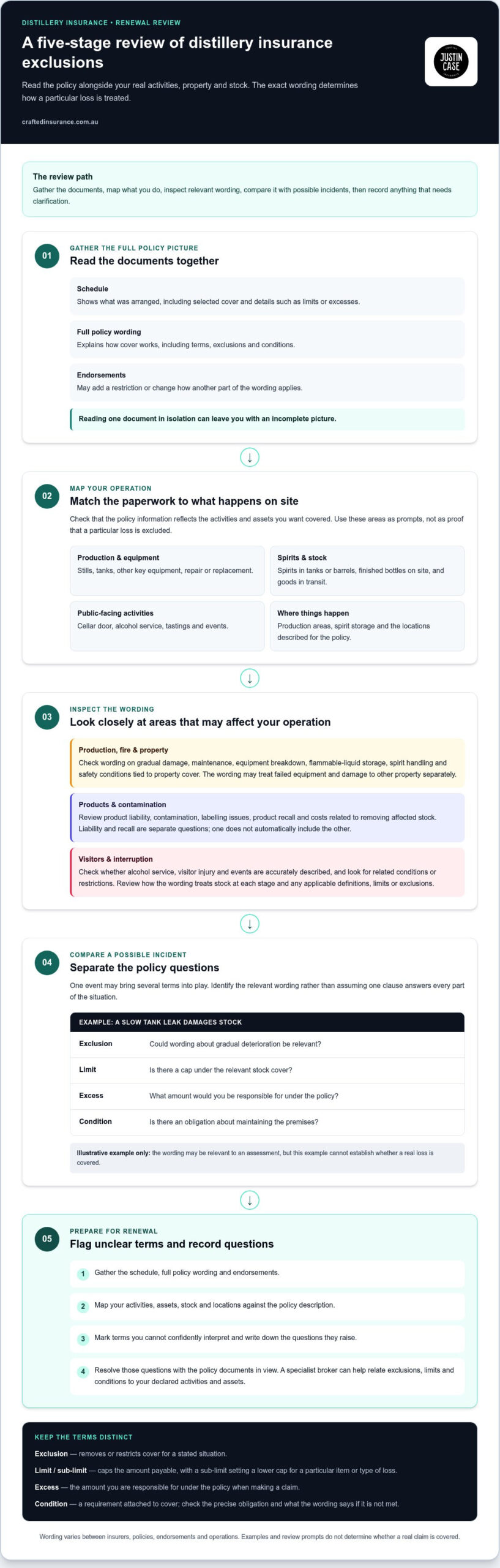
How to review distillery insurance exclusions before renewal
Renewal is a useful time to check whether your policy still reflects how your distillery operates. A four-step review can make distillery insurance exclusions easier to spot and help you prepare focused questions for your broker. It’s not about changing safe work practices. It’s about comparing the paperwork with the business you actually run.
- Collect the full set of documents. Gather your current schedule, complete policy wording, all endorsements and renewal information. Include relevant correspondence about changes or previous policy adjustments. If a document refers to another clause or definition, have that wording handy too. A partial set can make a term harder to interpret.
- Map your activities and assets. Note how you produce spirits, the key equipment you use, where stock is held and how products are sold. Include cellar-door service, tastings, events and other visitor activities. Where relevant, distinguish stock you own from contract production or other arrangements. The aim is a clear snapshot, not a technical report.
- Flag wording that needs a closer look. Mark exclusions, exceptions, conditions, sub-limits and defined terms that could relate to your operation. Beside each one, note the activity or asset that prompted the question. Don’t assume a clause applies just because its heading sounds relevant, or that an exception removes every restriction.
- Record questions and answers. Ask how the wording relates to your activities and the information declared for the policy. For example, you might ask how a stock definition treats spirit at different production stages, or what a condition requires in practice. Keep written notes of explanations and any policy changes agreed during renewal.
Build a clear picture of the operation
Be specific enough to make the comparison useful. List production methods, stills and other significant equipment, stock locations, sales channels and public-facing services. Note material changes since the policy began or the last renewal, such as a new product line, a different storage arrangement or added visitor activities. This gives your broker a current picture to compare with the wording, rather than an outdated snapshot.
Keep the information factual. If production is carried out under contract, or stock is held under a different arrangement, describe that clearly. Don’t guess at policy language. Explain what happens at the distillery and identify where the wording seems difficult to match to it.
Turn unclear clauses into useful questions
Circle unfamiliar terms and note the practical scenario you’re trying to understand. Ask which clause applies, whether an exception or condition changes its effect, and how any stated limit or sub-limit works alongside it. If an answer leads to a change, keep the updated documents and written record together. That will make the reasoning easier to follow at the next renewal.
A specialist broker can help connect policy wording with your declared activities and assets. Explore Crafted Insurance’s specialist support for help reviewing questions raised by your distillery’s operation.
Get specialist help understanding distillery insurance exclusions
Policy wording can be hard to connect with the day-to-day reality of making and selling spirits. A specialist broker can help map exclusions, limits and conditions against your declared activities and assets, then identify where the wording needs closer discussion. That means looking beyond a broad cover description to the details of production, stock, sales and visitor services.
Crafted Insurance works with Australian craft beverage businesses through risk assessment, insurance broking, claim advocacy and ongoing risk management. Risk assessment can help surface questions about how your operation is described and where policy terms may need clarification. The aim is a clearer conversation about the wording, not a promise about what a future claim will do.
What a specialist broker can bring to an exclusion review
A specialist broker can turn dense clauses into practical questions. Does the wording match how your spirit is produced and stored? Are sales, events or visitor activities reflected in the declared operation? Are there limits or conditions attached to assets that matter most to your business? These questions help focus attention on terms that deserve discussion.
If a claim arises, claim advocacy can support communication and help present relevant information. It can’t guarantee a particular decision. The insurer considers the policy wording and circumstances of the loss, so clear records and a realistic understanding of the terms remain important.
Make the next renewal conversation more useful
Bring your current schedule, full policy wording, endorsements and renewal information, along with an up-to-date outline of how the distillery operates. Prioritise clauses that could affect essential activities or valuable assets. A focused discussion is easier when you can point to the exact wording and explain the process, stock or service it relates to.
Keep a written record of the questions raised, explanations received and any changes agreed. When revised documents arrive, compare them with those notes. Check that the final paperwork reflects the agreed arrangement, and keep the updated documents together for future reference.
This process can take some of the guesswork out of distillery insurance exclusions. You don’t need to untangle every clause alone. Specialist guidance can help turn the fine print into clear questions and support informed decisions about your insurance and risk management.
Talk with Crafted Insurance about your distillery when you’re ready to discuss your operation and the policy wording around it.
Make your next insurance conversation count
Your distillery won’t stand still. New products, production changes or new ways to welcome visitors can affect what your policy needs to describe. Make reviewing distillery insurance exclusions part of your regular business planning, not just a task for renewal week.
Keep an ongoing list of operational changes and policy questions as they arise. Bring those details to a discussion with a specialist broker, who can help interpret wording against your declared activities and assets. Risk assessment and claim advocacy can support clearer conversations about potential gaps and relevant policy terms. No broker can promise how a claim will be decided, but informed questions can help you understand the arrangement you have.
Crafted Insurance specialises in Australian craft beverage businesses. Start a conversation about your distillery cover to put your policy questions in context.
A little clarity now can make the next step feel more manageable.
Frequently Asked Questions
Are distillery insurance exclusions the same across every insurer?
No. Distillery insurance exclusions can differ between insurers and policies, and endorsements may change how a clause applies. Even similar headings can have different definitions, exceptions or conditions. Compare the actual wording, not just a summary or list of cover types. Check how each policy describes stock, equipment and visitor activities, then note differences that could matter to your operation.
Can an insurer exclude a distillery activity that was not declared?
It may affect how a policy responds, but an undeclared activity doesn’t automatically settle the outcome. The policy terms, the information provided when cover was arranged or renewed, and the circumstances all matter. If you’ve added contract distilling, tastings or a new sales channel, review what was declared and what the policy says about changes. Keep a record of the activity and related communications with your broker or insurer.
Are spirits ageing in barrels automatically covered by distillery insurance?
No, don’t assume barrel-aged spirit is automatically covered just because the policy insures stock. Check how the wording defines stock and whether spirit ageing in barrels is treated differently from bottled product. Look at the insured locations, events covered, applicable limits and how stock value is worked out. A loss could raise separate questions about what caused the damage and how the affected spirit is valued.
Does business interruption insurance cover every distillery shutdown?
No. A shutdown alone may not meet the policy’s requirements for business interruption cover. The wording may set out a specific trigger, such as insured damage, and define how the interruption and loss are assessed. A voluntary closure, production delay or restricted access could raise different questions under different policies. Check the trigger and relevant exclusions before relying on this cover for a particular disruption.
Can a broker remove an exclusion from my distillery policy?
A broker can’t unilaterally remove an exclusion or guarantee that an insurer will change its terms. They can explain what the clause means for your declared operation and discuss whether alternative wording or terms can be requested from the insurer. Any change depends on the insurer’s decision and should appear in the issued policy documents. Ask for the effect of a proposed change to be explained clearly before relying on it.
What should I do if I think an exclusion may affect a claim?
Notify your insurer or broker promptly and follow the claims steps set out in your policy. Keep relevant records, such as photographs, repair documents, stock details and a clear timeline of events. Point to the clause you’re concerned about and ask how it relates to the circumstances. A specialist broker can support communication and claim advocacy, but only the policy wording and claim assessment can determine the response.