
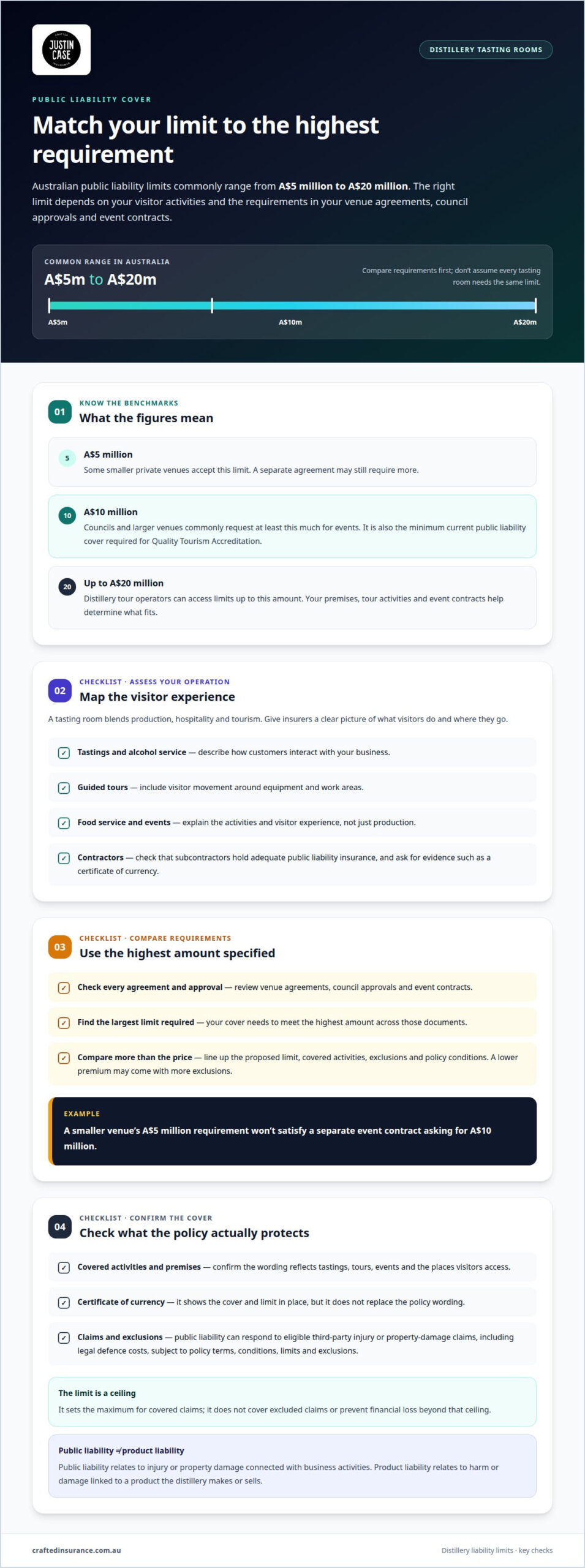
There isn’t one fixed public liability limit for every distillery tasting room. If you’re weighing how much public liability a distillery tasting room needs, common Australian cover amounts range from A$5 million to A$20 million. Councils and larger venues commonly ask for at least A$10 million, while some smaller private venues accept A$5 million.
The required limit can vary, and a venue agreement may matter as much as the risks of tastings, tours or events. The right insurance also depends on what your distillery does and how customers interact with your business.
This guide explains what public and product liability can respond to, which other covers may be relevant, and how venue and council requirements affect the limit you need. The aim is to help you assess your tasting room’s risks and keep your cover aligned with your operations.
Key Takeaways
- Match your cover to the real activities in your tasting room, from tours and tastings to food service and events.
- Public liability can help with eligible third-party injury and property-damage claims, including legal defence costs, subject to the policy wording.
- Consider how product liability, property, business interruption and other covers fit your distillery’s risks.
- Alcohol service rules vary by state and territory, so the way you serve and host visitors matters when arranging cover.
Cover for injury, property damage and legal defence costs
In Australia, public liability can respond to eligible third-party injury or property-damage claims linked to distillery business activities. A$10 million is standard for tourism businesses, while distillery tour operators can access limits up to A$20 million. Tastings, tours, events and food service all bring visitors into the risk picture. If a visitor is injured during a tour, the policy may meet legal defence costs, settlements or court-awarded damages, up to its limit and subject to the wording.
Public liability and product liability address different types of claims. Public liability concerns injury or property damage connected with business activities, such as a visitor slipping during a tasting. Product liability concerns harm or damage linked to a product the distillery makes or sells. If a patron becomes unwell after consuming contaminated spirits, product liability may be relevant. Policy terms, conditions, limits and exclusions determine how a claim is handled.
One-day public liability cover applies to the period nominated when the policy is purchased. Short-term policies may cover a set period, from a single day to a few weeks. An annual policy provides cover for a continuous twelve-month period, rather than separate cover for individual events. A small indoor seminar without alcohol and a food-and-wine festival with live music present different exposures. When arranging cover, give the insurer a clear breakdown of the event, activities and visitor experience.
Product liability and product recall cover are different. A fault in bottle glass could leave fragments in a batch and trigger a recall. Product recall cover can help protect a business against recall-related exposure, while product liability relates to third-party injury or property damage claims. Distilleries using subcontractors should ensure their contractors hold adequate public liability insurance. Ask for evidence, such as a certificate of currency, and include the contractor’s activities in the cover review. This can help identify gaps before a tour, event or production task begins.
Insurance types for craft breweries and distilleries
A tasting room combines production, hospitality and tourism, so one policy may not address every exposure. Public liability insurance can respond to eligible third-party injury or property damage claims. Product liability relates to harm or damage linked to products. Distilleries may also consider property, business interruption, workers’ compensation, management liability, cyber and product recall cover. Commercial vehicles and goods in transit may matter when deliveries or transport are part of the operation.
Tour activities affect how insurers assess a distillery’s risks. A guided production tour, tasting, food service and private event each create different visitor interactions. The public liability policy should describe the activities the business provides, not treat the venue as production-only. A broker can help map those activities to relevant cover, including how alcohol is served and where visitors move around equipment or other work areas.
Tourism accreditation can set a clear insurance benchmark. Quality Tourism Accreditation requires current public liability insurance of at least A$10 million. Public liability insurance isn’t legally mandatory for every Australian business in most cases, but accreditation, contracts or booking arrangements may make it a practical requirement. Tourism businesses should also consider whether their policy wording reflects each customer-facing activity.
Cost varies with the business’s activities, size, location, claims history and selected cover. This example isn’t a distillery-specific quote. It shows why a broker needs a clear picture of the business before assessing cover. Employers in Australia are required by law to have workers’ compensation insurance. Sole traders need a different approach, because workers’ compensation doesn’t cover sole traders or partners.
Public liability limits requested by venues and councils
In Australia, common public liability limits range from A$5 million to A$20 million. Your premises, tour activities and event contracts help determine which limit fits.
Limits for breweries, distilleries and tours
Distillery tour operators can access public liability limits up to A$20 million. Across Australia, councils and larger venues commonly request at least A$10 million for events, while some smaller private venues accept A$5 million. Breweries and distilleries hosting tastings or tours should consider the full visitor experience, not just production risks. A specialist can tailor insurance cover around those activities and protect your business from eligible claims.
Comparing quotes and choosing a limit
To compare quotes, line up the proposed limit, covered activities, exclusions and policy conditions. Then compare each figure with the requirements in your venue agreements, council approvals and event contracts. Choose a limit that meets the highest amount specified across those agreements and approvals. For example, a smaller venue’s A$5 million requirement won’t satisfy a separate event contract asking for A$10 million.
A certificate of currency shows the cover and limit in place, but it doesn’t replace the policy wording. Read the terms for the premises and activities covered, along with exclusions that could affect tastings, tours or events. A lower premium may come with more exclusions, so compare what each quote protects, not just its price. Consider whether the policy addresses the third-party injury and property damage risks created by your actual operations. The limit sets a ceiling for covered claims; it doesn’t cover excluded claims or prevent financial loss beyond that ceiling. A tailored comparison helps connect the contract requirement with the protection your distillery needs.
Alcohol service and liquor liability conditions
Serving tastings adds a liquor-service dimension to a distillery’s business insurance. The public liability limit alone doesn’t explain how an alcohol-related incident will be treated. Policy wording, declared activities and applicable liquor rules all matter. Describe how visitors receive tastings, whether service accompanies tours, and whether alcohol is served at private events. A production-only description may not reflect what happens on the premises.
Pour size matters operationally because it affects how much alcohol each visitor receives. Record the tasting format and serving sizes, and make sure the activity description reflects the service you provide. Don’t assume a tasting pour falls outside liquor rules. Rules vary by state and territory, and an exemption in one jurisdiction doesn’t establish the position elsewhere.
For example, Queensland’s tour liquor exemption is capped at 2 standard drinks per person per day. The ACT’s tour liquor exemption is capped at 2 standard drinks per person. In New South Wales, tour operators have no general liquor exemption, but a tour authorisation is available on an on-premises licence under clause 46 of the Liquor Regulation 2018. These distinctions can affect how a tasting tour may operate.
Tasmania also treats transport differently for liquor licensing: the Liquor Licensing Act 1990 treats a means of transport as premises for liquor licensing purposes. So a distillery running a tasting experience during transport needs to account for that legal relationship, not just the venue where the tour starts. Record where alcohol is served, who serves it and how tastings connect with tour activities.
Before events or tours begin, align the policy wording with the way alcohol is actually served. Clear activity descriptions help the insurer assess the exposure, while exclusions and conditions show what the cover responds to. A specialist insurance review can connect liquor service, tours and public liability without assuming every alcohol-related claim is covered. Review distillery insurance cover for a closer look at how your operations fit together.
Crafted Insurance
Crafted Insurance helps Australian craft distilleries bring production, sales and tasting-room risks into one insurance conversation. Its tailored Insurance on Tap™ packages support operations including micro and local craft distilleries, with risk management to help identify and reduce exposures.
A specialist broker can help when your tasting room adds tours, events or other activities, or when a venue requires a particular liability limit. Crafted Insurance offers a free insurance risk audit to help map activities against your cover, policy wording and business needs. It also provides claim advocacy if a claim arises.
Want to talk through cover for your distillery? Contact Crafted Insurance.
Keep your cover aligned as your tasting room grows
Your tasting room can change as your business evolves. New tour formats, private functions or a different way of serving visitors can shift the risks around your premises. Treat insurance as part of operating decisions, not a document to file away after opening. A timely review can help keep cover aligned with the experience you actually offer.
If you’re still weighing how much public liability a distillery tasting room needs, focus on the activities you run and the obligations attached to each venue or event. Then look beyond the headline limit. The policy wording needs to fit the way your business operates, so you can decide with a clearer view of what the cover does.
Crafted Insurance works with Australian craft beverage businesses on tailored insurance and risk management. Take the next step by talking with Crafted Insurance about tasting room cover. You can get the conversation moving and return your attention to the craft, the visitors and the experience you’re building.
Frequently Asked Questions
What type of insurance do I need?
A distillery needs insurance matched to its production, sales and visitor activities. A practical starting point is public and product liability, property, business interruption, workers’ compensation if you employ staff, and product recall cover. Cyber, management liability, commercial vehicle or goods-in-transit insurance may also suit particular operations. For example, a distillery shipping products has different exposures from one selling only at its own premises.
What can it cover?
Public liability may respond to eligible third-party injury or property damage claims linked to your business. For example, a visitor’s belongings might be accidentally damaged during a tasting-room activity. Product liability addresses claims connected with harm or damage caused by a product. Some policies may also cover legal defence costs. The policy wording sets out the applicable activities, limits, conditions and exclusions.
What factors affect my public liability insurance premium?
Premiums can reflect your business’s size, nature, location, claims history, risk exposures and chosen level of cover. A production site that also hosts tastings, tours and private events presents a different mix of activities from a site without public access. Insurers also assess the details provided about the operation. Clear information helps them price the risk and shape the proposed cover.
What insurance does a distillery tour business need in Australia?
A tour business should consider public and product liability, then assess property, business interruption and workers’ compensation if it employs staff. When deciding how much public liability for a distillery tasting room to carry, account for visitor activities, event agreements and the premises used. For instance, a business using subcontracted guides should consider their role in the visitor experience and their liability arrangements.
What public liability insurance limit is typical for an Australian distillery tasting room?
Common Australian public liability limits range from A$5 million to A$20 million. Choosing how much public liability for a distillery tasting room to carry starts with the requirements attached to your venue and events. Councils and larger venues commonly ask for at least A$10 million, while some smaller private venues accept A$5 million. Where agreements differ, use the highest stated limit as your benchmark.
What minimum public liability cover do Australian distillery venues need by law?
Australian law does not require public liability insurance for every business or event in most cases. A venue, council, accreditation scheme or booking arrangement may still make cover a condition of operating or participating. That’s a contractual or programme requirement, not a universal legal minimum. Before confirming an event, identify the relevant agreement and match its required limit to the policy documentation.