
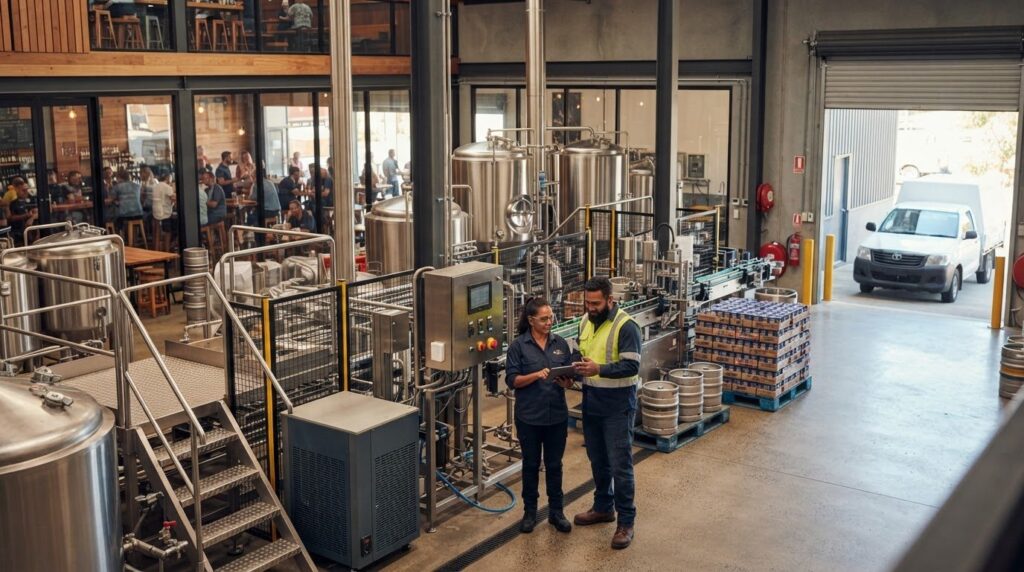
What if a failed chiller spoils a batch and leaves your brewing line idle? Brewery business insurance needs to reflect more than the building and the gear inside it. It should follow how your brewery makes, stores and sells beer, from production equipment and stock to deliveries and taproom service.
Even a small operation can face a costly interruption. The challenge is working out which policies fit your setup, which exclusions or conditions matter, and whether a change in production has left a gap in your cover.
This guide explains the main cover categories Australian breweries can discuss, the operational details to disclose and what to review as the business grows. Use it to organise your information and ask clearer questions about how policy terms relate to your production, sales and public-service exposures.
Key Takeaways
- Brewery business insurance should reflect how your operation makes, stores and sells beer, not rely on a one-size-fits-all package.
- Review cover options for buildings, brewing and packaging equipment, stock and interruptions to production.
- Map your sales channels, from wholesale to direct customer service, to identify exposures that need discussion.
- At renewal, update details about premises, equipment, stock and operational changes, then review policy wording for gaps.
- A specialist broker can help connect your brewery’s risks to suitable cover and explain policy terms.
Brewery business insurance starts with how your operation runs
Receiving ingredients, brewing, fermenting, packaging, storing and dispatching beer all involve different assets and activities. Add customer service on site, and the risk picture changes again. Brewery business insurance is best understood as a set of covers selected for your operation, not one universal policy for every producer.
The right questions depend on your premises, equipment, stock, products, sales channels and scale. A brewery focused on production and wholesale may have different priorities from one that also serves customers on site. Both should consider how damage, equipment breakdown or an incident involving another person could affect day-to-day operations.
Insurance can respond to defined events, but the detail matters. Policy wording sets out what is covered, while conditions, exclusions and limits shape how cover applies. Insurers also need an accurate description of the business. For a plain-language introduction to insurance principles and terminology, see Understanding Insurance.
Insurance cover responds to specified risks; risk prevention works to reduce the chance of those risks causing harm. Both matter. A policy doesn’t replace safe work practices or regular equipment care.
Which parts of a brewery can create business exposure?
Brewing brings process equipment and production into focus. Packaging adds machinery and materials. Storage raises questions about buildings, finished stock and ingredients, while deliveries bring goods and vehicles into the picture. If customers visit the site, their presence creates separate third-party considerations.
Consider a small brewery that starts with a compact brewing setup and sells wholesale. As it grows, it might add a packaging line, hold more stock or begin regular deliveries. Those changes can affect the value of property and equipment at risk, the amount of stock held and the way the business interacts with customers or other parties. The operational details matter more than the label “brewery”.
Why a general business policy may need a closer look
A general business policy may suit some activities, but its wording and your circumstances determine how it applies. A clear description of the business helps insurance discussions reflect what actually happens on site, including brewing, packaging, storage, sales and customer service.
That description can become outdated as the business changes. Adding a taproom introduces customer-facing activity. Starting wholesale sales changes how beer moves beyond the premises. Installing new equipment changes the assets to consider. These changes don’t automatically mean existing cover is unsuitable, but they are good reasons to review the details rather than assume the original arrangement still fits.
Keep a simple operational map: note what happens at each stage, which assets support it, where stock is held and how customers receive the product. This gives your broker a practical starting point for discussing cover and checking how policy terms fit the brewery.
What brewery business insurance can cover: the main policy categories
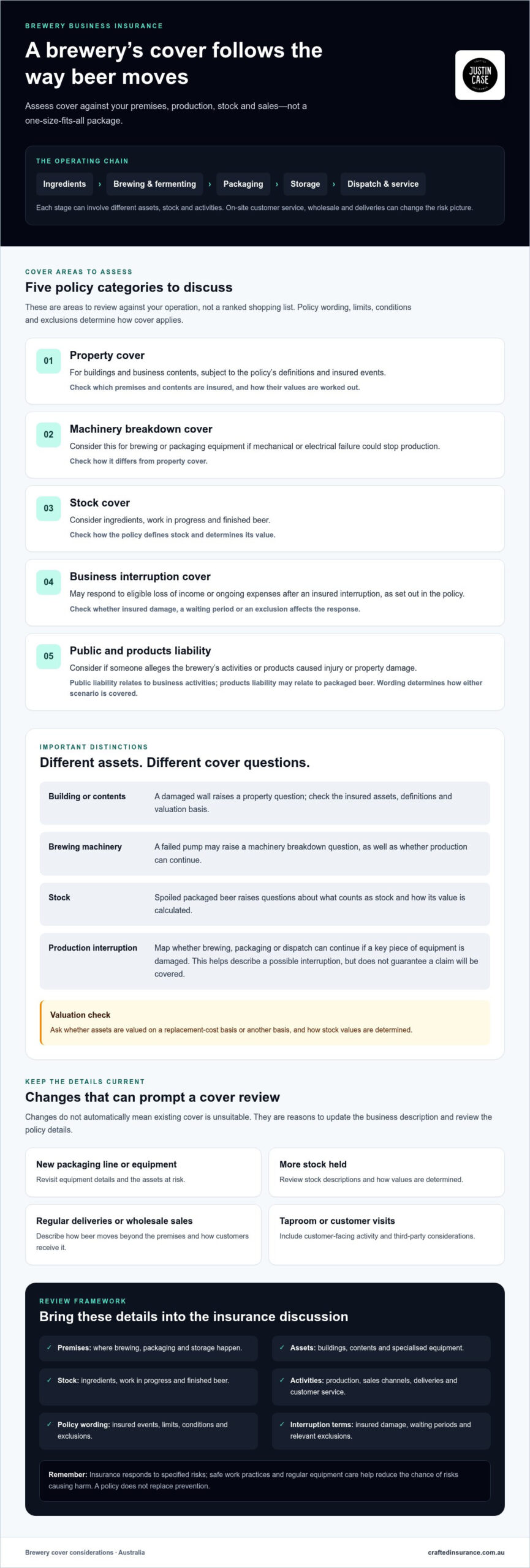
No single package suits every brewery. Assess these cover categories against your operations rather than treating them as a shopping list. Policy wording, limits, conditions and exclusions determine how a policy responds, so compare the actual terms with the assets and activities you need to protect.
For an Australian overview of common business policies, Australian Business Insurance Types explains how cover can address different business risks. For a brewery, discussions often include:
- Property cover for buildings and business contents, subject to the policy’s definitions and insured events.
- Machinery breakdown cover to consider for brewing or packaging equipment if mechanical or electrical failure could stop production. Check how it differs from property cover.
- Stock cover for ingredients, work in progress and finished beer. Check how the policy defines stock and how its value is determined.
- Business interruption cover for eligible loss of income or ongoing expenses after an insured interruption, as set out in the policy.
- Public and products liability to consider if someone alleges the brewery’s activities or products caused injury or property damage.
Property, equipment, stock and business interruption
Buildings and contents aren’t the same as specialised brewing machinery or stock. A damaged wall, a failed pump and spoiled packaged beer raise different cover questions. Check which assets are insured, how their values are calculated and whether the policy uses replacement cost or another valuation basis.
Interruption cover has its own detail. A payment may depend on insured damage and other policy terms, while a waiting period or exclusion may affect the response. Map the production chain: if a key piece of equipment is damaged, can brewing, packaging or dispatch continue? This helps you describe the potential interruption, but it doesn’t guarantee a claim will be covered.
Liability and people-related cover considerations
Public liability generally relates to allegations of injury or property damage connected with business activities. For example, a visitor might allege they were injured at a brewery event. Products liability may be relevant if a customer alleges a packaged beer caused injury or damaged property. The policy wording determines whether and how either scenario is covered.
If you employ staff, workers compensation requirements apply under schemes that vary by state and territory. Check current official guidance for the jurisdictions where your employees work, and consider how employee-related cover fits alongside your other policies.
In short: asset cover concerns things you own, liability cover concerns claims made against the business, and interruption cover concerns eligible disruption to trading. A specialist broker can help assess how these discussions fit your brewery. Explore brewery insurance support.
Match brewery insurance to production, sales and distribution
The same brewery can face a different risk picture as it grows. A production-only setup, a wholesale operation and a brewery selling directly to customers don’t move beer, equipment or people in the same way. Use the activity map below to identify cover categories to discuss in light of your actual operations.
Production and packaging: Brewing or packaging equipment could be damaged or unavailable. Discuss property and machinery breakdown cover, and whether interruption cover responds to eligible damage that disrupts production.
Storage: Ingredients, work in progress and finished beer may be held on site. Discuss how property or stock cover defines the items insured and values them.
Wholesale supply: Beer supplied to retailers or hospitality businesses moves beyond the brewery. Discuss product liability and how stock is treated while stored or in transit.
Deliveries: If your team delivers, or a third party handles transport, disclose the arrangement. Discuss relevant vehicle, goods-in-transit or liability exposures.
Direct sales and events: Customer visits, tastings or off-site events bring public-facing activity into the picture. Discuss public liability and how the policy describes those activities.
Contract brewing: If you brew for another business, explain who owns ingredients and finished stock, and who handles packaging, storage and delivery. Those responsibilities can shape the cover discussion.
These are discussion points, not a ready-made package. The Independent Brewers Association of Australia provides industry context for independent brewers. Your own operating details help make insurance discussions specific to your business.
Production, storage and equipment dependencies
If a key piece of brewing equipment is damaged, production may slow or stop. Packaging schedules can shift, and ingredients or work in progress may be affected. The impact depends on how your process is set up and what the policy says about the event and resulting interruption.
Keep an asset list with current equipment values, maintenance arrangements and notes on which production stages rely on each item. This record helps explain what’s at stake and supports a review if you add machinery, change production volume or move premises. Keep relevant maintenance and safety records together as well.
Wholesale, deliveries and customer-facing sales
Wholesale sales can involve supply agreements, storage away from your premises and delivery through your own fleet or a logistics provider. Direct sales may mean customers visit your site or meet your team at an external event. Each arrangement changes who handles the product and where interactions take place.
Disclose your sales channels, third-party logistics, event activity and any on-site service that forms part of your brewery’s work. If customer service is a major part of the operation, brewpub activities raise additional questions. Describe those activities clearly rather than relying on a production-only description.
Review your cover when production volume rises, premises change, new equipment comes online or distribution expands. Brewery business insurance should keep pace with the operation you’re running now, not just the one you started with.
Review brewery insurance with a practical disclosure and renewal checklist
Renewal is a useful time to check that your insurance still reflects the business you run today. Gather current information, flag changes and work through the policy wording before discussing possible gaps. Clear records make the review more useful.
- Map your activities. Note what happens at each premises, from brewing and packaging to storage, deliveries and customer service.
- Gather your records. Bring together equipment and stock information, asset records and relevant contracts.
- Identify changes. List new premises, equipment, products, sales channels, production arrangements or changes in scale since the last review.
- Review the wording. Check what the policy says about covered events, exclusions, conditions, limits and excesses.
- Discuss possible gaps. Compare those terms with your current activities and clarify unclear points with your broker.
Information to gather before reviewing cover
Start with the essentials: premises, brewing and packaging processes, key equipment, stock held and how beer reaches customers. Include wholesale arrangements, direct sales and any third-party storage or delivery that forms part of the operation.
Bring relevant contracts and a current asset record. Separate confirmed figures from estimates, and note where information needs updating. If equipment values or stock levels fluctuate, explain how you recorded them and what period they represent. The goal is a clear, honest picture, not a perfect spreadsheet.
Questions to resolve in the policy wording
Look beyond the policy summary. Read the full wording to understand which events can trigger cover, what exclusions apply and what conditions require action. A certificate or summary can be handy for reference, but it doesn’t replace the policy detail.
Check the limits and any sub-limits against the assets or activities they apply to. Understand the excess, which is the amount you may need to contribute towards a claim, and ask how it applies in different circumstances. For interruption cover, review the trigger, any waiting period and the terms used to calculate a loss. Don’t assume similar policy labels mean identical protection.
As you review brewery business insurance, write down questions in plain language: “What would need to happen for this section to respond?” and “Does this condition apply to our current process?” A specialist broker can explain policy terms and discuss how they relate to your brewery’s operations.
For a focused review of your brewery’s insurance and risk considerations, explore brewery risk support.
How a specialist broker can help arrange brewery business insurance
A brewery’s insurance questions can span production, stock, wholesale supply and customer service. A specialist broker helps bring those moving parts together by assessing how the operation runs, discussing suitable insurance options with insurers, comparing policy terms and explaining where wording or limits may need a closer look.
This can be useful when a brewery has outgrown its original setup. A broker familiar with craft beverage businesses can connect practical details, such as production processes and sales channels, to the insurance discussion. The aim is to help you make informed choices, not to push a standard package that ignores how your brewery works.
What specialist support can look like
The discussion can start with your premises, equipment, stock, production activities and how beer reaches customers. From there, a broker can help identify which cover categories to explore and explain differences between policy options in everyday language. This makes it easier to focus on terms that matter to your operation, rather than comparing policy names alone.
Support can continue after cover is arranged. As your business changes, ongoing reviews can bring new equipment, higher production, different sales channels or customer-facing activities back into the insurance discussion. A broker can also provide claim advocacy, helping you understand the process and communicate with the insurer if an incident occurs. The insurer makes underwriting and claim decisions under the relevant policy terms. Advocacy is support, not a promise that a claim will be accepted or paid.
Crafted Insurance is a specialist Australian broker focused on craft beverage businesses, including breweries. The business states it has a decade of experience working in this field. That focus helps keep insurance conversations grounded in brewery operations, not just broad business categories.
A straightforward next step for Australian brewery owners
Start with the facts you already have. Outline what happens at the brewery, the equipment and stock involved, how you sell or distribute beer, and what cover you currently hold. You don’t need to have every policy question solved before starting the conversation.
Crafted Insurance offers a free insurance risk audit as a starting point for reviewing your brewery’s risks and current insurance arrangements. The audit can organise the discussion around your business and highlight questions to explore. Any insurance options remain subject to insurer assessment and policy terms.
To start a focused conversation about your operation, arrange a brewery insurance risk audit with Crafted Insurance.
Make your next brewery move with confidence
Growth often comes one decision at a time: a new product, a bigger production run or another way to reach customers. Build insurance into those discussions alongside practical questions about space, equipment and the effect of the change on your team. Reviewing the implications early helps surface questions while there’s still room to adjust plans.
Brewery business insurance should keep pace with the brewery you’re building. Treat each change as a prompt to review whether your arrangements still match the operation, rather than waiting until renewal. That doesn’t remove uncertainty, but it can make decisions clearer and help you focus on brewing and serving your customers.
Ready to review what’s changing and what you want to protect? Book your free brewery insurance risk audit with Crafted Insurance.
Frequently Asked Questions
Is brewery business insurance legally required in Australia?
There isn’t one insurance package that every Australian brewery must hold by law. Requirements depend on your activities and circumstances. For example, workers compensation obligations are handled through state and territory schemes. Other insurance may be required by a lease, lender or customer contract rather than legislation. Check current official guidance for your situation, and distinguish legal obligations from cover you choose to manage business risks.
Does brewery insurance cover product recalls?
Not necessarily. Product recall expenses aren’t automatically covered by every brewery insurance arrangement. A policy’s response can depend on why the recall happened, its exclusions and whether relevant cover has been arranged. Product liability and product recall cover address different potential costs, so don’t assume one includes the other. Keep clear records of products and distribution, then review the recall wording with your broker.
Can a brewery insure its brewing equipment and stock?
Equipment and stock may be insured under relevant property or contents arrangements, depending on the policy wording. Consider a new canning line: its value, location and the events that could cause damage all affect the cover discussion. Ingredients, beer being produced and finished stock may also be treated differently. Keep purchase records and stock valuations up to date, and check for exclusions or sub-limits that could affect specific items.
How much does brewery business insurance cost in Australia?
There’s no single price for brewery business insurance. The premium can reflect your activities, premises, equipment and stock values, turnover, claims history, chosen limits, excesses and policy terms. A production-focused brewery and one with several sales channels may present different risk information. Share accurate details before comparing options, then ask your broker to explain what assumptions and cover are reflected in each quote.
Does brewery insurance cover business interruption?
It may respond to an interruption caused by an insured event, but the policy’s trigger and terms decide whether cover applies. For example, a temporary shutdown after property damage may be treated differently from a delay caused by a supplier problem. Check waiting periods, exclusions, the indemnity period and how any loss is calculated. Don’t assume every slowdown or equipment fault qualifies.
What should I tell my broker when arranging brewery insurance?
Describe the brewery as it operates now, including production methods, products, premises, staff, sales channels and delivery arrangements. Mention contract brewing, events or customer service if they’re part of your business. Also flag upcoming changes, such as installing a new line or moving stock off site. Share current asset records and relevant contracts, and distinguish confirmed details from estimates.
Can a brewery change its insurance as the business grows?
Yes, insurance arrangements can be reviewed as your business changes. Tell your broker if you add equipment, increase production, change premises or start selling through a new channel. For instance, moving from wholesale-only sales to serving customers on site changes the activities to discuss. Any adjustment depends on the insurer’s assessment and agreed policy terms, so don’t assume existing cover automatically extends to new operations.