
Many brewery insurance mistakes start with small details that no longer match how the business operates. A new taproom, upgraded equipment or a change in how you sell and distribute beer can alter your risks, while your policy information stays the same.
You’ve got a brewery to run, so reviewing insurance can easily slide down the list. But it’s worth knowing whether your declared activities, property values and cover details are current, and what your policy says about the risks your business faces.
This guide looks at common assumptions that can leave an Australian brewery exposed. You’ll see which business changes deserve a closer look, why cover suited to a restaurant may not reflect brewing operations, and how equipment, stock and sales details can affect the insurance review.
Use the practical checks below to identify questions for your broker or insurer, without getting buried in policy fine print.
Key Takeaways
- Brewery insurance mistakes often begin with assumptions. A policy label alone won’t tell you how cover applies to your operation.
- Use changes in turnover, stock, equipment, premises use and sales channels as prompts to revisit the business details on your policy.
- Treat common cover concerns as questions to investigate, not proof that a particular loss is covered or excluded.
- Compare your brewery’s current activities with the information supplied to your insurer, the policy schedule and relevant wording.
- A specialist review can help identify brewery-specific risks and shape practical next steps for tailored cover.
Brewery insurance mistakes often start with a risky assumption
There’s plenty behind every pint: recipe testing, production, packaging, sales and the welcome at the bar. A brewery might also host events or distribute products. Those activities are part of the business, but they can involve different risks and insurance questions.
A policy label can sound reassuring, but it doesn’t explain exactly how a particular policy responds. The schedule, wording, limits, exclusions and conditions all matter. The risky assumption is simple: “We have insurance, so everything we do must be accounted for.” A policy title alone can’t confirm that.
Brewery insurance mistakes often take root when owners rely on a policy name instead of checking whether the details reflect their actual activities. Start with what’s declared, where policy boundaries may sit, and whether changes to the way you brew, sell or serve call for a closer look.
Myth: one business policy automatically covers the whole brewery
Brewing, selling packaged beer, serving customers in a taproom and hosting events aren’t identical activities. Each can raise different questions about property, equipment, customers, products or income. A broad description such as “business insurance” doesn’t, by itself, explain how those risks are handled.
For example, the wording and limits may treat production equipment differently from stock, or set conditions that matter to a particular activity. An event may bring different customer and premises considerations from a production-only day. These are prompts to check the policy, not conclusions about what any policy will or won’t cover.
An insurance gap is a difference between the protection a business expects and what its policy actually provides for a particular risk or loss. It can be easy to miss if you look only at a policy label rather than the terms beneath it.
Reality: the right questions depend on how the brewery operates
A production-only brewery may have different priorities from one that serves customers, runs events or sells off-site. Start by listing what happens on the premises, what leaves the site and how customers interact with the business. Brewery operations and risks can vary across the brewing process, so the details of your operation matter when reviewing insurance.
Scale doesn’t tell the whole story. A nano brewery might have a compact setup and a narrow sales channel. A micro brewery could add more equipment or distribution. A larger operator may have several premises, a busier taproom or a broader product range. These are examples, not a checklist every brewery must match.
Ask whether the policy information describes the brewery as it operates now. What do you make and sell? Do customers visit? Do you host events or sell off-site? Your answers help identify which details deserve attention, without assuming every Australian brewery needs identical cover. For businesses preparing to open, this insurance checklist for starting a brewery can help identify risks from planning through production.
Brewery insurance mistakes in business declarations can cause mismatches
A brewery can change quickly. Production grows, a new tank arrives, stock levels shift with the season, or a side door becomes the entrance to a busy taproom. If the information used to arrange insurance stays frozen in time, it may no longer describe the operation being insured.
Outdated details don’t automatically mean a claim won’t be covered. They can, however, make it harder to see whether the declared risks, values and policy terms still line up with the business today. A broker or insurer assesses the information provided alongside the applicable policy terms. Keeping the information current gives them a more accurate picture to work with.
Myth: last year’s figures and equipment list are close enough
Last year’s turnover, stock levels and equipment list can be a useful starting point, but they may not reflect the business now. A larger production run can change the value of stock on site. New brewing equipment or packaging machinery can also leave an older asset list incomplete.
Replacement values deserve a fresh look, too. A purchase price from years ago may not reflect what it would take to replace an item today. Don’t guess at a figure or assume every asset is treated the same way. Keep records that support the information you provide, such as current sales records, stock reports, invoices and an updated equipment register.
Accurate, current declarations help your broker or insurer assess the brewery you operate now, not the one you ran last year. It’s a simple idea that can get lost among production plans, supplier orders and service schedules.
Reality: operational changes deserve an insurance review
A business change can affect the information used to assess its risks. Adding a taproom means customers visit the premises. Hosting events adds another activity to describe. Starting wholesale supply or selling through a new channel changes how products reach customers. New production equipment can alter the property details you’ve supplied.
None of these changes automatically means a particular cover will or won’t respond. They’re reasons to update the relevant information and review the schedule and wording with your broker or insurer. This helps clarify how the change affects the details recorded and whether the terms need attention.
- Note changes to turnover, stock, equipment or premises use.
- Record new activities, such as events, taproom service or wholesale supply.
- Share updated information with your broker or insurer, and keep supporting records together.
Make the review part of the change itself, rather than leaving it until renewal. A brewery insurance review can help bring the relevant business details and questions into focus.
Brewery insurance mistakes often come from assuming a risk is included
A policy can sound broad while still setting specific boundaries. A property policy label, for example, doesn’t answer every question about equipment failure, stock or lost income. A general liability label doesn’t automatically explain how customer, product or premises exposures are treated.
Exclusions, limits, conditions and endorsements can all affect how a policy responds. Treat familiar assumptions as prompts to check the schedule and wording, not as universal conclusions about cover. These examples can help organise that review.
Myth: If stock is insured, spoiled beer and recall costs are included too.
Check: How does the wording distinguish stock, spoilage, contamination and recall-related costs?
Myth: General liability covers every customer or alcohol-related claim.
Check: How are customer-serving activities, product-related liability and premises risks described?
Myth: Property cover automatically includes machinery breakdown.
Check: What wording, limits and conditions apply to equipment failure?
Myth: If an incident interrupts brewing, lost income is covered.
Check: What events and conditions apply to business interruption?
Myth: stock, spoilage, contamination and recalls are all treated alike
Stored stock is a different question from product spoiled after an incident, contamination, or costs linked to recalling beer already distributed. The policy may define these situations differently or apply different exclusions, limits or conditions. Check how the wording describes each event, including what happens if affected product has left the brewery. Don’t assume one stock figure answers them all.
Trace the product’s path, too. Is it stored on site, supplied wholesale or sold directly to customers? These details help frame the questions to review, without implying that a particular loss is covered or excluded.
Myth: serving alcohol, equipment breakdown and lost income are automatic inclusions
Serving alcohol raises different questions from product liability or a general premises incident. A busy taproom, an event and a production area each involve distinct activities. A broad liability label alone doesn’t explain how the policy treats them.
Machinery breakdown and business interruption also need separate attention. One concerns damage or failure involving equipment; the other concerns income impacts and the conditions that apply. Whether cover applies depends on the policy wording and the circumstances.
For each concern, check the policy schedule and relevant wording for definitions, limits, exclusions and conditions. Note any endorsements that change the standard terms. Then compare what you find with the brewery’s actual activities and the losses you want to understand. That’s more useful than relying on a policy name or assuming similar-sounding risks are treated alike.
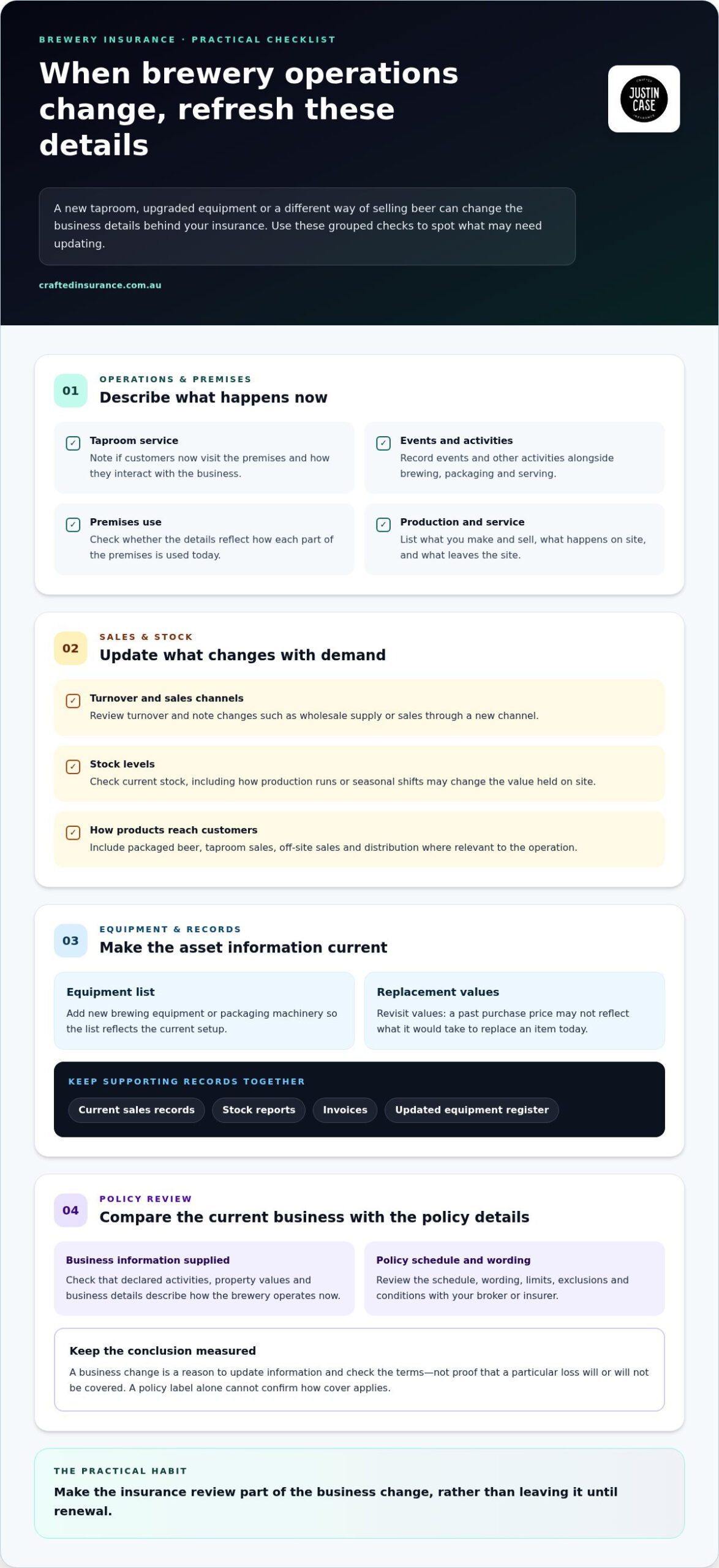
A practical check can catch brewery insurance mistakes before renewal
Compare how the brewery operates with the information used to arrange its insurance. Repeat the check when operations change, not just at renewal. A short, organised review can help you spot differences and raise clear questions.
Run a simple operations-to-policy cross-check
Start with what happens across the business today. Note production, storage, sales channels, customer service and events. Then compare that list with the business activities and values shown in your insurance documents.
- Write down current activities. Include what you make, where stock is stored, how products are sold, and whether customers visit or events take place.
- Compare the business details. Look at the information supplied when cover was arranged, including declared activities and relevant property or equipment values.
- Read the schedule and wording. Check that the documents reflect the details you supplied, then flag unclear terms or apparent differences for discussion.
- Record questions. Note what you want clarified rather than treating uncertain wording as confirmation that a particular loss is covered.
Keep the comparison practical. If the brewery now sells wholesale as well as directly, note the change and check whether it’s reflected in the information held for the policy. The aim isn’t to interpret every clause on your own. It’s to give your broker or insurer a clear picture and a useful set of questions.
Keep changes and questions easy to follow
Make a simple record whenever something changes. A new piece of production equipment, a different use for part of the premises, a shift in turnover or a new distribution arrangement can all be worth noting. Add the date and keep relevant supporting records with the note.
Store current policy schedules, full wording and business records together. That might include equipment lists, purchase invoices, stock information and sales records. An organised file saves time when you compare details, explain a change or prepare for renewal.
These habits can help prevent brewery insurance mistakes from sitting unnoticed in old paperwork. They also make it easier to review exposures with a specialist broker when a policy term or business activity isn’t clear. Raise questions while there’s time to understand them, rather than leaving them until a claim or renewal makes them urgent.
For brewery-specific support, request Crafted Insurance’s free insurance risk audit as a practical step in reviewing your risks and cover.
A specialist review helps turn brewery insurance lessons into next steps
The lesson behind these brewery insurance mistakes is straightforward: insurance information needs to match the brewery as it operates today. A specialist review can turn that into clear questions and practical decisions, without leaving you to untangle every policy detail alone.
Crafted Insurance works with Australian craft breweries, distilleries and brewpubs. It assesses business risks and arranges tailored insurance cover. The review considers the operation behind the paperwork, from brewing and storage through to sales and customer service.
What a specialist brewery insurance review can help clarify
Bring notes about your activities, values and any unclear policy wording to the review. A specialist can connect those details with brewery-specific exposures and identify where more information or a closer look at the terms may be useful.
Production, product distribution and serving customers all shape the risk picture in different ways. Tailored insurance arrangements can take those activities into account rather than assuming one setup suits every brewery. A review can clarify questions and options, but it doesn’t guarantee how a policy will respond to a future claim.
Take the next step without turning this into another admin headache
You don’t need a perfect file to begin. Gather a current picture of your operations, the values you’ve declared, and your policy schedule and wording. Add questions you’ve noted, such as whether a change in premises use or sales activity is reflected in the information on file.
Crafted can assess risks, support risk management and arrange cover tailored to the business. If a claim arises, Crafted also advocates for clients through the claims process. Policy terms and circumstances still matter, so no broker can promise a particular claim outcome.
A review can also make the next renewal easier. Keep updated notes and documents together, and use them as a working record when the brewery changes. That way, you’re not rebuilding the whole picture from memory when insurance paperwork lands in the inbox.
Crafted Insurance’s advertised free insurance risk audit is a practical starting point. Bring your questions and current documents to make the review focused and useful.
Make your next insurance check part of the brew cycle
Your brewery won’t stand still, and your insurance review doesn’t have to become a once-a-year scramble. Treat it like other operational housekeeping: revisit the details when the business changes, and keep unanswered questions in one place.
That habit can make the next insurance conversation more useful. Instead of starting from scratch, you’ll have a clearer picture of what’s changed and what needs a closer look. It’s a practical way to keep brewery insurance mistakes from becoming an afterthought while you focus on making and serving beer.
Crafted Insurance is an Australian specialist broker for craft breweries, distilleries and brewpubs. Its brewery insurance review includes an advertised free insurance risk audit.
Start with the questions you already have. One clear next step can make the paperwork feel more manageable and leave you with more headspace for the work you love.
Frequently Asked Questions
Does a brewery need separate liquor liability insurance?
Not necessarily as a separate policy, but a brewery that serves alcohol should check how its existing arrangements address customer-related alcohol exposures. The answer depends on the insurer’s terms, the brewery’s activities and the cover arranged. A production-only operation may face different questions from a taproom or brewpub. Ask for clarity on how customer service, events and alcohol-related incidents are treated, rather than relying on the policy name.
Can a standard business insurance policy cover brewery equipment breakdown?
It may, but a standard business policy doesn’t automatically confirm cover for every type of equipment failure. Check whether the wording addresses sudden mechanical or electrical breakdown, and note any exclusions, conditions or limits. A damaged pump, for example, raises different questions from equipment affected by a broader insured event. If the policy language is unclear, a broker can explain how the terms relate to the equipment your brewery relies on.
What happens if a brewery’s sales or stock values are underinsured?
If declared sales or stock values are too low, the information used to assess the risk may not reflect the business accurately. A loss settlement can be affected by the policy’s limits, valuation terms and other conditions, so don’t assume the shortfall will be treated in one particular way. These brewery insurance mistakes are a reason to keep sales and stock records current and discuss material changes with your broker or insurer.
Does brewery insurance cover spoiled beer or a product recall?
It depends on the policy wording and the cause of the loss. Beer spoiled by a refrigeration issue, product affected by contamination and costs connected with recalling beer already distributed are different situations to investigate. Look for relevant definitions, exclusions, limits and conditions, including any terms about where the product is held or sold. Keep batch, storage and distribution records organised so you can explain the circumstances if a problem arises.
Should a brewery tell its insurer when it adds a taproom or starts hosting events?
Yes, raise the change with your broker or insurer so the business information can be reviewed. A taproom changes how customers use the premises, while events can bring different activities and attendance patterns. Share practical details such as what the event involves, where it takes place and whether alcohol is served. The insurer or broker can assess the updated information against the policy terms, without assuming the change automatically alters cover.
How often should a brewery review its insurance details?
Review them before renewal and whenever a meaningful change happens, such as a new sales channel, premises use or major equipment purchase. Keep a dated note of changes, update relevant business records and compare them with the information held for the policy. This makes it easier to spot differences early and gives your broker a clearer starting point than an old equipment list or figures recalled from memory.
Can a brewery insurance broker help if a claim is disputed?
Yes. A broker can help you understand the policy wording, organise relevant documents and communicate with the insurer about the issues in dispute. Useful records may include invoices, maintenance notes, photographs and a timeline of events, depending on the claim. A broker can advocate for you through the claims process, but can’t guarantee the insurer’s decision or payment. Keep copies of correspondence and ask for explanations of any terms or decisions you don’t understand.