

A cellar door can leave a distillery exposed even if it has public liability cover. Nano distillery insurance should consider property and stock, public and product liability, machinery breakdown and business interruption, as well as claims connected to serving alcohol. Fire cover alone won’t pay for mechanical or electrical failure in a still.
There’s a lot to weigh up when your focus is making good spirits and welcoming people through the door. Start with how the operation runs, from production and maturing stock to tastings, sales and equipment repairs.
This guide covers insurance areas Australian craft distilleries should consider, including liquor liability, fire and explosion, spirit stock values, still repairs and business interruption. It also explains which policy details matter for a small operation and how specialist risk advice can help you assess the different exposures.
Key Takeaways
- Make sure your cellar door liability arrangements address alcohol service, not just general visitor risks.
- Review how you value maturing spirit, work in progress and finished stock as each changes over time.
- Match business interruption cover to the time it could take to repair or replace a still and resume production.
- Separate fire protection from equipment breakdown cover so a still failure doesn’t leave a costly gap.
04 Do I need liquor liability for my distillery cellar door?
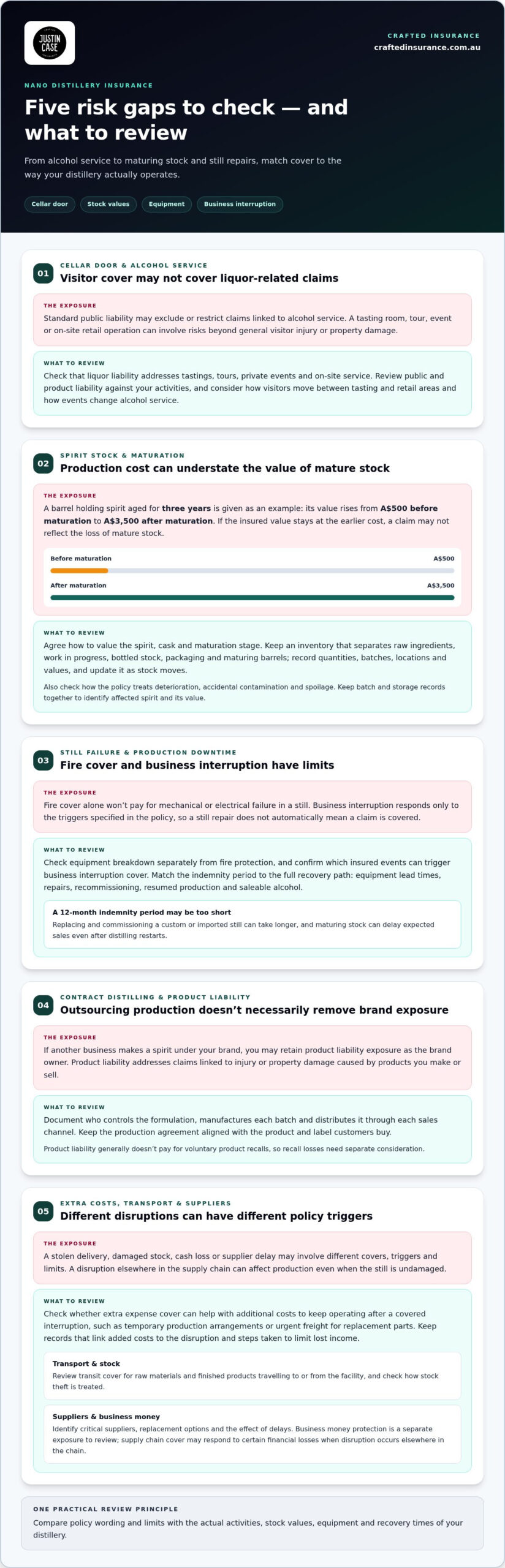
Yes. Cover for tasting rooms, tours, events and on-site retail should reflect the activities taking place, including serving alcohol. Standard public liability may exclude or restrict claims linked to alcohol service, so pay particular attention to cellar door liquor liability.
Public and Product Liability
Public liability can respond to claims involving injury to visitors or damage to their property during distillery operations. Product liability addresses claims linked to injury or property damage caused by products you make or sell. Review both against your actual activities, from production and packaging to tours, tastings and retail sales.
Contract distilling calls for clear documentation. If another business makes a spirit under your brand, you may retain product liability exposure as the brand owner. Record who controls the formulation, manufactures each batch and distributes it through each sales channel. Keep the production agreement aligned with the product and label customers buy.
Liquor Liability for Tastings
Liquor liability can protect against claims arising when alcohol sold or served on-site contributes to harm to a patron or damage to private property. Standard public liability may restrict this exposure. Check that the policy addresses tastings, tours, private events and on-site service rather than assuming visitor cover includes liquor-related claims.
Review the limit alongside your service model. Choose a liquor liability limit that reflects your distillery’s service model and exposure. Consider how visitors move between the tasting area and retail space, and whether events change the way alcohol is served. Product liability generally doesn’t pay for voluntary product recalls, so recall losses require separate consideration.
Include transport in your review. Personal vehicle policies don’t cover business use, so staff using their own vehicles for deliveries or distillery errands may need hired and non-owned auto liability. List the work trips and vehicles involved, then ensure the arrangement reflects those uses. This exposure is separate from cellar door and product claims.
Spirit stock, barrels and deterioration
A spirit’s value changes as it matures, so using only its manufacturing cost to set stock values can leave a gap. Consider raw materials, work in progress, finished bottles, packaging and casks, not just production costs. Distillery stock values can fluctuate, making accurate records important when setting property limits and preparing claims.
Consider a barrel holding spirit aged for three (3) years. One example values the barrel and spirit at A$3,500 after maturation, compared with A$500 before maturation. If the insured value still reflects that earlier cost, the settlement may not reflect the loss of mature stock. Agree how each stage is valued, including the spirit, cask and maturation period.
Create an inventory that separates raw ingredients, bottled stock and maturing barrels. Record quantities, batch details, locations and values, then update the records as production continues and products move into storage or sales. This gives a clearer picture of exposures at each site and helps distinguish stock loss from damage to buildings or equipment.
Check how the policy treats deterioration, accidental contamination and spoilage. These events can affect a batch before delivery or after it leaves the distillery. A contaminated-stock loss is different from damage to stills or other production equipment. Keep batch records and storage details together so you can identify the affected spirit and its value.
Review the replacement value of stills and other property alongside stock limits. A flammable-materials incident could damage both equipment and stored product, so the values need to account for each loss category. For a practical review of stock values and distillery exposures, explore distillery risk management.
05 Does business interruption cover a distillery while a still is being repaired?
Business interruption cover can help with lost income and ongoing expenses when a covered event disrupts production. The policy responds only to the triggers it specifies, so a still repair alone doesn’t automatically mean a claim is covered.
Indemnity and Recovery Periods
The indemnity period is the time business interruption cover can support financial losses after an insured event. A 12-month period may be too short if replacing and commissioning a custom or imported still takes longer. Recovery planning should account for equipment lead times, repairs, recommissioning and the time needed to restore production.
Factor in the distillery’s product cycle. Replacing a still may restart distilling, but maturing stock can delay expected sales. Map the recovery stages, from equipment replacement to resumed production and saleable alcohol. Discuss an indemnity period that reflects the full recovery path, not just the repair schedule.
Extra Expense and Related Cover
Extra expense cover can help with additional costs to keep a distillery operating during an interruption, subject to the policy wording and insured event. Examples may include temporary production arrangements or urgent freight for replacement parts. Keep records linking each added cost to the disruption and to steps taken to limit lost income.
Transit cover can protect raw materials and finished products while they travel to or from the facility. Stock cover may also address theft, while business money protection is a separate exposure to review. These covers respond differently: a stolen delivery, damaged stock and cash loss may have different triggers and limits.
Supply chain cover may respond to certain financial losses when an interruption is caused by disruption elsewhere in the chain. For example, a supplier delay could affect production even if the still is undamaged. Identify critical suppliers, replacement options and the effects of delays. A broker can compare those exposures with policy triggers, exclusions and the recovery period.
03 Does distillery insurance cover fire and explosion from high-proof spirit?
Property insurance can cover fire damage to premises, equipment and stock when the event falls within the policy terms. Explosion, equipment breakdown and stock loss each need attention, as one section of cover doesn’t automatically include the others.
To compare quotes, give each broker the same business details, then compare limits, excesses, insured events and exclusions, not just premiums. Describe your risk controls accurately. Proactive distillery risk management can earn property coverage rate credits of up to 10 percent.
For a quote, prepare details about production, premises, equipment values, stock levels and storage arrangements. Include how much spirit is maturing, how flammable materials are stored, and whether you run tastings or sell on-site. These details help describe the operation and the exposures the policy needs to address.
Check the wording for exclusions affecting fire, explosion, contamination, spoilage and property damage. Fire cover alone doesn’t cover mechanical or electrical failure, so machinery breakdown needs a separate section. Contamination or spoilage cover may apply to specified events, including unsatisfactory batches, but the policy terms set the limits.
Review stock cover for raw materials, finished product and packaging, including goods in transit. A delivery damaged on the road presents a different claim from a still breakdown at the premises. Check whether business use of personal vehicles is covered, too. Personal auto policies may not cover work-related driving, so businesses should review whether separate cover is needed.
For a nano distillery insurance review, list each asset and the loss scenario it faces: fire, explosion, breakdown or stock damage. Then compare the wording against those exposures before choosing limits. Review distillery risk management to bring the main hazards and cover gaps into focus.
Crafted Insurance: Nano Brewery
Crafted Insurance helps Australian craft producers assess the cover relevant to these risks. Its MICRO DISTILLERY package is designed for distilleries where production, maturing stock, cellar door activity and specialist equipment all need consideration.
A specialist broker can help when your setup changes, such as adding tastings, increasing barrel storage or replacing a still. Crafted Insurance offers tailored insurance packages, risk management support and claims advocacy to help you understand how cover fits your operation.
For a practical conversation about your distillery’s insurance needs, contact Crafted Insurance.
Make your next change a chance to review your cover
Your distillery won’t stand still. A new product, extra storage or a change in how customers visit can shift the risks around your operation. Treat each change as a prompt to review your nano distillery insurance, rather than waiting until renewal to spot a mismatch.
Bring an up-to-date picture of your business to the review: what you make, how you sell it, where you store it and what has changed. That gives the conversation a useful starting point and helps connect cover to the way your distillery actually runs.
Crafted Insurance works with craft businesses through packages including NANO DISTILLERY, MICRO DISTILLERY and BREWPUB. If your operation is evolving, a specialist discussion can help you plan the next step with a clearer view of your risks.
Contact Crafted Insurance about cover, and keep building your distillery with confidence.
Frequently Asked Questions
01 What insurance does a craft distillery need in Australia?
An Australian craft distillery should consider cover for its premises, equipment, stock, liability and interruption to trading. The right mix depends on what happens at the site. A producer selling directly to visitors, for example, has different activities to account for than one supplying packaged spirits through retailers. Map production, sales and visitor activities before reviewing policy sections and limits.
06 Is the gin I bottle covered if it injures a customer?
Product liability can respond to claims alleging that a spirit caused injury or property damage, subject to the policy terms. For example, a customer might allege an injury after buying bottled gin. Keep batch, ingredient, bottling and distribution records so you can identify the product involved. Review whether cover addresses products sold through each channel, including direct sales and wholesale.
Want help getting distillery cover?
Yes. Crafted Insurance arranges specialist cover for Australian craft distilleries and offers a Nano Distillery package. Its risk audit can help identify exposures tied to your production setup and sales activities. Prepare a clear outline of your operation, including what you make and how you sell it. To start a conversation about cover, call 1800 962 089.
What insurance policies does a nano distillery in Australia need?
Start by matching policy sections to your business activities and assets. A distillery may need property, public and product liability, liquor liability, machinery breakdown and business interruption cover. Consider stock protection for ingredients, packaging and spirits, plus transit cover if goods travel between sites or to customers. Then check that the insured business description reflects both production and sales, not just one activity.
How much does nano distillery insurance cost in Australia?
The cost of nano distillery insurance depends on the business and is provided after a quote request. Key factors include premises, equipment and stock values, production methods, sales channels, visitor activity, claims history and selected limits. For a useful comparison, give each broker the same description of your operation and review excesses and exclusions alongside the premium.
Which Australian insurers or brokers cover nano distilleries and craft spirits producers?
Crafted Insurance is an Australian specialist broker for craft breweries, distilleries and brewpubs. It assesses business risks and arranges cover suited to each operation. Share how production, distribution and customer sales work to help make sure the cover review reflects the business you actually run.