
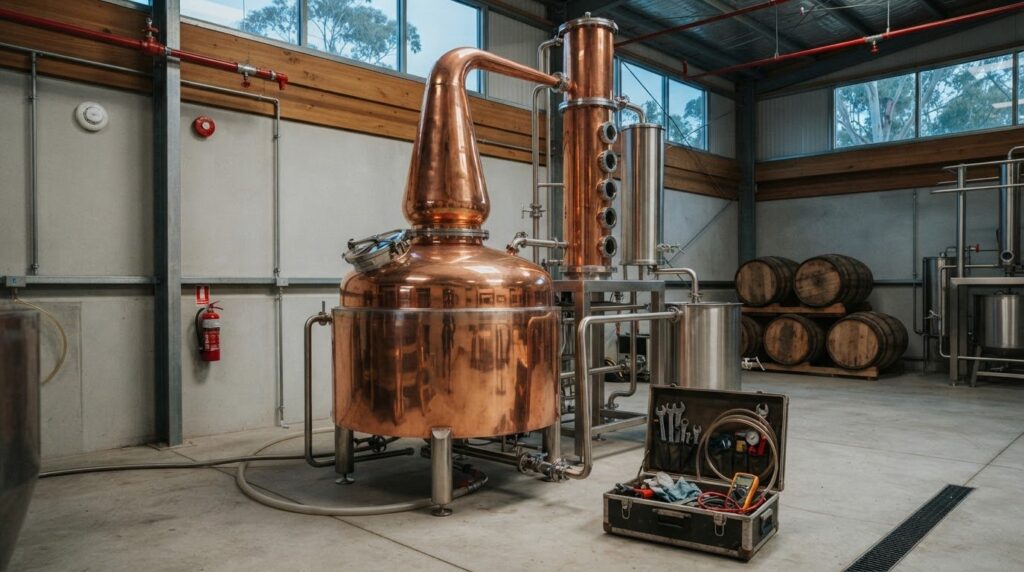
Fire is a core insured peril under distillery property cover, subject to the policy’s terms, limits and exclusions. But distillery fire risk insurance is different from cover for a broken still: machinery breakdown is a separate section, while business interruption may respond if insured damage stops production. That distinction matters when reviewing your cover.
High-proof spirits on site make fire and explosion risks especially important to assess. Ethanol vapour can escape from tanks, casks, pumps, pipes or hoses, so insurers may consider how spirit is stored and handled, as well as ventilation, electrical protection and separation from production areas.
This guide explains what Australian craft distilleries should review across fire and explosion risks, still repairs, buildings, equipment, maturing spirit stock and lost income. You’ll also see how specialist insurance brokers and schemes can help bring those moving parts together. Because a policy should reflect how your distillery actually works, not just the still at its centre.
Key Takeaways
- Review how spirit is stored and transferred, along with ventilation, ignition sources and electrical protections, to help manage fire and explosion risks.
- Set business interruption cover around realistic still replacement and commissioning times, plus the time needed to rebuild stock and resume production.
- Reassess building, equipment and maturing spirit values as your distillery grows or adds major assets.
- Compare specialist insurance options on matching business details, and weigh policy exclusions alongside the premium.
1. 03 Does distillery insurance cover fire and explosion from high-proof spirit?
Fire is a core insured peril under distillery property cover, subject to policy terms, limits and exclusions. But fire cover alone doesn’t automatically cover every explosion loss, liability claim or equipment failure. Distillery fire risk insurance should reflect how your stills, spirit and premises are protected.
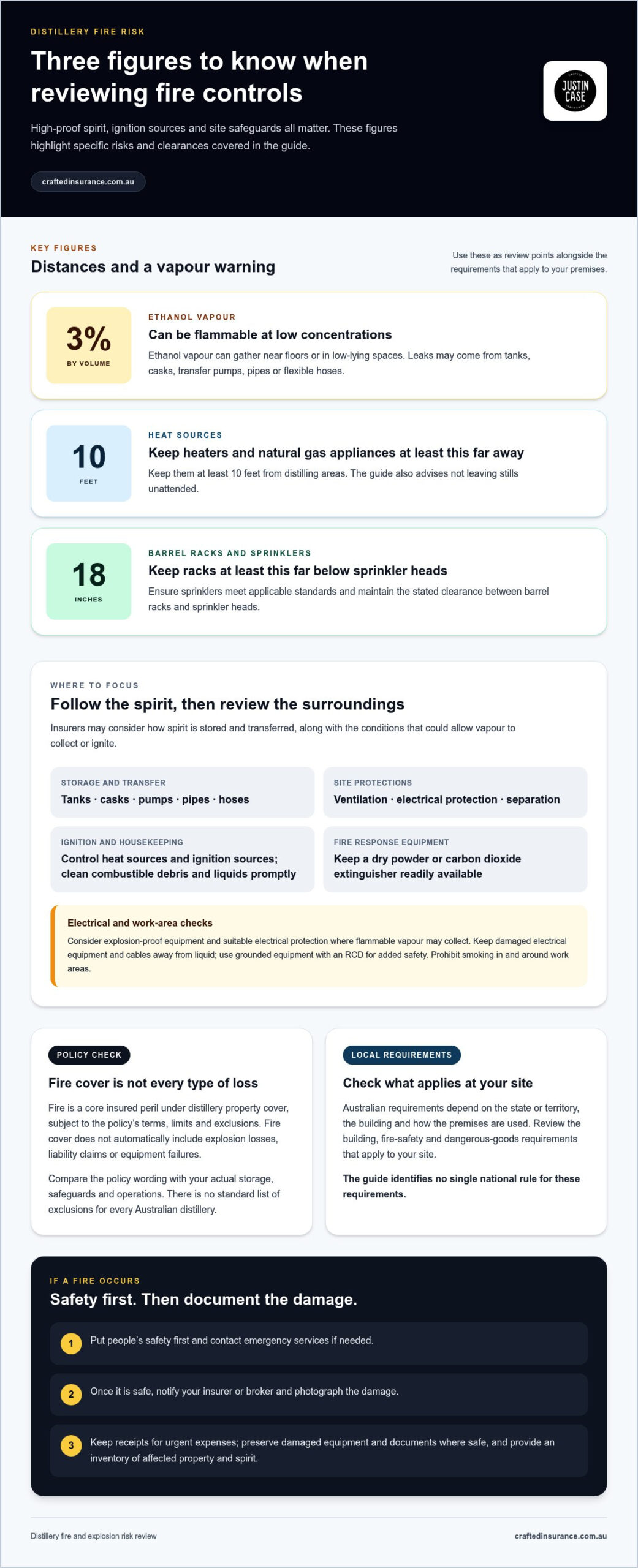
Ethanol vapour is flammable and can gather near floors or in low-lying spaces. It can create a fire or explosion hazard if spirit leaks from tanks, casks, transfer pumps, pipes or flexible hoses. Vapour can be flammable at concentrations as low as 3 percent by volume.
Insurers assess how you store and transfer spirit, the ventilation, electrical protections and separation between storage and production. They also consider heat sources. Keep heaters and natural gas appliances at least 10 feet from distilling areas, and don’t leave stills unattended.
Practical controls matter. Maintain ventilation, control ignition sources, clean combustible debris and liquids promptly, and prohibit smoking in and around work areas. Keep a dry powder or carbon dioxide extinguisher readily available. Ensure sprinklers meet applicable standards, and keep barrel racks at least 18 inches below sprinkler heads.
Australian requirements depend on the state or territory, building and how the premises are used. Review the building, fire-safety and dangerous-goods requirements that apply to your site, as there is no single national rule identified here. Consider explosion-proof equipment and suitable electrical protection in areas where flammable vapour may collect. Keep damaged electrical equipment and cables away from liquid, and use grounded equipment with an RCD for added safety.
There is no standard list of fire-policy exclusions for every Australian distillery. Cover depends on the policy’s terms, limits, exclusions and conditions, so compare them with your actual storage, safeguards and operations.
After a fire, put people’s safety first and contact emergency services if needed. Once it’s safe, notify your insurer or broker, photograph the damage and keep receipts for urgent expenses. Preserve damaged equipment and documents where safe, and provide an inventory of affected property and spirit.
There is no standard set of exclusions for every Australian distillery; cover depends on each policy’s terms, limits, exclusions and conditions. Fire cover does not automatically include explosion losses, liability claims or equipment failures, and insurers may assess spirit storage and transfer, ventilation, electrical protection, separation and other AS 1940 distillery insurance fire-safety controls.
2. 05 Does business interruption cover a distillery while a still is being repaired?
Business interruption cover may respond to lost income when insured damage, such as a fire, stops production. A still breakdown alone doesn’t automatically trigger it. The interruption generally needs to follow damage insured under the policy, so the cause of the stoppage matters as much as the repair.
Start with the still’s replacement and commissioning timeline. Custom-built or imported equipment can take time to source, install and test. A 12-month indemnity period can be too short for a distillery relying on specialist stills. Set the period around realistic replacement lead times, then allow for the further time needed to restart production.
Restarting production can take longer than replacing a still. A whisky distillery, for example, may face a gap before it can rebuild stock for future sales. Consider whether the business interruption period accounts for that recovery, not just equipment repair time. Factor in lost production, orders, seasonal demand and cash flow.
Review extra expense cover alongside lost income. After a fire, temporary storage, alternative production arrangements or urgent equipment hire could help keep parts of the business moving. The policy wording determines which expenses qualify, what damage must trigger cover, and what limits or exclusions apply. Don’t assume every workaround is insured.
Base your review on how the distillery operates. List critical equipment, supplier and commissioning lead times, stock in storage, and the steps needed to resume production. Compare these details with the policy’s indemnity period and business interruption basis. Update the information when production capacity, equipment or sales channels change.
A tailored insurance package should connect property damage, interruption and extra expenses without treating them as interchangeable. For a practical review of distillery exposures and recovery planning, explore distillery risk management alongside your policy details.
3. Commercial property coverage for buildings, stills and ageing spirits
Distillery property cover can protect buildings, stills, production equipment and stock against fire and other insured damage, subject to policy terms, limits and exclusions. Business interruption may respond to lost income after insured damage prevents operations. Check that the cover reflects each part of your property and how you use it.
Ageing spirit needs particular attention. A cask’s value can change substantially as it matures, so update declared stock values over time. A barrel of whisky after five years may be worth far more than new-make spirit. Record cask numbers, locations and values, and keep the records current.
Review property limits at least annually, and whenever you add barrel inventory, buy major equipment or expand the facility. Insurers may consider building materials, age, renovation history, cool-room or insulated-panel construction, fire protection and security. Disclose traditional expanded polystyrene cool-room panels, whatever the amount used. Keep panel specifications and installation records with your property documents.
Fire cover alone doesn’t provide machinery breakdown cover. Boilers, condensers and refrigeration equipment need a separate machinery breakdown section if you want protection for equipment failure. Check each item’s insured value and consider how a breakdown could affect production, stored spirit or temperature-sensitive stock.
Public tastings and tours bring visitors into production or storage areas. Review liability cover for these activities, and address liquor liability specifically if you serve tastings or sell alcohol by the glass. Where practical, keep visitor routes separate from stills, hot surfaces and cask storage. This helps manage hazards and make visitor arrangements clear.
Contamination can affect spirit, packaging and stock records after an incident. Keep inventory and production records alongside, but separate from, equipment schedules, and document how you would identify affected batches. A clear paper trail helps explain which property, stock and production were affected; the policy wording determines what losses are insured.
4. Specialist distillery insurance brokers and schemes
A specialist broker understands how a distillery’s production, spirit storage and public activities connect. That matters when one incident could involve fire or explosion damage, electrical equipment, stock and visitor liability. Discuss your actual operations, including tastings, contract production, ageing warehouses and changes to sales channels.
Prepare a consistent picture of your operation before comparing cover. Gather building details, equipment schedules, stock values, fire-protection information and the business interruption period you need. Include liquor liability if you serve tastings or sell alcohol by the glass. Matching information helps a broker compare suitable options using the same assumptions.
When comparing quotes, use the same business information for each option, then review policy exclusions as well as premiums. Look closely at how each policy treats fire, machinery breakdown, stock, business interruption and public liability. A lower premium may come with limits or exclusions that leave a gap for part of your operation.
Ask your broker to explain the claims process in practical terms. Discuss what records can help document damaged equipment, affected spirit and interrupted production. Also talk through how changes to the premises, electrical systems, storage or visitor activities should be reflected in the policy. Keep the answers and updated schedules together for future reviews.
A scheme designed for craft producers may bring relevant cover sections together, but the policy wording still matters. Check whether the proposed package fits your distillery’s scale, equipment, stock and public-facing work. A whisky producer with ageing casks has different property considerations from a small operation focused on fresh production and tastings.
Make the next step a structured review, not a quick premium comparison. Review your distillery’s insurance risks against its real operations, assets and recovery needs.
Crafted Insurance: Nano Brewery
Crafted Insurance helps Australian craft distilleries review insurance and operational risks, including fire, equipment, stock and business interruption. Its specialist packages include NANO DISTILLERY and MICRO DISTILLERY. A FREE INSURANCE RISK AUDIT can help identify exposures across production, storage and public-facing activities.
Crafted Insurance also provides claim advocacy and ongoing risk management, bringing policy questions and practical risk controls into the same conversation. This can be useful when your stills, ageing spirit or visitor activities change and your cover needs a fresh look.
For a distillery-specific conversation, visit craftedinsurance.com.au.
Build insurance into your next operational review
Your distillery changes as production grows, equipment shifts and new visitor experiences take shape. Make insurance part of those decisions, not an afterthought. A fresh distillery fire risk insurance review can help keep your protection aligned with how the business operates today.
Crafted Insurance works with craft operations including Nano Brewery, Micro Distillery and BrewPub businesses. Bring planned changes into the conversation early, whether you’re adjusting production or adding a public-facing activity. That gives you room to consider the risks alongside the opportunity.
And you can keep the next step straightforward. Contact Crafted Insurance about distillery cover to discuss your operation and what you’d like to review. Then get back to the work that brought you here in the first place: making good spirit and building a distillery you’re proud of.
Frequently Asked Questions
01 What insurance does a craft distillery need in Australia?
A craft distillery should consider cover for its premises, production equipment, spirit stock and business interruption. Public and product liability also matter, especially if the business sells spirits or welcomes visitors. The right combination depends on activities such as contract production, tastings and online sales. Map each activity to its potential losses, then check that the relevant policy sections and limits fit.
03 Does distillery insurance cover fire and explosion from high-proof spirit?
Property insurance can cover fire damage, but explosion losses depend on the policy wording, limits and exclusions. High-proof spirit creates particular exposure if vapour escapes during transfer or storage and meets an ignition source. Keep records of safeguards, maintenance and changes to spirit-handling procedures. These details help explain the actual risk and support a clear discussion about what the policy covers.
05 Does business interruption cover a distillery while a still is being repaired?
Business interruption may cover lost income if insured damage causes a shutdown, but mechanical failure alone may not trigger cover. Check the policy’s insured-event requirements and indemnity period. Consider how long it would take to recommission a replacement still and restore production stock. A distillery dependent on one specialised still faces a different recovery challenge from one with alternative production capacity.
Want help getting distillery cover?
Crafted Insurance can help Australian distilleries assess their risks and arrange cover suited to their operations. Its specialist broking packages include Micro Distillery, and its support includes risk audits, claim advocacy and ongoing risk management. If you’re reviewing a new venture or a change to your operations, contact Crafted Insurance about distillery cover to start the conversation.
What fire risks are specific to Australian distilleries?
Distilleries handle flammable spirit and vapour around hot production equipment, creating fire and explosion risks. Ageing warehouses add stored casks and changing stock values to the picture. Building materials matter too, including expanded polystyrene cool-room panels. Consider how a leak, ignition source or fire-protection failure could affect workers, visitors, equipment and spirit, and include those scenarios in your risk review.
Is distillery fire insurance available in Australia, and which insurers offer it?
Australian distilleries can seek commercial property cover that includes fire, subject to policy terms, limits and exclusions. The insurers available depend on the operation and the risks presented, so a specialist broker can help source suitable options. Compare two or three quotes using the same business details, and weigh exclusions and cover sections alongside the premium, not just the headline price.