
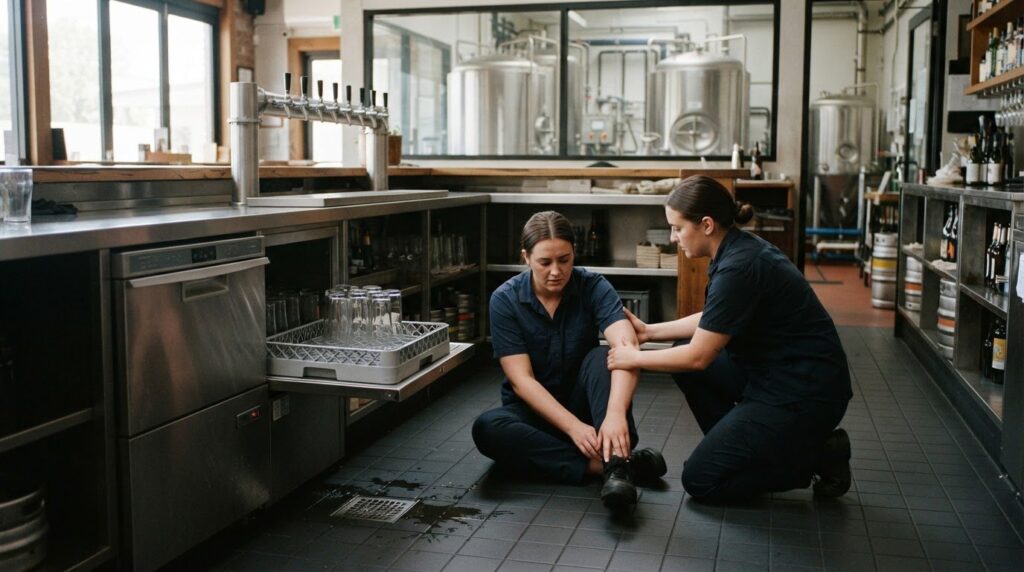
A brewery’s workers compensation cover isn’t optional when you employ workers. Workers compensation insurance for brewery employees is generally compulsory for Australian businesses with workers, and it may help cover lost wages, medical expenses and rehabilitation after a work-related injury or illness. The rules vary by state and territory.
A brewery is a hands-on, busy workplace. From production to customer service, an injury can affect both your team and your operation. This guide explains what workers compensation insurance for brewery employees may cover, how premiums and claim payments are treated for tax, and what to know about the rules in your state or territory.
We’ll explain how premiums are calculated and why a brewery’s work, payroll and staffing arrangements matter. This will help you understand your team’s cover needs and when specialist insurance advice can help.
Key Takeaways
- Understand which work-related injuries and illnesses may qualify for support, including wage replacement, treatment and rehabilitation.
- See how payroll and industry classification shape premiums, and what to consider when reviewing your brewery’s cover.
- Learn the general tax treatment of premiums and claim payments, so you can account for them appropriately.
- Identify why workers compensation rules differ between states and territories, and where your local scheme fits.
What is workers compensation insurance?
Workers compensation insurance supports employees with eligible work-related injuries or illnesses. For breweries, it may help cover treatment, lost income and support for a return to work.
Workplace injury and illness benefits
Depending on the circumstances, benefits may include weekly payments when an employee cannot work, medical and related expenses, and rehabilitation services. A permanent injury may qualify for a lump-sum payment, and benefits may also apply after a worker’s death. For example, treatment and rehabilitation may form part of a claim after an employee is injured handling production equipment. The specific benefits depend on the circumstances of the claim.
Eligible work-related conditions
Eligible conditions may include physical or mental health injuries, work-caused diseases and illnesses, and injuries during work-related travel. A work-related recurrence or worsening of an existing condition may also be covered. For example, an existing injury that worsens while an employee performs brewery duties may be relevant to a claim. Eligibility depends on the connection between the injury or illness and the work.
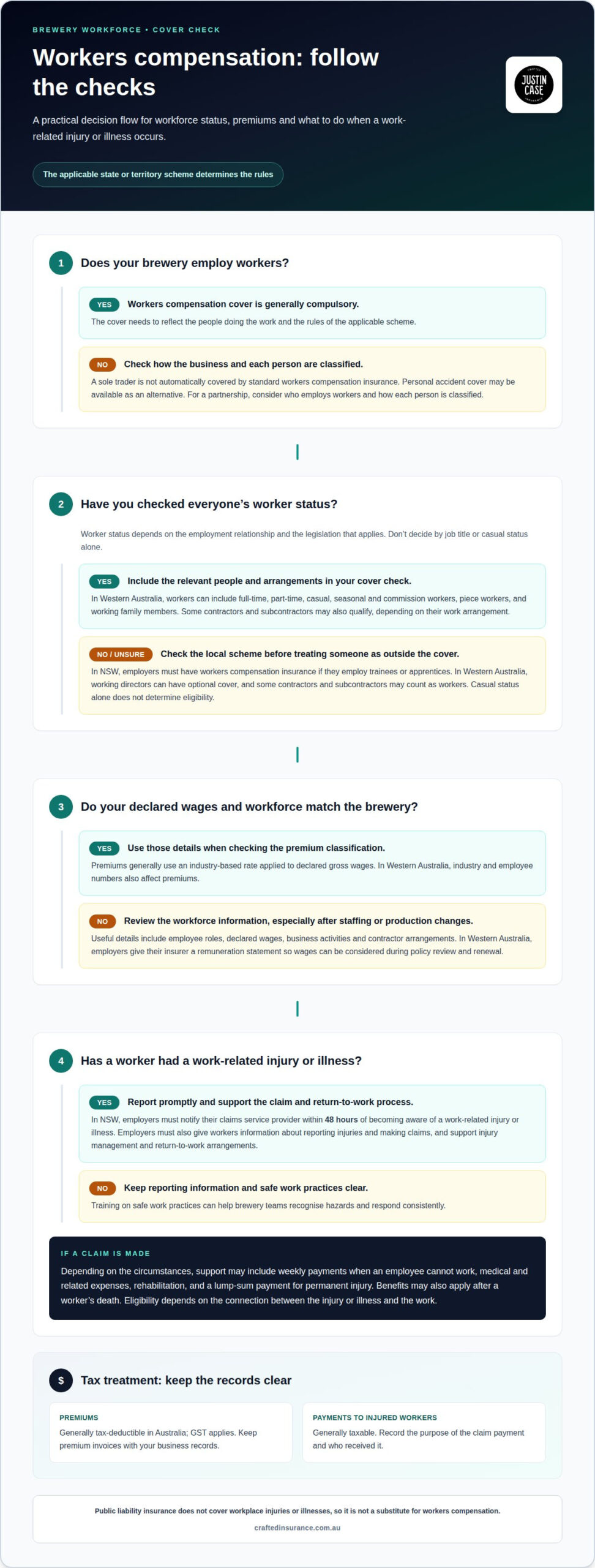
Premiums generally use an industry-based rate applied to declared gross wages. In Western Australia, industry and employee numbers also affect premiums. The applicable scheme, the brewery’s work and its payroll profile all matter when establishing the premium classification.
Worker status matters too. Under Western Australia’s Workers Compensation and Injury Management Act 2023, a worker can include full-time, part-time, casual, seasonal and commission workers, piece workers, and working family members. Some contractors and subcontractors may also qualify, depending on their work arrangement.
Employers must give workers information explaining how to report an injury and make a claim. Report incidents promptly; in NSW, employers must notify their claims service provider within 48 hours of becoming aware of a work-related injury or illness. Employers must also support injury management and return-to-work arrangements. Training on safe work practices can help brewery teams recognise hazards and respond consistently.
Workers compensation cover for employers and trade businesses
Australian businesses that employ workers must hold workers compensation cover. Workers compensation insurance for brewery employees needs to reflect the people doing the work and the rules of the applicable scheme.
Covered workers and workplace conditions
Workers compensation can respond to workplace injuries and occupational illnesses connected with an employee’s work. Benefits may include weekly compensation, medical expenses, rehabilitation, and lump-sum payments for permanent impairment or death. For a brewery, this could mean a claim after a production injury or a work-related illness.
Worker status depends on the employment relationship and the applicable legislation. In Western Australia, working directors can have optional cover, and some contractors and subcontractors may count as workers depending on their arrangement. In NSW, employers must have workers compensation insurance if they employ trainees or apprentices. Casual status alone does not determine eligibility.
A sole trader is not automatically covered by standard workers compensation insurance. Personal accident cover may be available as an alternative. For partnerships, consider who employs workers and how each person is classified. Public liability insurance does not cover workplace injuries or illnesses, so it is not a substitute for workers compensation.
Payroll compliance and coverage checks
Payroll information can help employers check whether their workers compensation cover reflects the entity paying wages. A broker can review a brewery’s payroll and cover against WorkCover WA requirements. Useful details include employee roles, declared wages, business activities and contractor arrangements. Together, these details help show whether the declared workforce reflects the operation.
In Western Australia, employers give their insurer a remuneration statement so wages can be considered during policy review and renewal. For workers compensation insurance for brewery employees, a broker can help organise payroll information and assess whether the declared workforce reflects the brewery’s activities and staffing changes.
For a brewery changing its staffing or production mix, brewery risk management can bring those operational details into the coverage discussion.
Tax deductibility of premiums and claim reimbursements
Workers compensation insurance premiums are generally tax-deductible in Australia, and GST applies. Keep premium invoices with your business records so the expense is easy to identify during tax preparation.
Workers compensation payments to injured workers are generally taxable. A claim payment may replace lost income or meet medical expenses, so record its purpose and recipient. The tax treatment matters both to the employee receiving benefits and to the business managing claim-related transactions.
Premiums are generally calculated using industry-based rates applied to declared gross wages. In Western Australia, industry and employee numbers also affect premiums. Changes to brewery payroll can therefore affect the calculation at review or renewal.
A broker can help a brewery arrange workers compensation insurance and manage claims administration. They can organise policy information, explain how to notify a claim and help assemble relevant records for the insurer. For a workplace injury, these records may include incident details, employee information and medical documentation.
After a claim is lodged, the insurer manages the claim and related medical costs under the applicable scheme. Benefits may include medical treatment, rehabilitation and weekly payments. Return-to-work support can also be part of injury management, helping coordinate suitable duties and the employee’s return to the workplace.
To arrange cover, a broker can help identify the relevant state or territory scheme, gather business and payroll details, and organise the required policy. For claims, the broker can assist with notification and documentation, then advocate for the brewery during the process. Prompt reporting helps get the claims process underway.
Keep premium, payroll and claim records together, but clearly separated. For example, file an annual premium invoice apart from medical expense documents and claim correspondence. Clear records help explain what each amount relates to, without confusing a claim reimbursement with an insurance premium.
State and territory workers compensation legislation
Australian workers compensation is governed by state and territory legislation. Schemes differ in their rules, administration, benefits and insurers, so it is important to identify the applicable jurisdiction.
State and territory scheme differences
NSW, Victoria, Queensland and South Australia use a single government provider to underwrite their schemes. In the ACT, Northern Territory, Tasmania and Western Australia, private insurers underwrite cover, and employers choose from approved providers.
Legislation also varies. Victoria’s scheme operates under the Workplace Injury Rehabilitation and Compensation Act, while Western Australia’s legislation is called the Workers Compensation and Injury Management Act. These differences can affect how employers arrange cover and how claims and payments are managed.
Choosing the applicable scheme
The relevant state or territory scheme covers brewery employees according to the jurisdiction that applies to the employer’s work arrangements. The workplace location and employment structure help establish which scheme applies. Commonwealth employees and some licensed corporations may fall under Comcare instead.
NSW employers generally need workers compensation insurance if they expect to pay at least A$7,501 in wages and benefits during a financial year. They must also insure trainees or apprentices. These NSW requirements show why employee roles and payroll need to be considered alongside the brewery’s location.
Accurate payroll information is essential at renewal. In Western Australia, employers give their insurer a remuneration statement so wages can be considered during policy review and renewal. Changes in staffing or payroll can affect the figures assessed, making renewal a practical time to align declared remuneration with the brewery’s workforce.
A broker can help map the brewery’s work arrangements to the relevant scheme, organise remuneration details and explain insurer options where private underwriting applies. This support can help keep cover aligned as operations change. The scheme sets the rules for injured worker benefits, rehabilitation and permanent impairment.
Get help reviewing your brewery’s workers compensation cover against the state or territory scheme that applies.
Crafted Insurance
Crafted Insurance helps Australian breweries make sense of insurance and operational risks. If you’re reviewing workers compensation cover, its specialist brokers can consider your brewery’s activities, workforce and state or territory scheme, then help shape an appropriate insurance approach.
From a Nano Brewery to a Local Craft Brewery or BrewPub, every operation is different. Crafted Insurance offers tailored packages, risk audits, claim advocacy and ongoing risk management for craft businesses. This support can help you understand how employee cover fits alongside the risks of production, sales and public service.
For a practical discussion about your brewery’s insurance needs, contact Crafted Insurance.
Set up cover that can keep pace with your brewery
Make sure your insurance discussion reflects how your brewery operates now, not just what it produced last year. Staffing changes, new work arrangements and shifts in production can all make a review worthwhile. Clear records and an up-to-date picture of your operations help keep the discussion focused.
Choosing workers compensation insurance for brewery employees is one way to look after the people behind every batch. A specialist broker can connect your operation’s details with the cover discussion and support you as circumstances change.
Ready to talk through your brewery’s needs? Contact Crafted Insurance to discuss cover. Then get back to building a brewery your team can be proud of.
Frequently Asked Questions
Do apprentices and trainees need to be included?
Include apprentices and trainees in your workers compensation arrangements. In NSW, employers must have workers compensation insurance if they employ trainees or apprentices. Make sure their roles, wages and work activities are reflected in the brewery’s workforce information. For example, an apprentice who moves between production tasks and cleaning duties should be included as part of the employed workforce.
How much will insurance cost?
Your premium depends on factors including your brewery’s industry classification and declared gross wages. In Western Australia, the industry and number of employees also affect premiums. Changes to payroll or staffing can alter the figures used at review or renewal. Keep wage and role details organised so the premium assessment reflects your brewery’s actual operations.
What about contractors and sub-contractors?
Contractors and subcontractors may count as workers, depending on their working arrangement and the applicable state or territory law. In Western Australia, the arrangement determines worker status, and contractors can be jointly or individually liable for a claim. For example, if your brewery engages a contractor for production work, consider the actual working relationship, not just the contract label.
What should I do if an injury occurs?
Act promptly: arrange appropriate care, record the incident and notify the relevant claims service provider or insurer. Give the worker clear information about how to report the injury and make a claim. Record practical details such as when and where it happened, the task involved and the immediate response. Timely, accurate records help move the claims process forward; similarly, for workplaces or personnel operating in the UK, firms such as Scotland Claims Injury Lawyers assist individuals through the equivalent personal injury claims process.
What types of injuries and illnesses are covered?
Workers compensation may cover physical or mental health injuries, work-caused illnesses and diseases, work-related travel injuries, and a work-related worsening or recurrence of an existing condition. For a brewery, this could include an injury during a work task or an illness linked to workplace exposure. The key consideration is the connection between the condition and the person’s work.
Who is considered a worker?
Worker definitions vary by scheme, so a job title alone does not determine someone’s status. In Western Australia, workers can include full-time, part-time, casual, seasonal and commission workers, piece workers, and working family members. Some contractors and subcontractors may also qualify. Review each person’s actual working arrangement, particularly when family members or contractors contribute to brewery operations.