

Directors and officers insurance may cover only part of the risk facing a distillery. Management liability insurance for distillery directors can also combine cover for the organisation, employment-related claims, statutory liability and other business exposures. The sections and limits vary between policies.
That distinction matters when you’re running a small or growing distillery. A claim might involve a director’s decision, an employment dispute or an allegation against the business itself. It’s a lot to manage while you’re busy making and selling great spirits.
This guide explains how management liability differs from D&O insurance, the claims that may arise and how cover can apply to Australian distilleries and SMEs. You’ll also learn what policy sections can cover, what to weigh when arranging insurance and how specialist advice can help align cover with the way your operation runs.
Key Takeaways
- Understand how management liability can extend beyond directors’ and officers’ cover to address risks faced by the organisation.
- Learn which policy sections may respond to claims involving directors, employees and business operations.
- Spot the kinds of workplace, regulatory and management allegations that can create legal and financial pressure.
- See why the right cover for an SME distillery depends on its operations, exposures and policy wording.
Management Liability Insurance vs Directors and Officers Insurance: What’s the Difference?
Directors and officers (D&O) insurance focuses on claims against leaders for wrongful conduct. In Australia, management liability policies often combine D&O cover with protection for the company and other business risks.
Directors’ and officers’ liability
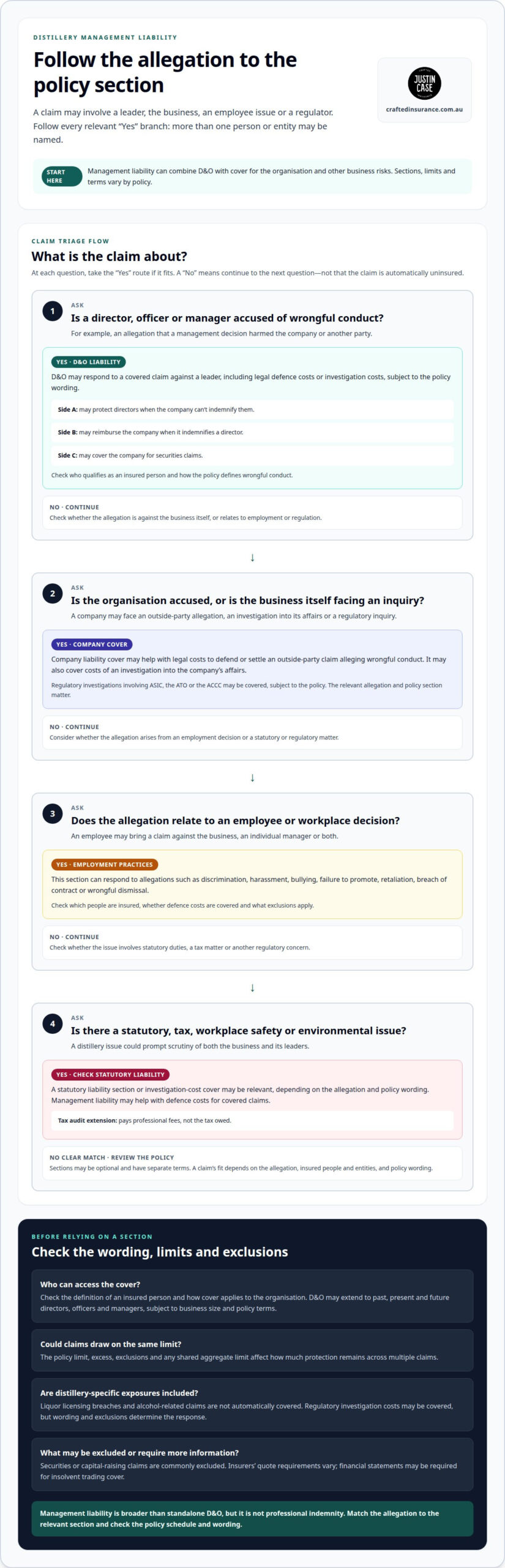
D&O cover can respond when a director, officer or manager faces a claim alleging wrongful conduct while managing the business. For example, the allegation might be that a decision harmed the company or another party. A claim may also lead to an investigation and legal defence costs. Check who qualifies as an insured person and how the policy defines wrongful conduct.
D&O insurance is often described through Side A, Side B and Side C. Side A can protect directors when the company can’t indemnify them. Side B can reimburse the company when it indemnifies a director. Side C can cover the company for securities claims. Defamation allegations connected with a director’s conduct may also be relevant, subject to the policy wording.
Personal liability for directors and officers
Yes. Australian directors and senior managers can face personal liability for decisions made while managing a business, depending on the circumstances. Directors have duties under Corporations Law, including acting with reasonable care and skill and in the company’s best interests.
A distillery tax, workplace safety or environmental issue could prompt scrutiny of the business and its leaders. Whether an individual is liable depends on the alleged conduct and their role. Management liability may help with defence costs for covered claims, but a tax audit extension pays professional fees, not the tax owed.
Management liability and directors’ and officers’ cover
Yes. Australian management liability insurance commonly includes D&O liability, alongside sections such as employment practices, statutory liability, crime and company cover. Some sections may be optional, so check the policy schedule.
The practical difference is breadth: standalone D&O focuses on claims against directors and officers, while management liability can address claims against both leaders and the organisation. It isn’t professional indemnity, which relates to professional services. For a distillery, review the insured people, covered allegations, investigation costs, exclusions and whether different claims share an aggregate limit.
Management liability cover for organisations and their leaders
Management liability can protect a private business and its leaders against different claims arising from business decisions. A policy may combine several sections, each with its own terms.
Cover for alleged mismanagement
Company liability cover may help with legal costs to defend or settle outside-party claims alleging wrongful conduct. It can also cover costs of an investigation into the company’s affairs. For example, a distillery might face an allegation that a management decision caused another party a loss.
Regulatory investigations involving bodies such as ASIC, the ATO or the ACCC may also be covered, subject to the policy. This differs from professional indemnity insurance, which relates to professional services. The relevant cover depends on the allegation and policy section.
Cover across leadership roles
D&O cover can extend to past, present and future directors, officers and managers, subject to business size and policy terms. This can matter when a claim arrives after a leadership change but concerns decisions made by a former director.
Company reimbursement cover may respond when the business indemnifies a director or officer for a wrongful-act claim, to the extent it is permitted or required to provide that indemnity. The policy should identify who qualifies as an insured person and how the organisation’s own cover applies.
Policy terms, limits and exclusions
That range is not a distillery-specific limit. The policy limit, excess, exclusions and whether sections share an aggregate limit all affect how much protection remains across multiple claims.
Does cover include liquor licensing breaches, alcohol-related claims or regulatory investigations? Regulatory investigation costs may be covered, but liquor licensing and alcohol-related claims aren’t automatically covered. The wording and exclusions determine how the policy responds. Securities or capital-raising claims are commonly excluded.
Insurers’ quote requirements vary. Expect to provide details about the business and the cover sought; financial statements may be required for insolvent trading cover. For a distillery, distillery risk management can help identify exposures to discuss when arranging protection.
Common management liability claims
Claims can arise from employment decisions, alleged management wrongdoing or business conduct. For a distillery, an employee dispute and a regulator’s inquiry involve different allegations and policy considerations.
Discrimination claims
An employee may allege discrimination, harassment or bullying at work. Employment practices cover can also respond to allegations involving failure to promote, retaliation, breach of contract or wrongful dismissal.
For example, a worker who says they were dismissed unfairly may bring a claim against the business or an individual manager. Review whether the policy covers defence costs for employment allegations, which people it insures and what exclusions apply. Cover depends on the policy wording.
Potential claimants
Employees may bring claims about dismissal, bullying, harassment or discrimination. Outside parties may allege that the company or its leaders caused a loss through wrongful conduct, misrepresentation or breach of contract.
A claim may name the business, a director, a manager or more than one of them. That distinction matters: the policy needs to show which insured people and entities can access each section. An allegation against an individual can also trigger an investigation into the organisation’s conduct.
Defamation is another possible allegation. For instance, a director’s email about a former employee or supplier could prompt a claim that the statement harmed someone’s reputation. Whether cover applies depends on the policy’s definitions, exclusions and the circumstances of the alleged conduct.
Other examples include alleged breaches of directors’ duties, employee fraud or dishonesty, and workplace health and safety or environmental breaches. Statutory liability may help with defence costs, fines or penalties under some statutes. However, some Australian states prohibit insurance for work health and safety fines, while defence costs for those allegations are typically covered.
These claims don’t all follow the same path. An employment allegation may involve a worker and the business, while a regulatory matter can lead to an investigation of company operations. Check how the policy treats defence costs, investigations and claims naming both the organisation and an individual. Those details shape how the cover responds.
Management liability insurance for small and medium-sized businesses
A small distillery can face management claims just like a larger company. Management liability is commonly arranged for Australian businesses with 5 to 50 employees and turnover between A$500,000 and A$20 million. These ranges offer context, not a rule about who can apply. The operation’s structure, activities and exposures help shape the cover required.
For an SME, one allegation can name both the business and a director. Company reimbursement cover may respond when the business indemnifies a director or officer for an alleged wrongful act, within the limits of its indemnity. Company liability can address certain claims against the organisation itself. The wording should show how each section responds when a claim involves both.
Employment practices cover may address allegations of harassment, discrimination, retaliation or unfair dismissal. For example, a former employee might allege that a dismissal breached their employment agreement. The policy’s definitions, exclusions and defence-cost provisions matter: they show which employment claims are covered and whether the business or an individual can access that protection.
Other sections may address statutory liability, crime or tax audit costs, but they don’t all respond to the same event. A regulator’s investigation may involve different cover from an employee’s dishonesty or an ATO review. Some sections are optional, and policy limits may be shared across sections. Defence costs for one claim could therefore reduce what remains for another.
Start the placement process with a clear picture of the distillery: its legal entity, turnover, staffing, activities and existing insurance. Financial statements may be needed when seeking insolvent trading cover. The insurer assesses the requested sections and limits against the business’s exposures. This information helps a broker identify gaps between the operation’s risks and the policy wording.
For a distillery SME, management liability should fit the business rather than simply mirror a generic package. Discuss management liability risks and how they connect with your operation’s size, staffing and activities.
Crafted Insurance: Risk Management
Crafted Insurance can help distillery operators connect management liability concerns with practical risk management. That’s useful when your operation changes, such as adding staff, expanding production or opening a tasting space, because each change can bring different management exposures.
For a nano or micro distillery, risk management can help identify where employment practices, governance and day-to-day operations may leave the business exposed. The aim is to understand those risks and consider how they relate to your organisation’s insurance needs, rather than treating a policy as a one-size-fits-all fix.
If you’re reviewing management liability for your distillery, contact Crafted Insurance to discuss your risk management needs.
Make your next cover review count
Your next step is to connect the policy with the way your distillery actually operates. Changes to staffing, production, ownership or customer-facing activities can shift the risks your organisation needs to consider. A focused review can help turn those details into a clearer discussion about cover, limits and policy wording.
Crafted Insurance works with craft operators, including Nano Brewery, Micro Distillery and BrewPub businesses. Its risk management service can help distillery operators consider their exposures alongside their insurance needs. That’s a practical starting point if you’re reviewing management liability insurance for distillery directors or your organisation’s protection.
Bring your questions about the business structure, leadership roles and changing operations into the conversation. Contact Crafted Insurance about your cover and take the next step towards a policy discussion shaped around your distillery.
Frequently Asked Questions
What can it cover?
Management liability can cover eligible defence costs and other expenses arising from claims against a business or its leaders. Depending on the policy, sections may address employment disputes, statutory allegations, employee dishonesty, tax audit costs or company liability. For example, a distillery facing an employee complaint and a separate investigation may need different policy sections to respond. The schedule and wording show which protections apply.
What are a director’s duties?
Australian directors must act with reasonable care and skill, in the company’s best interests, honestly and for a proper purpose. They must also disclose and manage personal interests that conflict with the company’s interests. For example, a director with a financial interest in a supplier should address that conflict appropriately. Directors must also ensure the company doesn’t incur debts it can’t reasonably repay.
Why is D&O insurance important?
D&O insurance can help protect directors and officers from the financial burden of claims alleging wrongful decisions or conduct. A director might face an allegation after approving a contract or handling a conflict of interest. Cover can help with legal defence costs, subject to the policy. It doesn’t remove directors’ duties or guarantee that every claim will be covered, so the insured roles and exclusions matter.
What does management liability insurance cover for distillery directors in Australia?
For distillery directors, management liability insurance can combine cover for leadership decisions with sections addressing claims against the organisation. The available protection depends on the policy selected. A dispute about a manager’s decision may involve different cover from an allegation about employee conduct or a regulator’s inquiry. Review the wording for insured people, covered allegations, defence costs and exclusions before relying on a section.
How do management liability, directors and officers, and public liability insurance differ for distilleries?
Management liability can bundle protection for business leaders and the organisation. D&O insurance focuses on claims against directors and officers over their management conduct and may sit within a broader management liability policy. Public liability is a separate type of cover for claims involving third-party injury or property damage connected with business activities. A visitor injury in a tasting area is a different exposure from an allegation about a director’s decision.
How can an Australian distillery work with a broker to compare management liability policies and choose suitable cover?
Give your broker a clear picture of your business structure, distillery activities, workforce and the cover you’re considering. Working with an insurance advisory firm such as Putney Insurance Group can help you compare policy definitions, insured roles, limits, exclusions and whether sections share an aggregate limit. Ask how the wording treats claims most relevant to your operation, such as employment allegations or regulatory investigations. This turns policy comparisons into a practical review of your business exposures.