
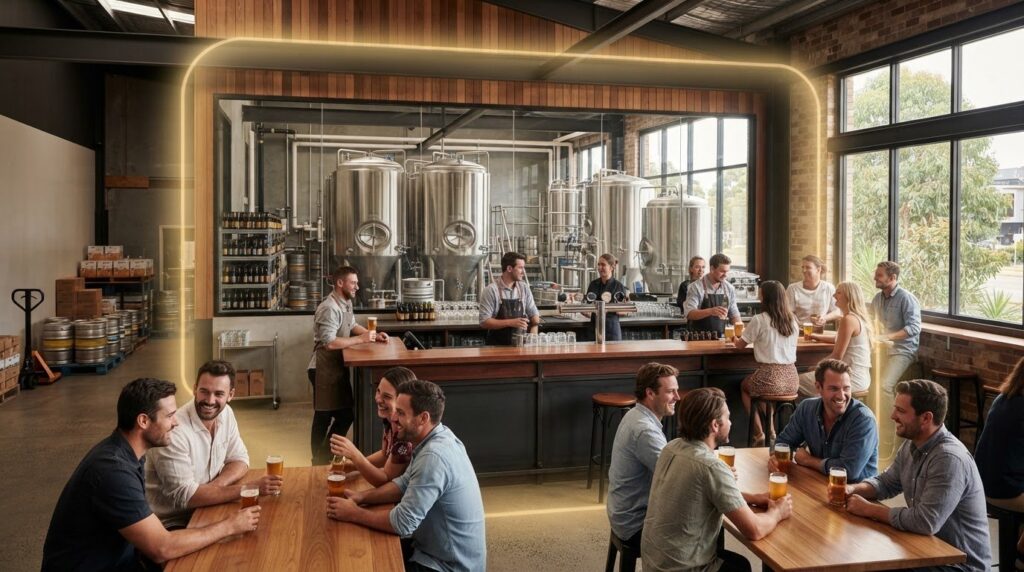
What if a problem starts in the brewhouse but leads to a claim in the taproom? For a business that makes, serves and sells beer, brewpub insurance Australia needs to reflect the whole operation, not just one part of it.
A brewery policy combined with standard hospitality cover may seem like a straightforward solution, but brewing, serving patrons and selling packaged beer bring different risks. Policy wording matters: machinery breakdown, spoiled stock, a product recall and a patron incident can each raise different questions about cover, limits and exclusions.
This guide explains key insurance considerations for an Australian brewpub and what to prepare before reviewing your cover. You’ll see how production, taproom service and packaged sales can shape your needs, what to look for in policy details, and when to revisit cover as your business changes. A specialist broker who understands craft beverage businesses can help you work through the details without treating your operation like a standard venue.
Key Takeaways
- Brewpub insurance Australia should reflect how your business brews, serves, sells and hosts, rather than assume one standard policy fits all.
- Consider property, public liability and product liability separately, then review what the policy wording actually covers.
- Compare brewing and storage, taproom service, packaged sales and events to spot exposures that could otherwise be missed.
- Before reviewing cover, map your premises, equipment, staff, food service, events and sales channels.
- As your brewpub grows or changes, revisit your insurance approach with a specialist broker who understands craft beverage businesses.
Australian brewpub insurance: what makes it different?
A brewpub can be a production site, a place to eat and drink, a retail outlet and a venue for visitors, all under one roof. That mix is part of its appeal, but it also means there is more than one type of exposure to consider when arranging insurance.
A brewery-only review may focus on brewing and storage, while a hospitality-only review may centre on customers and service. Either approach can leave parts of the business out of the conversation. Start with what you do, where you do it and how the activities connect.
How a brewpub combines production and hospitality
Behind the bar, brewing areas may hold tanks, boilers and other equipment, with ingredients and finished beer stored nearby. Out front, staff serve customers. The business may also sell packaged products or take visitors into production areas. Each activity can raise different property, liability or interruption questions.
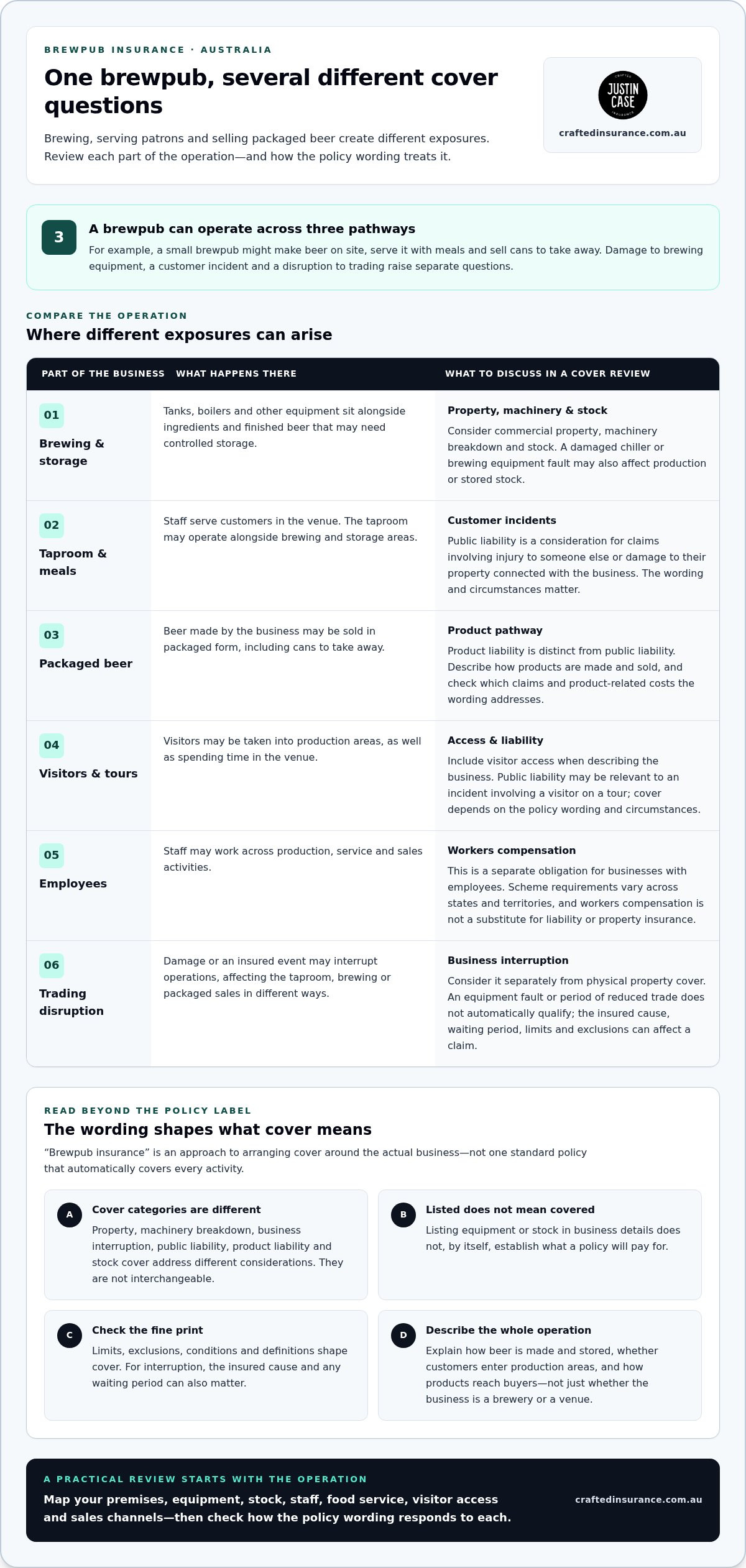
For example, a small brewpub might make beer on site, serve it with meals and sell cans to take away. Damage to brewing equipment could affect production, while a customer incident could raise a separate liability question. A disruption might also affect taproom trade and packaged sales in different ways. This is an illustrative scenario, not a case study.
What does brewpub insurance usually mean?
Brewpub insurance is an approach to arranging business cover around a brewpub’s actual brewing, hospitality and sales activities. It isn’t the name of one standard policy, and the cover available depends on the insurer, policy terms and details of the business.
That distinction matters. “Brewpub insurance” can mean a tailored combination of insurance considerations, not a ready-made package that automatically covers every activity. Depending on the operation, these may include commercial property, machinery breakdown, business interruption, public liability, product liability or stock cover.
These categories aren’t interchangeable. Public liability and product liability address different types of potential claims, and their scope depends on the wording. Listing equipment or stock in your business details doesn’t, by itself, establish what a policy will pay for. Limits, exclusions, conditions and definitions all shape the cover.
Consider brewpub insurance Australia in the context of your full operation, not by policy label alone. The insurer’s appetite and policy terms matter, as do details such as how beer is made and stored, whether customers enter production areas, and how products reach buyers.
Accurate information is a practical starting point. Describe production, service and sales together, rather than presenting the business as only a brewery or only a venue. This gives a broker a clearer picture to assess and helps focus questions about the wording before you rely on assumptions. For a related perspective on smaller-scale production and sales, see this guide to nano brewery insurance in Australia.
What risks can brewpub insurance help address?
A brewpub has assets to protect, customers to look after and products that leave the premises. Rather than choosing policies by name alone, consider what could happen to each part of the operation and what the policy wording says about that situation.
Property, equipment and interruption exposures
Commercial property cover may be considered for the premises, brewing equipment, furniture, stock and other business contents. Take a damaged chiller: the equipment is a physical asset, but a breakdown could also interrupt production or affect stock that needs controlled storage.
Business interruption cover is a separate consideration. It may respond to lost income after an insured event disrupts operations, subject to the policy’s terms. That doesn’t mean every equipment fault or period of reduced trade will qualify. The insured cause, any waiting period, limits and exclusions can all affect whether a claim responds.
Damage to the premises can have a similar ripple effect. A closure might affect the taproom while brewing or packaged sales are also disrupted. When reviewing property details, map the assets and activities that rely on each space. This can help distinguish physical damage from the potential costs of interrupted trading.
Customer, product and staff-related exposures
Public liability is a consideration for claims involving injury to someone else or damage to their property connected with the business. In a brewpub, that could involve a customer in the venue or a visitor on a tour. Whether a particular incident falls within cover depends on the policy wording and circumstances.
Product liability is distinct. It relates to claims connected with beer made or sold by the business. A brewpub selling packaged beer has a different product pathway from one serving beer only on site, so describe both accurately when discussing cover. Neither label guarantees protection for every claim or product-related cost.
Staff bring another consideration. In Australia, workers compensation is a separate obligation for businesses with employees, and scheme requirements vary across states and territories. It isn’t a substitute for liability or property insurance. Keep employee arrangements distinct in your insurance review and check the rules that apply to your business.
Policy limits, exclusions and conditions do the fine-print work. The Insurance Council of Australia offers an overview of the General Insurance Industry in Australia, but your own policy wording determines the cover you’ve arranged. For brewpub insurance Australia, the cause of an incident, the activity involved and the terms of cover all matter.
Crafted Insurance offers a free insurance risk audit for craft beverage businesses. Explore specialist brewpub insurance support to discuss your operation and how a broker can assess it.
How do insurance considerations change across a brewpub’s activities?
The right questions vary across a brewpub. A fermentation area, a busy taproom and a packaged beer order each involve different activities. Use the comparison below to identify what to include in an insurance review. It isn’t a promise that a particular policy will cover any listed exposure.
| Activity | Example exposure | Insurance consideration |
|---|---|---|
| Brewing and storage | Damage to production equipment or stored ingredients and beer | Consider how property, equipment and stock are described, and what policy terms apply to damage or interruption. |
| On-premises service | A customer is injured in the taproom or another area open to visitors | Review public-facing activities and relevant liability terms, including any limits and exclusions. |
| Packaged sales | Beer leaves the venue for a customer or wholesale buyer | Consider product-related exposures and whether the business’s sales channels are accurately described. |
| Events | A ticketed tasting or function brings extra visitors to the premises | Include the event format and activities in the review, rather than describing the business as taproom service only. |
Brewing, storage and packaged beer sales
Production and storage are connected, but they aren’t the same exposure. Brewing equipment and the premises are physical assets. Ingredients and finished beer are stock. Whether a policy responds to damage depends on its wording, the cause of the damage and the property insured.
Sales beyond the taproom add another step. Supplying packaged beer to retailers or offering delivery changes how the product reaches customers, and can bring distribution or product-related questions into the review. Describe those channels clearly so the business’s actual sales pattern is part of the discussion, rather than assuming every policy treats it alike.
Taproom service, food and events
Serving customers adds public-facing activity to a business that also makes beer. Food service is another operation to describe. Ticketed tastings, private functions and other events can change who attends and what happens on site, so include them even if they’re occasional.
Be specific about what visitors can access, what staff serve and whether events involve activities beyond ordinary taproom trade. The aim isn’t to predict every mishap. It’s to give a broker a clear picture to assess against policy terms, rather than leave part of the operation unstated.
If your brewpub adds wholesale accounts, delivery or a new event format, revisit the description of your activities. brewpub insurance Australia should reflect how the business operates now, not just how it operated when cover was first arranged. Use the table as an educational prompt, not confirmation of cover. Insurer terms, limits, exclusions and your business details determine what a policy may respond to.
What information should you gather before reviewing brewpub insurance?
A clear picture of how your brewpub runs gives a broker something useful to assess. Start with an accurate snapshot of your activities, premises, assets, staff and sales channels, then note what’s changing.
Work through these steps in order:
- Map each activity, from brewing and storage to taproom service, food, events and packaged sales.
- Note where each activity happens and which areas customers, staff or visitors can access.
- Summarise premises, equipment, stock and staffing, using current records where available.
- List sales channels, including on-site sales, wholesale and delivery, plus any planned changes.
- Gather current policy documents and mark questions about limits, exclusions and conditions.
Map what the business actually does
Describe a typical working day, not just the business label. Record how beer is made and stored, how customers are served, whether food is prepared and how often you host events. Include ticketed tastings and private functions, even if they’re occasional.
Then note what’s changing. New equipment, expanded trading hours, a delivery service or another sales channel can alter the operation being reviewed. Clear details help a broker understand the whole picture.
Gather premises, assets and operating details
Pull together information about the premises, brewing equipment, business contents and stock. Include business interruption information, such as records that help explain how a disruption could affect trading, if you have it. The aim is to support a practical discussion, not build a full risk-audit checklist.
Summarise staffing and operating arrangements, too. Keep current insurance documents nearby and note any wording you want explained. Limits, exclusions and conditions can be easy to skim past, so bring specific questions rather than relying on memory.
Accuracy matters more than polish. If you serve food, run events or sell beer beyond the taproom, say so plainly. If a change is still being planned, include it as a planned change. These details give your broker a stronger basis for assessing your needs and arranging an insurance approach that reflects the business you run.
For a specialist review, arrange a free insurance risk audit with Crafted Insurance. Use it to discuss your brewpub’s activities and the information you’ve gathered.
How Crafted Insurance supports Australian brewpubs
A brewpub doesn’t fit neatly into one box. Brewing, serving customers and selling packaged beer all shape the business, so a useful insurance discussion needs to account for how those activities work together.
Crafted Insurance is an Australian specialist broker for brewpubs, craft breweries and distilleries. It assesses operational risks and arranges suitable insurance. The focus is on understanding the business behind the policy paperwork, rather than assuming every venue or brewery has the same needs.
Specialist support shaped around your operation
When assessing a brewpub, Crafted considers how production, storage, customer service and sales fit together. That context helps shape an insurance approach around the activities you describe. Crafted arranges insurance as a broker, and available cover depends on insurer terms and your business details.
A broker can help you work through policy wording, including the limits, exclusions and conditions that affect what cover may respond to. As your operation changes, its insurance needs may change too. New equipment, expanded service or a different sales channel can all be reasons to review your cover.
Clear details make for a more useful conversation. A specialist who understands brewing and hospitality can connect production risks with public-facing operations, rather than treating the taproom as an afterthought or overlooking the brewing side.
Support can continue beyond arranging cover. Crafted provides claims advocacy to help clients through the claims process, as well as ongoing risk management. This is practical support when questions arise, not a promise that a claim will be accepted or paid. The policy wording and circumstances still matter.
A practical next step for your brewpub
Crafted offers a free insurance risk audit for craft beverage businesses. It provides a starting point for discussing your operation, its risks and the insurance questions worth exploring. Bring details of what you brew, how you serve customers and where your products are sold.
That conversation can help put the moving parts in order. It won’t replace reading policy terms, but it can help you understand what to examine and how an insurance approach relates to your business.
To talk through brewpub insurance Australia with a specialist broker, Explore brewpub insurance support. Start with the operation you run today and the changes you’re planning next.
Make your next growth move with confidence
Use an insurance review as a checkpoint before expanding production, adding a sales channel or changing how the taproom operates. This helps keep the conversation aligned with the business you’re building.
For brewpub insurance Australia, the details behind each change matter. Crafted Insurance specialises in Australian craft breweries, distilleries and brewpubs, and can assess your operation as it evolves. Its free insurance risk audit offers a practical starting point for identifying questions to raise in a cover review.
Crafted also provides risk assessment, ongoing risk management and claims advocacy to help you through the claims process. No broker can promise a claim outcome, but specialist support can help you make sense of the process.
Ready to make your next review more focused? Explore specialist brewpub insurance support and take the next step with a clearer view of your business risks.
Frequently Asked Questions
Does a brewpub need different insurance from a brewery?
It may need a different insurance approach because a brewpub has customer-facing activities alongside production. A brewery that adds a taproom, serves food or hosts visitors has changed its operating profile, even if the brewing process stays the same. For brewpub insurance Australia, describe those activities together when reviewing cover. The aim is to have the business assessed as it operates, rather than relying on a brewery-only description.
Is public liability insurance the same as product liability insurance?
No. Public liability generally relates to claims involving injury to another person or damage to their property connected with your business. Product liability relates to claims connected with a product you make or sell. For example, a visitor’s injury at a tasting and a claim about packaged beer raise different questions. Policy definitions, limits and exclusions determine how each type of cover may respond.
Can brewpub insurance cover live music or ticketed events?
It may, but don’t assume your usual venue cover automatically applies to every event. Live music, ticketed tastings and private functions can involve different arrangements, attendance and activities from ordinary taproom service. Include the event type and how it runs in your insurance review. The insurer’s terms determine whether relevant cover applies and whether conditions or exclusions affect a particular claim.
Does brewpub insurance cover beer stock while it is being transported?
Not necessarily. Cover for beer stored at your premises doesn’t automatically mean it’s covered in transit. The answer depends on the policy wording, the journey and how the beer is being moved or supplied. If you deliver orders or send stock to wholesale buyers, include those arrangements in your review so your broker can examine whether the policy addresses goods away from your premises.
What happens if brewing equipment breaks down?
A breakdown doesn’t automatically mean the repair or resulting losses are insured. The policy may distinguish sudden equipment failure from damage caused by another insured event, and machinery breakdown cover may be a separate consideration. For example, a failed pump could halt production without causing wider property damage. Check how the policy defines equipment failure, what conditions apply and whether interruption losses are addressed.
Can a brewpub claim for a product recall or contamination incident?
Possibly, but recall costs and contamination losses aren’t automatically covered by product liability or a standard business policy. Product recall cover may need to be considered separately, and the policy wording sets out what events and costs it addresses. Keep batch and distribution records to help identify affected products and customers. If an incident occurs, notify your broker and follow the policy’s claim notification requirements.
Does workers compensation apply to brewpub staff across Australia?
Workers compensation is generally a legal requirement for businesses with employees, but the rules and schemes vary between Australian states and territories. A brewpub’s staffing arrangements may include production, kitchen and taproom roles, so keep a clear record of who works for the business and where. Check the requirements that apply to your operation with the relevant state or territory workers compensation authority, as this is separate from business insurance.