
A brewery can reduce its exposure to injury and property loss by combining practical safety procedures with insurance suited to the way it makes, serves and sells beer. That is the core of brewery risk management: identify hazards early, reduce the chance of harm, and understand what insurance may cover if something goes wrong.
You’ve put care into the beer, the space and the experience. But cleaning chemicals, draught-line work, hot equipment, busy taprooms and fire can put staff, customers and property at risk. A consistent process helps protect people and prevent an incident from disrupting the business.
This guide covers common brewery and taproom hazards, practical ways to reduce them through clear procedures, and how to assess insurance for injury and property damage. It also explains how a specialist broker can connect risk controls with insurance planning, so the process stays practical rather than becoming another job on brew day.
Key Takeaways
- Map injury and property-loss hazards across production areas and taprooms, from draught-line cleaning to fire risks.
- Use clear cleaning, flushing and equipment-check procedures to help prevent avoidable incidents.
- Build workplace safety practices around the hazards, tasks and people in your brewery.
- Review fire and hazardous-area controls alongside insurance cover suited to your brewery’s operations.
1. Brewery and taproom injury and property-loss risks
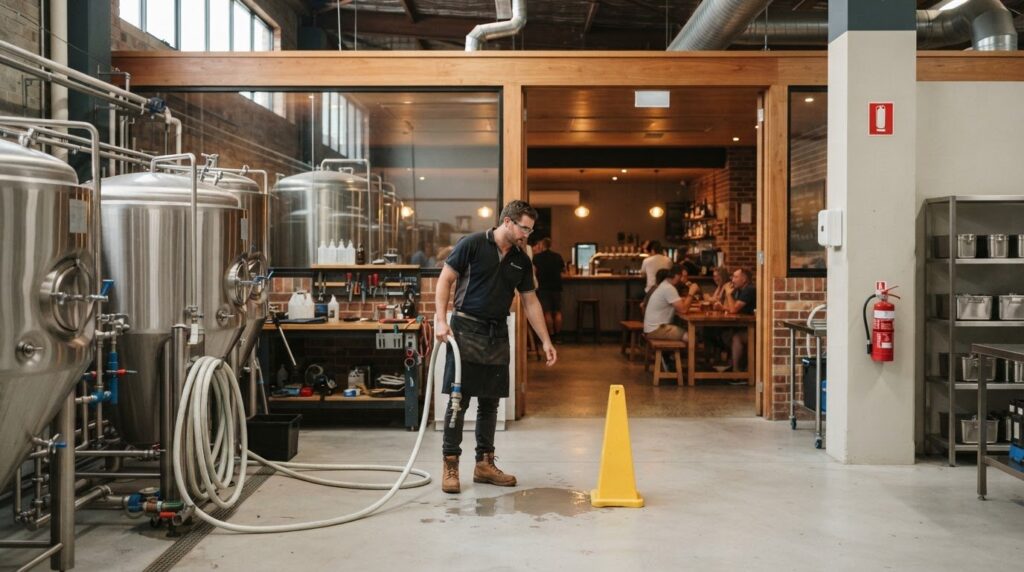
A brewery brings hot liquids, pressurised vessels, cleaning chemicals and customers together, each with different potential risks. A wet patch beside a cellar tank can cause a fall; a hose across a work route can trip someone carrying equipment. In a taproom, broken glass, crowded walkways and spilled drinks can put staff and patrons at risk.
Chemical handling calls for careful routines. Draught-line cleaning, for example, involves products that need to be kept separate from ingredients and finished beer. Label containers, store them securely, and record who completes each cleaning task. Use a clear sign-off so the next person knows the line has been cleaned and prepared for service.
Property hazards can interrupt production as well as damage the building. A leaking hose may affect stock, floors or nearby electrical equipment. Heat sources, faulty machinery and combustible materials can increase fire exposure. Walk through the site, record hazards by location, and assign someone to follow each repair through to completion.
Workplace safety rules and regulator guidance vary across Australian states and territories. Match procedures to the requirements that apply where the brewery operates, and review them when tasks, equipment or premises change.
Risk-management software can bring incident reports, near misses, inspections, maintenance and training records together. Pair those records with a practical risk audit to identify gaps in site controls and insurance planning.
Make records useful, not just tidy. After a customer slips, note the location, surface condition and response. After a cellar near miss, record the task and equipment involved. Reviewing these details can reveal recurring hazards and show where a procedure needs attention. Effective brewery risk management turns observations into safer routines and better-informed decisions.
3. Operational protocols
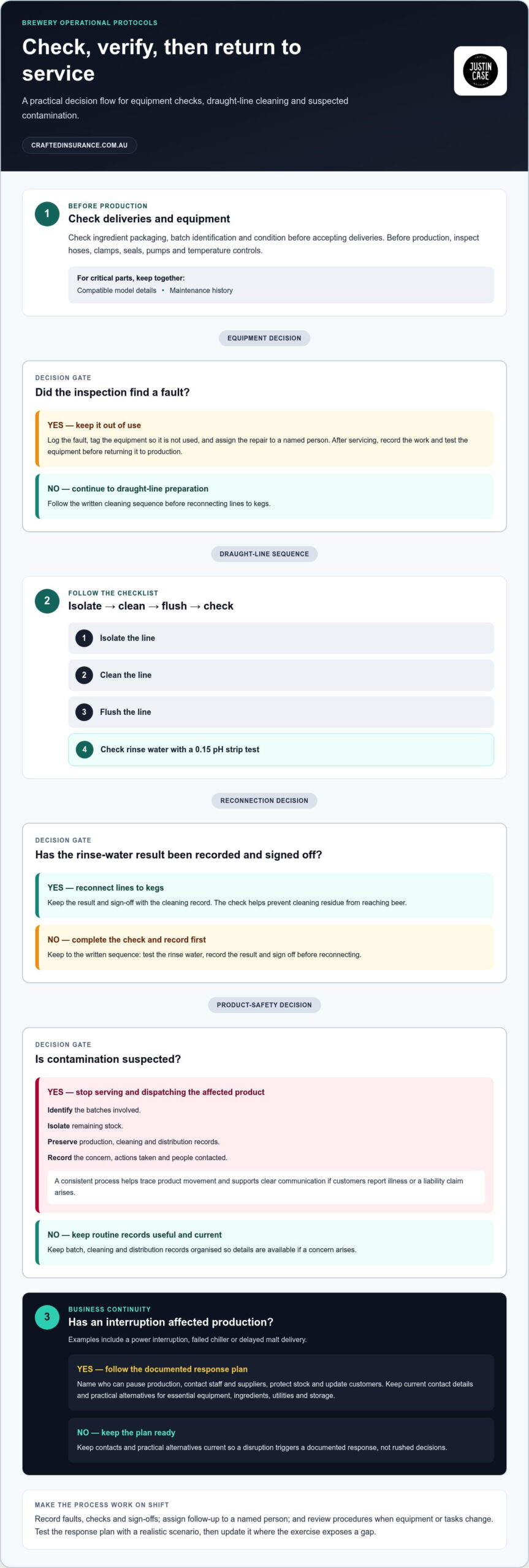
Reliable routines catch small failures before they disrupt a brew day. Keep approved supplier details, ingredient specifications and delivery records together. When ingredients arrive, check their packaging, batch identification and condition before accepting them. For critical parts, record compatible models and maintenance history so replacements aren’t a last-minute guess.
Base equipment checks on the task, not memory. Before production, inspect hoses, clamps, seals, pumps and temperature controls. Log faults, tag equipment that shouldn’t be used, and assign repairs to a named person. After servicing, record the work and test the equipment before returning it to production.
For draught-line cleaning, write the sequence into a checklist: isolate the line, clean it, flush it, then check rinse water with a 0.15 pH strip test before reconnecting lines to kegs. Record the result and sign-off. That final step helps prevent cleaning residue from reaching beer.
Business continuity starts with a clear response plan. Name who can pause production, contact staff and suppliers, protect stock, and update customers. Keep current contact details and practical alternatives for essential equipment, ingredients, utilities and storage. A power interruption, failed chiller or delayed malt delivery should trigger a documented response, not rushed decisions.
If contamination is suspected, stop serving and dispatching the affected product. Identify the batches involved, isolate remaining stock, and preserve production, cleaning and distribution records. Record the concern, actions taken and people contacted. A consistent process helps trace product movement and supports clear communication if customers report illness or a liability claim arises.
Test the plan with a realistic scenario, such as a failed fermenter or a product-quality complaint. Check whether staff can find batch records, follow escalation steps and explain who owns each action. Then update the procedure where the exercise exposes a gap. Practical risk management support for breweries can help connect operational controls with wider exposure planning.
3. What are the Australian workplace health and safety requirements for breweries?
Australian workplace health and safety (WHS) rules are administered by state and territory regulators, so specific requirements depend on where the brewery operates. The practical starting point is consistent: identify work hazards, put controls in place, train people for their tasks, and review controls when work changes.
Map each work area and activity. A brewhouse assessment might cover hot wort, steam, moving pumps, slippery floors and manual handling. A cellar review could consider confined spaces, hoses and pressurised vessels. Record each hazard, the chosen controls, who is responsible, and when the controls will be reviewed.
Make procedures usable on shift. Give staff clear instructions for chemical handling, cleaning, equipment isolation and spill response. New starters need task-specific induction before working independently. For example, someone cleaning a tank should know the approved process, required protective equipment, and how to report a fault or stop work.
Consult the workers who do the jobs. They can spot practical risks a paperwork-only inspection might miss, such as a hard-to-reach valve or a delivery route crossing a wet area. Record concerns and decisions, then tell the team what changed. Keep training, maintenance and incident records organised so managers can see whether controls are working.
Review the system after an injury, near miss, equipment change or new production task. A new canning line, for instance, may introduce moving parts, noise or different cleaning steps. Reassess the task before routine use, update procedures, and brief affected workers on the changes.
For compliance, identify the regulator and WHS requirements that apply in the brewery’s state or territory, then compare them with current site procedures. Check relevant guidance for the specific task, including safe equipment use, chemical handling and emergency arrangements. Keep the assessment focused on the brewery: a taproom, cellar and packaging area each present different work risks.
WHS rules are administered by state and territory regulators, so requirements vary with the brewery’s location. Identify the relevant regulator and requirements, then check that site procedures align with them.
4. What are the fire, explosion, and hazardous-area requirements for breweries in Australia?
No single fire-safety checklist suits every Australian brewery. The right controls depend on the building, equipment, processes and materials on site, as well as the state or territory where the business operates. Map hazards with a competent fire-safety professional and apply the requirements relevant to the premises and work.
Start by identifying ignition sources and fuel. In a brewhouse, burners, hot surfaces and electrical equipment can come into contact with combustible materials or vapours. Keep storage clear of heat sources, maintain equipment, and manage hot work through a permit process. The permit should identify the task, isolate nearby hazards, set precautions and record who authorises the work.
Consider where flammable atmospheres could form, including areas where flammable cleaning products are used or spirits are stored. A hazardous-area assessment identifies the location and extent of potential hazards, then informs suitable equipment and work controls. Don’t assume every part of the brewery has the same risk. A chemical store, production floor and loading area may need different safeguards.
Explosion planning also means controlling dust and pressure. Grain handling can create combustible dust, so prevent build-up around mills and extraction equipment. Inspect pressure-relief devices and vessel fittings as part of planned maintenance. Keep exits and firefighting equipment accessible, and make sure workers know how to raise an alarm and leave the building safely.
Record inspections, maintenance, training and corrective actions in a fire-safety register. Assign an owner to each action and close it out after checking the fix. Review the assessment after installing equipment, changing storage or altering production. For example, adding a spirit-handling area can change the hazards and controls needed nearby.
Fire and property risks can also shape the protection a brewery needs. Discuss brewery risk management to connect practical risk controls with insurance planning for your operation.
Crafted Insurance: Nano Brewery
Crafted Insurance helps Australian breweries connect practical risk controls with insurance suited to their operations through Insurance on Tap™. Its NANO BREWERY package is designed for smaller-scale producers reviewing cover for production, sales and public service risks.
This support can be useful when you’re opening a taproom, adding equipment, changing production or reviewing how existing cover fits your business. A risk audit and ongoing risk management can help identify exposures and strengthen your plans. If an incident leads to a claim, Crafted Insurance also provides claim advocacy.
Whether you run a nano brewery, micro brewery, brewpub or local craft brewery, the details of your operation matter. Talk to Crafted Insurance about brewery risk management for your business.
Build risk planning into your next business decision
Make brewery risk management part of planning for change, not a task saved for renewal time. A new service area, production shift or equipment upgrade can change the risk controls and insurance your operation needs. Regular reviews help keep those decisions connected.
Crafted Insurance supports craft beverage businesses through its NANO BREWERY, MICRO DISTILLERY and BREWPUB packages, all part of Insurance on Tap™. Its risk audits and ongoing risk management can help identify exposures, while claim advocacy can support you if a claim arises. A conversation with a specialist can bring day-to-day operations and insurance planning into clearer focus.
Gather a clear picture of how your business runs, including what has changed and which risks you want to manage. Then take the next step with a specialist who understands craft beverage operations.
Contact Crafted Insurance for help and keep building your business with confidence.
Frequently Asked Questions
What are the main risks facing breweries in Australia?
Breweries face risks to people, products, property and business continuity. A temperature-control failure, for example, can spoil a batch and delay planned orders. Customer complaints may also raise product-liability concerns, while a delivery incident can affect staff, stock or equipment. Map exposures across production, storage, sales and taproom service, then consider how one incident could affect other parts of the business.
What insurance does an Australian brewery need, and how much does it cost?
There’s no single cover mix for every brewery. Review whether insurance addresses your property, stock, equipment, public and product liability, and business interruption exposures. The price depends on the brewery’s circumstances and factors such as its activities, premises, equipment, stock and selected cover, and is given after a quote request. Compare policy terms, limits, excesses and exclusions against the losses your business could face.
How can breweries manage risks from fermentation, pressure vessels, chemicals, and CO2?
Use task-specific checks for each hazard. Track fermentation temperatures and investigate unusual readings before product quality shifts. Keep vessel operating instructions accessible, and record inspections and repairs. Store chemicals in labelled containers, separate from ingredients, and make handling directions easy to find. Treat CO2 release as a serious cellar hazard: assess ventilation, train staff to recognise warning signs, and set a clear response process that prevents untrained entry into an affected space.
How do brewery risk management practices differ by state and territory in Australia?
Workplace safety rules and regulator guidance are administered by state and territory, so breweries should identify the requirements that apply where they operate. Match procedures to those requirements and review them when tasks, equipment or premises change.
What risk management software and services are suitable for Australian breweries?
Risk-management software can bring incident reports, near misses, inspections, maintenance and training records together. Pair it with a practical risk audit; a specialist broker can help connect operational controls with insurance planning.